Tag Archives: writing

Own Goal Murder: Andrés Escobar and the Dark Side of Soccer

On a cold night in Pasadena, California, in June 1994, Colombia’s dream died with a single mistimed touch. Ten days later, one of its heroes was dead. The murder of Colombian defender Andrés Escobar remains one of the most shocking tragedies in sports history—not simply because a World Cup player was assassinated, but because his death exposed the deadly intersection of soccer, organized crime, gambling, politics, and national identity. Nearly three decades later, one question still lingers: Was Andrés Escobar killed over an own goal, or was he caught in a much larger war?

Colombia’s Golden Generation

By 1994, Colombia wasn’t simply participating in the World Cup—it was expected to challenge for the championship. Led by the eccentric coaching genius Francisco Maturana, Colombia had dazzled the world. The team had humiliated Argentina 5–0 in Buenos Aires during qualifying. Their attacking flair and technical precision prompted even Pelé to predict Colombia could win the tournament. The squad featured stars like Carlos Valderrama, Freddy Rincón, Faustino Asprilla and, anchoring the defense, Andrés Escobar. Nicknamed “The Gentleman,” Escobar was respected as much for his character as for his calm defending. Unlike many football celebrities, he avoided nightlife and scandal. Teammates described him as thoughtful, educated, and humble. He represented the Colombia many hoped their country could become.

A Nation Under Pressure

To understand Escobar’s death, it’s necessary to understand Colombia in the early 1990s. The country was emerging from one of its bloodiest periods. Drug cartels had accumulated enormous wealth and influence. While Pablo Escobar had been killed in December 1993, organized crime remained deeply intertwined with business—including professional soccer. Several Colombian clubs had long been suspected of receiving cartel money. For criminal organizations, soccer offered prestige, money laundering opportunities, and perhaps most importantly, enormous gambling stakes. The 1994 World Cup wasn’t just sport. Millions of dollars rode on every result.

Ninety Minutes That Changed Everything

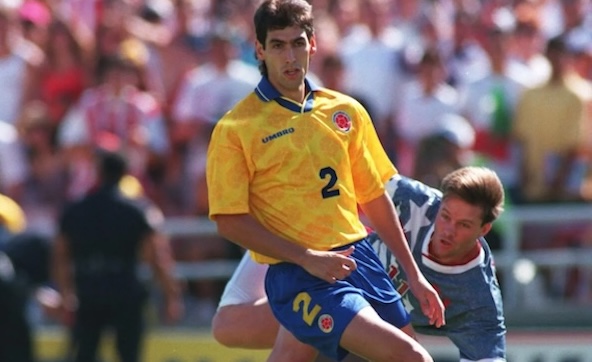
On June 22, 1994, Colombia faced the United States in Pasadena. A victory was essential after an opening loss to Romania. In the 35th minute came the play that would define history. American midfielder John Harkes drove a dangerous ball across the penalty area. Escobar slid to intercept. Instead of clearing the pass, the ball deflected into his own net. The Americans won 2–1 and Colombia was effectively eliminated from the World Cup tournament. After the game, television cameras were fixed on Escobar’s devastated expression. After returning home, he wrote a newspaper column urging Colombians not to despair. His closing words would become haunting: “Life does not end here.”

The Final Night

Despite warnings to remain home, Escobar decided to go out with friends in Medellín on July 2, 1994. Near 3 a.m., an argument erupted in a parking lot outside a nightclub. Witnesses later testified several men confronted Escobar, mocking the own goal. According to multiple accounts, the words “Goal!” were shouted after each shot. Six bullets struck him and died shortly afterward at age 27. The murder stunned Colombia—and the sporting world. More than 120,000 mourners reportedly attended his funeral.

The Official Investigation

FSM Garage Sale on eBay is OPEN 24/7 !!!!! Check it out…

Authorities arrested Humberto Muñoz Castro, a bodyguard employed by brothers Pedro David Gallón Henao and Santiago Gallón Henao, wealthy businessmen alleged to have connections with organized crime. Prosecutors argued the killing followed a drunken confrontation. Muñoz Castro was convicted of murder in 1995. Originally sentenced to more than 40 years, the sentence was later reduced. He served approximately eleven years before being released for good behavior. For many Colombians, justice felt incomplete.

The Questions That Never Went Away

Officially, the case was solved. Unofficially, doubts remain. Investigators and journalists have long debated whether the shooting was merely a drunken altercation or something far more calculated. Among the enduring questions:

Was gambling involved? The enormous betting activity surrounding Colombia’s World Cup campaign fueled speculation that wealthy gamblers suffered catastrophic losses after the U.S. defeat. No court ever proved gambling directly motivated the murder.

Who truly ordered the killing? Although Muñoz Castro admitted shooting Escobar, theories persist that more powerful figures encouraged—or expected—violent retaliation. No definitive evidence has emerged.

Why was Escobar targeted? Those who knew him insist he was among the least controversial players on the national team. His clean reputation makes his death even more difficult to comprehend.

Check out Hobby Cards, Sports, & Movie collectibles at the FSM Garage Sale on eBay!!!!!!.

A Symbol Beyond Soccer

Escobar’s murder transformed him into more than an athlete. He became a symbol of a nation trying to escape violence and his death prompted soul-searching throughout Colombian football. Security increased. Players became more cautious. The relationship between criminal money and professional clubs came under greater scrutiny. In time, Colombian soccer rebuilt its international reputation. Future generations—including stars like James Rodríguez—would compete on the world stage without carrying quite the same shadow.

Final Whistle

The murder of Andrés Escobar is often summarized with a deceptively simple sentence:

A soccer player was killed because he scored an own goal.

The truth is both more complicated and more unsettling. His own goal may have triggered the confrontation, but the forces surrounding Colombian soccer—organized crime, enormous gambling losses, toxic machismo, and a culture accustomed to violence—created the conditions in which a tragic mistake on the field could become a death sentence off it. In that sense, Andrés Escobar was never simply the victim of one misplaced kick – he was the victim of an entire system.

And while Colombia has changed dramatically since 1994, his death remains one of the most chilling reminders that, in rare moments, the world’s most beloved game can reflect its darkest realities. Because can sport ever be fully separated from the society around it?

Today, murals bearing Andrés Escobar’s likeness appear throughout Medellín. His famous quote “Life does not end here” has become an emblem of resilience. Ironically, the own goal that came to define his life represents only a single moment in a distinguished career.
Larry O’Brien: The Postmaster Who Became the Face of the NBA Finals Trophy

When NBA players celebrate a championship today, they raise one of the most recognizable trophies in sports: the Larry O’Brien Championship Trophy. From Michael Jordan to LeBron James and Stephen Curry, generations of champions have hoisted the gleaming gold trophy. Soon, players from the New York Knicks or San Antonio Spurs will be doing the same.

But unlike many sports trophies named after legendary athletes or coaches, the NBA’s championship prize honors a man who never played professional basketball. Larry O’Brien’s path to basketball immortality began not on the hardwood, but in the halls of American politics.

CHEAP collectibles available 24/7 at the FSM GARAGE SALE STORE on eBay !!!!!!

From Springfield to Washington

Lawrence Francis O’Brien Jr. was born in 1917 in Springfield, Massachusetts. Possessing a sharp political mind and remarkable organizational skills, O’Brien rose through the ranks of the Democratic Party during the mid-20th century.

He became one of the most influential political strategists in American history, helping orchestrate the successful presidential campaigns of John F. Kennedy and later serving in the administrations of both Kennedy and Lyndon B. Johnson.

As Postmaster General under Johnson and later chairman of the Democratic National Committee, O’Brien earned a reputation as one of Washington’s most effective administrators. His ability to negotiate, build relationships, and manage complex organizations would eventually attract the attention of an ambitious professional basketball league.

Taking Over the NBA

In 1975, the NBA hired O’Brien as its commissioner, a surprising choice for a sports league but one that would prove transformative.

At the time, professional basketball faced significant challenges. Television ratings were modest, many Finals games were shown on tape delay, and the league struggled to compete with the popularity of baseball and football. The NBA needed strong leadership and a long-term vision.

O’Brien brought exactly that.

Serving as commissioner from 1975 to 1984, he oversaw one of the most important growth periods in league history. During his tenure:

  • The NBA expanded its national television presence.
  • League revenues increased dramatically.
  • The popularity of professional basketball surged.
  • The NBA strengthened its relationship with sponsors and broadcasters.
  • The league became increasingly visible across North America and internationally.

Most importantly, O’Brien presided over the arrival of a new generation of stars that would redefine the sport.

The Magic and Bird Era

O’Brien’s tenure coincided with the emergence of one of basketball’s greatest rivalries: Magic Johnson versus Larry Bird. Their battles throughout the 1980s captivated fans and revitalized interest in the NBA. The league’s popularity exploded as the Lakers and Celtics met repeatedly on basketball’s biggest stage.

CHEAP collectibles available 24/7 at the FSM GARAGE SALE STORE on eBay !!!!!!

O’Brien’s business acumen helped capitalize on this golden opportunity. He worked to secure stronger television contracts and position the NBA as a premier entertainment product. By the time he retired in 1984, the foundation had been laid for the league’s future global growth under his successor, David Stern.

Why the Trophy Bears His Name

In 1984, the NBA decided to rename its championship trophy in honor of Larry O’Brien’s contributions to the league.

The trophy itself had existed since 1977, but after O’Brien stepped down as commissioner, league officials believed his leadership deserved permanent recognition. The trophy was officially renamed the Larry O’Brien Championship Trophy to commemorate his role in helping transform the NBA from a struggling league into a rapidly growing sports powerhouse.

The decision reflected a simple reality: without O’Brien’s stewardship during a critical period, the NBA’s rise to prominence might have unfolded very differently.

The Trophy Itself

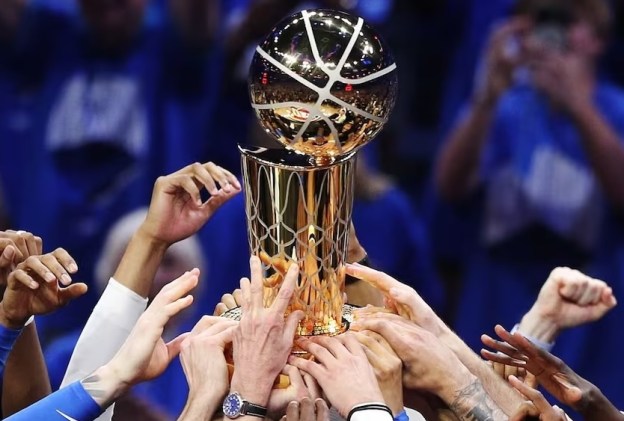
The trophy is crafted from sterling silver and coated in 24-karat gold. Standing roughly two feet tall, it features a basketball poised above a net, symbolizing the game’s ultimate achievement.

Each year, the winning team receives the trophy immediately after clinching the NBA Finals, creating one of sports’ most iconic celebration scenes.

https://images.openai.com/static-rsc-4/xnKZBfNQrxJvAgdpjMJr2QqLL9vqqjuX1bJoXPGtBjatPU9XLxf0r-TCrrm32BXK_w00Z0SKdWpmFBZB_w1IU7G0GwGKiUF2yMNlYre4QJu1-lPpW1cLM-Ih6mIOYMRbPV5aDjC6ahValFZndTS3Ll2HHZCK2Qu3z6WTcvspVOZ3M0CezGtW2tx436EDvBdb?purpose=fullsize

A Lasting Legacy

Larry O’Brien passed away in 1990, but his influence remains visible every June when a new NBA champion is crowned.

Unlike many executives whose contributions fade from public memory, O’Brien’s name is announced annually during the league’s most important moment. Every championship team—from the Showtime Lakers and Bird’s Celtics to Jordan’s Bulls, Curry’s Warriors, and future champions—becomes part of the legacy of the commissioner who helped guide the NBA into a new era.

In many ways, the Larry O’Brien Trophy represents more than a championship. It symbolizes the vision, leadership, and business savvy that helped transform professional basketball into the global phenomenon it is today.

CHEAP collectibles available 24/7 at the FSM GARAGE SALE STORE on eBay !!!!!!

The I-5 Killer: Green Bay Packers Reject Turns Murderer

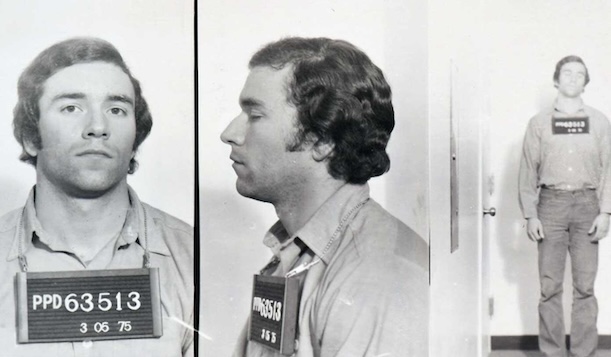
In the pantheon of American true crime, few cases are as unsettling—or as paradoxical—as that of Randall Woodfield. A man who once chased professional football dreams would instead become one of the most feared serial predators on the West Coast, terrorizing communities along Interstate 5 and leaving behind a trail of violence that investigators are still unraveling decades later.

From NFL Prospect to Criminal Suspect: Before the headlines and manhunt, Woodfield looked like a success story in the making. A standout wide receiver at Portland State University, he had the size, speed, and charisma scouts coveted. In 1974, he was drafted by the Green Bay Packers—a moment that should have marked the beginning of a professional career.

Visit the 24/7 Sports memorabilia GARAGE SALE over at our eBay store!!!

But the dream unraveled quickly. Woodfield never played a regular-season game, cut during training camp amid concerns about both performance and troubling behavior, including prior arrests for indecent exposure.

That early pattern—charm masking something darker—would define the next phase of his life.

The Descent: Early Crimes and Escalation: By the mid-1970s, Woodfield’s criminal behavior had escalated from exposure incidents to armed robbery and sexual assault. In 1975, he was arrested after a series of knife-point attacks in Portland and served time in prison before being paroled in 1979.

What followed his release was not rehabilitation—but acceleration.

Between 1980 and early 1981, Woodfield embarked on a spree of violence that stretched along the Interstate 5 corridor through Oregon, Washington, and California. His crimes—robberies, rapes, kidnappings, and murders—often took place near highway exits, rest stops, and small businesses, giving rise to the chilling nickname: “The I-5 Killer.”

Victims were frequently young women, targeted in moments of vulnerability. His methods were calculated: disguises like fake beards, sudden attacks, and the use of firearms or knives. The crimes escalated rapidly, with little cooling-off period—an intensity that alarmed investigators.

Though only one murder would ultimately lead to conviction, authorities believe his true victim count may be far higher—possibly dozens.

The Hunt Along Interstate 5: By late 1980, law enforcement agencies across multiple states realized they were dealing with a single, mobile predator. The geographic spread—over 500 miles of highway—complicated the investigation.

Patterns began to emerge:

  • Crimes clustered near I-5 exits
  • Similar descriptions of a suspect
  • Repeated use of weapons and disguises

Police circulated composite sketches and coordinated across jurisdictions—no small feat in an era before modern digital databases. The case drew increasing media attention, heightening public fear. The breakthrough would come not from forensic science alone, but from survival.

The Break That Cracked the Case: On January 18, 1981, Woodfield attacked two women at a workplace in Salem, Oregon. One victim, Shari Hull, was killed. The other, Beth Wilmot, survived—and her testimony proved pivotal.

Wilmot’s identification of Woodfield gave investigators what they desperately needed: a living witness who could tie the suspect directly to the crimes.

From there, the case moved quickly. Visit the 24/7 GARAGE SALE over at our eBay store!!!

Capture and Conviction: On March 7, 1981, authorities arrested Woodfield, bringing an end to the immediate wave of violence.

He was soon convicted of murder, attempted murder, and multiple sexual offenses. The sentence: life imprisonment plus decades more—effectively ensuring he would never walk free again.

Despite the conviction, Woodfield never confessed. His lack of remorse and refusal to accept responsibility frustrated investigators and victims’ families alike.

A Dark Legacy Still Unfolding: In true crime history, few narratives are as chilling as the I-5 Killer’s—not just because of the crimes themselves, but because of the life that preceded them… and how quickly it all unraveled.

What makes the Woodfield case particularly haunting is its incompleteness. Advances in DNA technology decades later have linked him to additional crimes, suggesting his full toll may never be known.

The story of Randall Woodfield is a study in contradiction. A man who once stood on the cusp of the NFL became instead a symbol of predation and violence. His athletic past—his time with the Green Bay Packers—only deepens the unease, a reminder that outward success can obscure inner darkness.

He remains incarcerated at the Oregon State Penitentiary, a former athlete whose name is now synonymous not with touchdowns—but terror.

Visit the 24/7 Sports memorabilia GARAGE SALE over at our eBay store!!!