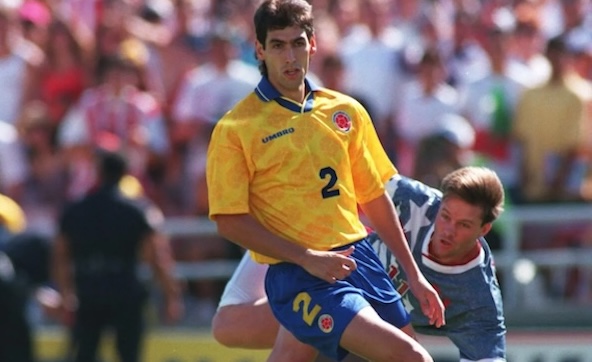
On a cold night in Pasadena, California, in June 1994, Colombia’s dream died with a single mistimed touch. Ten days later, one of its heroes was dead. The murder of Colombian defender Andrés Escobar remains one of the most shocking tragedies in sports history—not simply because a World Cup player was assassinated, but because his death exposed the deadly intersection of soccer, organized crime, gambling, politics, and national identity. Nearly three decades later, one question still lingers: Was Andrés Escobar killed over an own goal, or was he caught in a much larger war?
Colombia’s Golden Generation
By 1994, Colombia wasn’t simply participating in the World Cup—it was expected to challenge for the championship. Led by the eccentric coaching genius Francisco Maturana, Colombia had dazzled the world. The team had humiliated Argentina 5–0 in Buenos Aires during qualifying. Their attacking flair and technical precision prompted even Pelé to predict Colombia could win the tournament. The squad featured stars like Carlos Valderrama, Freddy Rincón, Faustino Asprilla and, anchoring the defense, Andrés Escobar. Nicknamed “The Gentleman,” Escobar was respected as much for his character as for his calm defending. Unlike many football celebrities, he avoided nightlife and scandal. Teammates described him as thoughtful, educated, and humble. He represented the Colombia many hoped their country could become.
A Nation Under Pressure
To understand Escobar’s death, it’s necessary to understand Colombia in the early 1990s. The country was emerging from one of its bloodiest periods. Drug cartels had accumulated enormous wealth and influence. While Pablo Escobar had been killed in December 1993, organized crime remained deeply intertwined with business—including professional soccer. Several Colombian clubs had long been suspected of receiving cartel money. For criminal organizations, soccer offered prestige, money laundering opportunities, and perhaps most importantly, enormous gambling stakes. The 1994 World Cup wasn’t just sport. Millions of dollars rode on every result.
Ninety Minutes That Changed Everything
On June 22, 1994, Colombia faced the United States in Pasadena. A victory was essential after an opening loss to Romania. In the 35th minute came the play that would define history. American midfielder John Harkes drove a dangerous ball across the penalty area. Escobar slid to intercept. Instead of clearing the pass, the ball deflected into his own net. The Americans won 2–1 and Colombia was effectively eliminated from the World Cup tournament. After the game, television cameras were fixed on Escobar’s devastated expression. After returning home, he wrote a newspaper column urging Colombians not to despair. His closing words would become haunting: “Life does not end here.”
The Final Night
Despite warnings to remain home, Escobar decided to go out with friends in Medellín on July 2, 1994. Near 3 a.m., an argument erupted in a parking lot outside a nightclub. Witnesses later testified several men confronted Escobar, mocking the own goal. According to multiple accounts, the words “Goal!” were shouted after each shot. Six bullets struck him and died shortly afterward at age 27. The murder stunned Colombia—and the sporting world. More than 120,000 mourners reportedly attended his funeral.
The Official Investigation
FSM Garage Sale on eBay is OPEN 24/7 !!!!! Check it out…
Authorities arrested Humberto Muñoz Castro, a bodyguard employed by brothers Pedro David Gallón Henao and Santiago Gallón Henao, wealthy businessmen alleged to have connections with organized crime. Prosecutors argued the killing followed a drunken confrontation. Muñoz Castro was convicted of murder in 1995. Originally sentenced to more than 40 years, the sentence was later reduced. He served approximately eleven years before being released for good behavior. For many Colombians, justice felt incomplete.
The Questions That Never Went Away
Officially, the case was solved. Unofficially, doubts remain. Investigators and journalists have long debated whether the shooting was merely a drunken altercation or something far more calculated. Among the enduring questions:
Was gambling involved? The enormous betting activity surrounding Colombia’s World Cup campaign fueled speculation that wealthy gamblers suffered catastrophic losses after the U.S. defeat. No court ever proved gambling directly motivated the murder.
Who truly ordered the killing? Although Muñoz Castro admitted shooting Escobar, theories persist that more powerful figures encouraged—or expected—violent retaliation. No definitive evidence has emerged.
Why was Escobar targeted? Those who knew him insist he was among the least controversial players on the national team. His clean reputation makes his death even more difficult to comprehend.
Check out Hobby Cards, Sports, & Movie collectibles at the FSM Garage Sale on eBay!!!!!!.
A Symbol Beyond Soccer
Escobar’s murder transformed him into more than an athlete. He became a symbol of a nation trying to escape violence and his death prompted soul-searching throughout Colombian football. Security increased. Players became more cautious. The relationship between criminal money and professional clubs came under greater scrutiny. In time, Colombian soccer rebuilt its international reputation. Future generations—including stars like James Rodríguez—would compete on the world stage without carrying quite the same shadow.
Final Whistle
The murder of Andrés Escobar is often summarized with a deceptively simple sentence:
A soccer player was killed because he scored an own goal.
The truth is both more complicated and more unsettling. His own goal may have triggered the confrontation, but the forces surrounding Colombian soccer—organized crime, enormous gambling losses, toxic machismo, and a culture accustomed to violence—created the conditions in which a tragic mistake on the field could become a death sentence off it. In that sense, Andrés Escobar was never simply the victim of one misplaced kick – he was the victim of an entire system.
And while Colombia has changed dramatically since 1994, his death remains one of the most chilling reminders that, in rare moments, the world’s most beloved game can reflect its darkest realities. Because can sport ever be fully separated from the society around it?
Today, murals bearing Andrés Escobar’s likeness appear throughout Medellín. His famous quote “Life does not end here” has become an emblem of resilience. Ironically, the own goal that came to define his life represents only a single moment in a distinguished career.

