Tag Archives: magazine subscriptions

Gloves Off: Ranking the Top 3 Fights in NHL Playoff History

The Stanley Cup Playoffs are hockey’s annual reminder that civilization is a fragile social construct. For roughly two months every spring, grown men with titanium dental work and a concerning disregard for personal safety strap knives to their feet and politely attempt to vaporize one another into the boards.

And while the NHL officially markets playoff hockey as a showcase of speed, skill, and precision, everyone knows there’s another sacred tradition: playoff fights. These are not your standard regular-season “let’s get this over with before the second intermission” dustups. Playoff fights carry the emotional weight of an entire city, the fury of seven games’ worth of cheap shots, and the raw chaos of a man who’s been cross-checked in the kidneys 14 consecutive shifts.

CHEAP MEMORABILIA @ FreeSportsMag’s 24/7 GARAGE SALE on eBay!!!!!!!!!!!!!!!!!!!!!!!!!!!!!!!

After careful review, several YouTube rabbit holes, and enough old-school hockey footage to make a laptop smell faintly of cigarette smoke and arena nachos, here are the Top Three Fights in NHL playoff history.

3. Tie Domi vs. Bob Probert (1994 Playoffs)

    This wasn’t a fight. This was an industrial accident.

    When Toronto’s Tie Domi squared off with Detroit’s Bob Probert, it was essentially a fire hydrant challenging a freight train to mutual destruction. Probert looked like he was carved out of Michigan steel mills. Domi looked like he had been genetically engineered in a Toronto basement specifically for uppercuts.

    The beauty of this tilt was the pure absence of hesitation. No theatrical circling. No jersey-adjusting. No “you sure?” nod.

    They just grabbed hold and started throwing enough haymakers to alter nearby weather patterns.

    At one point it looked less like hockey and more like two men trying to settle a labor dispute in a parking lot outside a Canadian Tire.

    This fight lands at number three because it perfectly captured playoff hockey’s central philosophy: if finesse isn’t working, become a demolition crew.

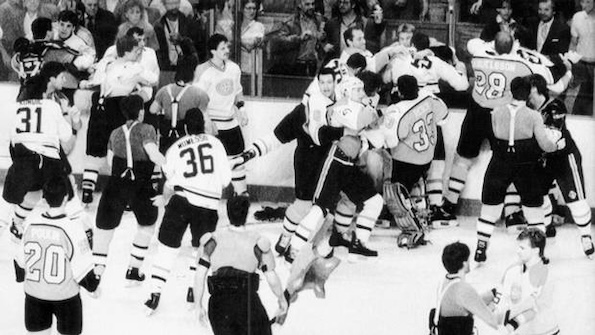
    2. The Good Friday Massacre: Quebec Nordiques vs. Montreal Canadiens (1984)

      Calling this a “fight” is like calling the Trojan War “a disagreement over property lines.”

      The legendary Good Friday Massacre between the Canadiens and Nordiques featured multiple bench-clearing brawls, enough penalties to require advanced accounting, and enough hostility to make family Thanksgiving arguments seem emotionally healthy.

      The rivalry was already nuclear. Add playoff tension, provincial hatred, and the collective decision by every player involved to temporarily abandon civilized behavior, and you got one of hockey’s all-time masterpieces of mayhem.

      Players fought. Then they got sent off. Then somehow they came back out and fought again. That’s commitment. That’s craftsmanship. This game proved the NHL playoffs are the only sporting event where “the officials have completely lost control” is often viewed as glowing praise.

      1. The Revenge Fight: Claude Lemieux vs. Darren McCarty (1997)

        This remains the undisputed heavyweight champion because it had everything — storyline, payoff, historical stakes, and the kind of raw energy that made viewers at home instinctively check whether they’d somehow been punched too. If hockey fights had a Hall of Fame wing with dramatic lighting and orchestral music, this would be the centerpiece. This wasn’t just a playoff fight. This was a Shakespearean revenge epic on ice.

        VISIT OUR eBay STORE and shop for sports and movie collectibles 24/7!!!!!!!!!!!

        After Lemieux’s infamous hit on Detroit’s Kris Draper the year before ignited one of the nastiest rivalries in sports, the Red Wings spent months waiting for justice like medieval knights preparing for battle.

        And when Darren McCarty finally got his hands on Claude Lemieux, it felt less like a fight and more like destiny cashing a very old check.

        The crowd in Detroit lost its collective mind. The benches erupted. Goalies joined in.

        It was playoff hockey distilled into its purest form: vengeance, chaos, and enough emotional intensity to register on seismographs.

        What are your thoughts? Are we missing any fights? Drop a comment below.
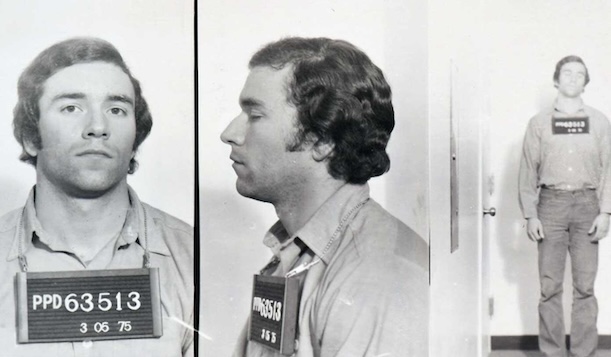
        The I-5 Killer: Green Bay Packers Reject Turns Murderer

        In the pantheon of American true crime, few cases are as unsettling—or as paradoxical—as that of Randall Woodfield. A man who once chased professional football dreams would instead become one of the most feared serial predators on the West Coast, terrorizing communities along Interstate 5 and leaving behind a trail of violence that investigators are still unraveling decades later.

        From NFL Prospect to Criminal Suspect: Before the headlines and manhunt, Woodfield looked like a success story in the making. A standout wide receiver at Portland State University, he had the size, speed, and charisma scouts coveted. In 1974, he was drafted by the Green Bay Packers—a moment that should have marked the beginning of a professional career.

        Visit the 24/7 Sports memorabilia GARAGE SALE over at our eBay store!!!

        But the dream unraveled quickly. Woodfield never played a regular-season game, cut during training camp amid concerns about both performance and troubling behavior, including prior arrests for indecent exposure.

        That early pattern—charm masking something darker—would define the next phase of his life.

        The Descent: Early Crimes and Escalation: By the mid-1970s, Woodfield’s criminal behavior had escalated from exposure incidents to armed robbery and sexual assault. In 1975, he was arrested after a series of knife-point attacks in Portland and served time in prison before being paroled in 1979.

        What followed his release was not rehabilitation—but acceleration.

        Between 1980 and early 1981, Woodfield embarked on a spree of violence that stretched along the Interstate 5 corridor through Oregon, Washington, and California. His crimes—robberies, rapes, kidnappings, and murders—often took place near highway exits, rest stops, and small businesses, giving rise to the chilling nickname: “The I-5 Killer.”

        Victims were frequently young women, targeted in moments of vulnerability. His methods were calculated: disguises like fake beards, sudden attacks, and the use of firearms or knives. The crimes escalated rapidly, with little cooling-off period—an intensity that alarmed investigators.

        Though only one murder would ultimately lead to conviction, authorities believe his true victim count may be far higher—possibly dozens.

        The Hunt Along Interstate 5: By late 1980, law enforcement agencies across multiple states realized they were dealing with a single, mobile predator. The geographic spread—over 500 miles of highway—complicated the investigation.

        Patterns began to emerge:

        • Crimes clustered near I-5 exits
        • Similar descriptions of a suspect
        • Repeated use of weapons and disguises

        Police circulated composite sketches and coordinated across jurisdictions—no small feat in an era before modern digital databases. The case drew increasing media attention, heightening public fear. The breakthrough would come not from forensic science alone, but from survival.

        The Break That Cracked the Case: On January 18, 1981, Woodfield attacked two women at a workplace in Salem, Oregon. One victim, Shari Hull, was killed. The other, Beth Wilmot, survived—and her testimony proved pivotal.

        Wilmot’s identification of Woodfield gave investigators what they desperately needed: a living witness who could tie the suspect directly to the crimes.

        From there, the case moved quickly. Visit the 24/7 GARAGE SALE over at our eBay store!!!

        Capture and Conviction: On March 7, 1981, authorities arrested Woodfield, bringing an end to the immediate wave of violence.

        He was soon convicted of murder, attempted murder, and multiple sexual offenses. The sentence: life imprisonment plus decades more—effectively ensuring he would never walk free again.

        Despite the conviction, Woodfield never confessed. His lack of remorse and refusal to accept responsibility frustrated investigators and victims’ families alike.

        A Dark Legacy Still Unfolding: In true crime history, few narratives are as chilling as the I-5 Killer’s—not just because of the crimes themselves, but because of the life that preceded them… and how quickly it all unraveled.

        What makes the Woodfield case particularly haunting is its incompleteness. Advances in DNA technology decades later have linked him to additional crimes, suggesting his full toll may never be known.

        The story of Randall Woodfield is a study in contradiction. A man who once stood on the cusp of the NFL became instead a symbol of predation and violence. His athletic past—his time with the Green Bay Packers—only deepens the unease, a reminder that outward success can obscure inner darkness.

        He remains incarcerated at the Oregon State Penitentiary, a former athlete whose name is now synonymous not with touchdowns—but terror.

        Visit the 24/7 Sports memorabilia GARAGE SALE over at our eBay store!!!

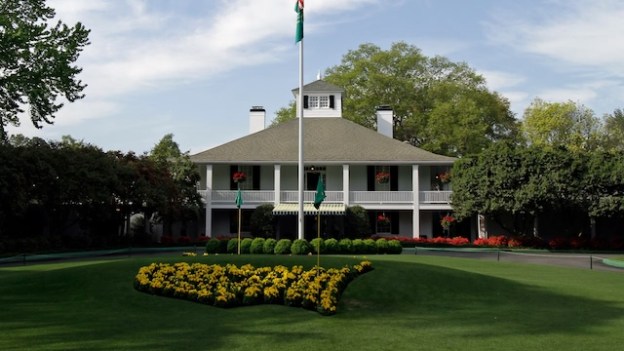
        Augusta National Golf Club

        Augusta National: From Fruitland to Golfing Landmark

        The story of the Augusta National Golf Club is one of the most influential chapters in the history of golf—an intersection of vision, architectural genius, and the ambition to create a permanent home for one of the sport’s greatest traditions. Located in Augusta, the course was not only designed to challenge the world’s best golfers but also to embody an idealized vision of natural beauty and sporting excellence.

        From Nursery to National Stage
        Before it became hallowed ground in professional golf, the land that would become Augusta National was known as the Fruitland Nursery, a sprawling 365-acre plant nursery established in the 19th century. By the early 1930s, the property had fallen into decline—until two men with a shared passion for golf saw its potential.

        Check out the FSM GARAGE SALE on eBay for cheap collectibles!!!

        Those men were legendary amateur golfer Bobby Jones and investment banker Clifford Roberts. Jones, widely regarded as one of the greatest amateur golfers in history, had retired from competitive golf at the peak of his career. Yet he still dreamed of creating a course that would represent everything he believed the game should be: strategic, beautiful, and fair.

        The Architect Behind the Vision
        To bring that vision to life, Jones and Roberts turned to renowned golf course architect Alister MacKenzie. MacKenzie, already famous for designs such as Cypress Point and Royal Melbourne, shared Jones’s belief that great golf courses should blend seamlessly with their natural surroundings.

        Working together, Jones and MacKenzie walked the old nursery grounds and envisioned a layout that would transform the land’s rolling hills, azaleas, and hardwood trees into a strategic masterpiece. MacKenzie completed the design in the early 1930s, though he died shortly before the course officially opened—never seeing the full legacy of his work unfold.

        Opening and the Birth of the Masters
        The course officially opened in 1933, and just one year later, in 1934, it hosted the inaugural tournament that would become the Masters Tournament. Originally called the Augusta National Invitation Tournament, it was conceived by Jones and Roberts as a way to bring the world’s best golfers to a single, elite venue.

        From the beginning, the tournament—and the course—stood apart. The layout demanded precision over power, rewarding strategy, imagination, and control. Its now-famous holes, including Amen Corner, quickly became iconic in the sport.

        FIND AUTOGRAPHS AND OTHER MEMORABILIA @ FSM’s eBay Store

        What set Augusta National apart was not just its beauty, but its philosophy. Jones and MacKenzie believed that golf should be a thinking person’s game, where risk and reward were constantly in balance. That philosophy is still visible in every dogleg, bunker placement, and elevation change.
        The course also became known for its meticulous maintenance and evolving design. Over the decades, it has undergone careful modifications to keep pace with modern equipment and athletic performance, while still preserving its original character.

        A Simple Legacy
        Today, Augusta National Golf Club is more than a course—it is a symbol of tradition in professional golf. Each spring, it becomes the stage for the Masters, where legends are made and history is written.

        Yet its origins remain rooted in a simple but powerful idea: that two visionaries, a master architect, and a forgotten nursery in Georgia could be transformed into one of the most revered sporting venues in the world.

        The Origin Story of Saying “March Madness”

        Every March, office pools explode, brackets bust, and underdogs become legends. The phrase “March Madness” now feels inseparable from the National Collegiate Athletic Association (NCAA) men’s basketball tournament—but its roots stretch back further than most fans realize. Long before billion-dollar TV deals and wall-to-wall coverage, March Madness belonged to high school basketball.

        In 1939, Illinois high school official Henry V. Porter used the term in an essay to describe the emotional frenzy surrounding the annual state basketball tournament. Porter, who worked with the Illinois High School Association, wrote about the electricity in small-town gyms, the packed crowds, and the statewide obsession that peaked every March. To him, “March Madness” captured the chaos, passion, and community pride of tournament time.

        At the time, the college game was still growing. That same year—1939—the first NCAA men’s basketball tournament was held, won by the Oregon Ducks men’s basketball team. But the phrase hadn’t yet attached itself to the college bracket. Fast forward to the 1980s. College basketball had become a television spectacle. As the tournament expanded and Cinderella stories multiplied, broadcasters searched for language big enough to match the moment.

        Enter Brent Musburger.

        While calling NCAA tournament games for CBS in the early 1980s, Musburger began using the term “March Madness” on national broadcasts. His booming delivery and prime-time platform cemented the phrase in the American sports vocabulary. What had once described Illinois high school gyms now echoed across the country.

        The NCAA eventually trademarked “March Madness,” formally tying it to the Division I basketball tournament held every year. The phrase fits perfectly considering the structure of the NCAA tournament demands drama. Unlike professional playoffs that stretch over series, the college game offers no safety net. Survive and advance—or vanish. Add in buzzer-beaters, 15-seeds toppling 2-seeds, and brackets shredded before the Sweet 16 and it’s hard to deny this emotional whiplash packed into three weeks.

        Today, “March Madness” represents more than just college basketball games being played. It means office bracket pools, billion-dollar TV contracts, Cinderella stories, alumni pride, and three weeks when productivity mysteriously declines nationwide What began as poetic wording in a 1939 essay evolved into one of the most powerful brands in American sports.

        And that’s fitting. Because every year, when the ball tips in mid-March and dreams hang on every possession, madness doesn’t feel like exaggeration. It feels accurate.

        Super Bowl LX: The Ultimate Snack Stats

        Super Bowl LX is here. While the touchdowns and dramatic halftime shows make headlines, let’s be honest — the real MVP of Super Bowl Sunday is the “buffet”. Every year, Americans transform living rooms into snack stadiums, and the numbers are big enough to make your belly ache and your belt tighten.

        The Numbers Don’t Lie (Thank Goodness). Forget total yardage — here’s the real stats breakdown of what gets consumed during the Super Bowl:

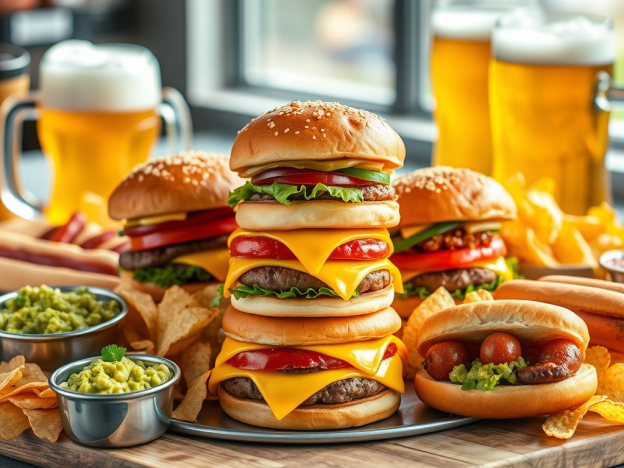
        🥔 Chips & Guac

        An estimated 11.2 million pounds of potato chips are eaten on Super Bowl Sunday alone. That’s enough chips to circle the Earth if you lined them up (probably). Add to that around 8 million pounds of tortilla chips — ideally dipped into guacamole, for which Americans buy 139.4 million pounds of avocados. Guac lovers rejoice (or regret).

        🍔 Burgers & Hot Dogs

        Estimates suggest that 8 to 14 billion hamburgers are grilled around Super Bowl weekend — second only to the Fourth of July in American grilling fervor. While not as tallied, thousands of pounds of hot dogs also disappear into eager mouths, often served with everything from mustard to leftover guac (no judgment here).

        🍺 Beer, Soda & Other Drinks

        Thirsty much? Fans knock back roughly 325.5 million gallons of beer over Super Bowl weekend — that’s like filling an Olympic swimming pool almost 2,000 times. Soda isn’t left out either, with millions of dollars’ worth being slurped along with the snacks.

        Counting Calories Not Recommended 

        You might think that with all this food people feel full. You also might think a football player could eat less. According to studies, the average person might ingest up to 2,400 calories in one afternoon of snacking — without touching the actual meal.

        That’s like downing:

        Half a pizza 🍕,

        Seven beers 🍺,

        Four bags of chips 🥔,

        … and then going to the grill to get your cheeseburger.

        The Super Bowl isn’t just a football game — it’s a caloric confrontational ritual. We gather with friends, turn up the big screen, and hold a moment of silence for our diets.

        All told, Super Bowl Sunday is second only to Thanksgiving in sheer food consumption but with more beer and fewer excuses.

        GET EXTRA CASH BACK WITH RAKUTEN

        An Extremely Scientific and Not-At-All-Overly-Dramatic Investigation of the Madden Curse

        For decades, football fans have debated one of the most important questions in sports—not whether overtime rules are fair, not whether the NFL should bring back those aggressively shiny 2000s jerseys, but something far more urgent: Does the Madden Curse really exist? And more importantly, should star players start refusing EA Sports’ calls the way we all avoid extended car warranties? Let us examine the evidence…

        The Case For the Curse

        The Madden Curse, in theory, is simple: a player appears on the cover of Madden, and something catastrophic happens the following season. Injury. Bad stats. A sudden inability to catch footballs, or in some cases, the sudden ability to catch only footballs thrown by the other team.

        Some examples have become legendary. You can’t talk about the curse without mentioning the dramatic tales of players who went from “unstoppable MVP machine” to “guy on the sideline Googling physical therapy clinics.” Even skeptics have to admit the pattern can look a little spooky—like a sports-themed ghost whispering, “Nice ACL you got there… shame if something happened to it.”

        The Case Against the Curse

        Skeptics argue that star players get hurt because football is, scientifically speaking, a sport where enormous humans collide at highway speeds. They claim injuries are “normal” and “predictable” and not the result of a digital box with a picture of you pointing heroically into the middle distance.

        These skeptics are, of course, no fun at parties.

        Scientific Investigation (Not Peer Reviewed; Honestly Not Even Self Reviewed)

        In conducting our personal research, we employed cutting-edge methodologies:

        * Watching YouTube highlight compilations

        * Googling “Is the Madden Curse real??”

        * Squinting dramatically at spreadsheets

        Our findings are groundbreaking: sometimes players get better after being on the cover. Sometimes they get worse. Sometimes they become memes. In other words, the Madden Curse behaves exactly like my houseplants—occasionally thriving, occasionally collapsing, and completely unpredictable.

        Final Verdict

        Does the Madden Curse truly exist? Maybe. Maybe not. But it’s definitely fun to blame when your favorite player suddenly forgets how ankles work.

        And until science proves otherwise, we should all treat the Madden cover like a mysterious ancient artifact—admire from afar, but maybe don’t touch it unless you’ve recently updated your insurance policy.

        So yes, the Madden Curse exists, at least in our hearts, our memes, and the overly dramatic sports takes we write on the internet.

        Hakuna Matata: The True Crime Story of Bison Dele in Four Short Chapters

        The story of Bison Dele’s death reads like the final chapter of a noir thriller—sun-soaked paradise masking dark secrets, a charismatic ex-athlete yearning for peace, and someone whose jealousy would turn deadly. It’s a story of fame, escape, and the ultimate betrayal, set not in the cold alleys of a city but on the endless blue of the South Pacific.

        Chapter 1: The Disappearing Star

        Bison Dele wasn’t just another basketball player. Born Brian Carson Williams in 1969, he was a gifted, soulful giant who seemed both drawn to and haunted by fame. After stints with the Orlando Magic, Denver Nuggets, Los Angeles Clippers, and Chicago Bulls—where he won an NBA championship in 1997—Dele walked away at just 30 years old. He turned down millions, choosing freedom over fortune. He traveled the world, learned to play saxophone, and sailed from port to port, often unreachable, as if trying to erase the celebrity that had once defined him.

        By 2002, Dele had settled into a quiet life aboard his beloved catamaran, the Hakuna Matata, named for the Swahili phrase meaning “no worries.” He sailed with his girlfriend, Serena Karlan, and occasionally with his older brother, Miles Dabord. Where Bison was introspective and gentle, his brother Miles could be restless, jealous, and increasingly unstable at times.

        Chapter 2: Setting Sail

        In early July 2002, Dele, Karlan, and Miles departed from Tahiti with their captain, Bertrand Saldo. It was supposed to be a short voyage—just a few days of island hopping. But when the Hakuna Matata failed to return, family and friends began to worry. No distress signals were sent. No sightings were reported. The ocean had seemingly swallowed four people whole.

        Then, days later, the Hakuna Matata reappeared—mysteriously docked in Tahiti, piloted by a single man. He called himself “Arlando”—but fingerprints told a darker truth. It was Miles Dabord, alone.

        Chapter 3: The Impostor

        Dabord told conflicting stories to anyone who would listen. He said the others were “in Tahiti,” and that there had been an “accident.” But his behavior told another story. He forged his brother’s signature to withdraw money from Dele’s accounts. He bought gold. He changed his identity. And when investigators pressed him, his tangled web began to unravel.

        Authorities pieced together a chilling narrative: somewhere in the remote waters between Tahiti and Honolulu, Miles had snapped. An argument escalated—possibly over money or control of the boat. In a fit of rage, he struck Serena. When the captain intervened, he was killed too. Finally, Bison—who had always tried to protect those around him—was murdered as well.

        Miles, left alone with the aftermath, allegedly weighted their bodies and cast them into the sea, letting the Pacific become their grave.

        Chapter 4: The Final Act

        By September 2002, the truth was closing in. U.S. authorities tracked Dabord to a hotel in Tijuana, Mexico. He was found unconscious after an apparent insulin overdose—an act of apparent suicide. He never regained consciousness. When he died, so too did any chance of recovering the full truth.

        The bodies of Bison Dele, Serena Karlan, and Bertrand Saldo were never found.

        Epilogue: The Dream That Sank

        In life, Bison Dele sought peace—a life far from the noise of arenas and headlines. He chased freedom across continents, only to be betrayed by a person he trusted to share the journey.

        His death remains one of sport’s most haunting mysteries—a story of blood and brotherhood on the high seas, where jealousy drowned love, and paradise turned to nightmare.

        The Pacific still rolls on, indifferent and endless. Somewhere beneath it, the echoes of Bison Dele’s final voyage drift with the tides—a reminder that even in paradise, darkness can find its way aboard.

        Teddy Roosevelt: The First MMA President?

        Theodore “Teddy” Roosevelt, the 26th president of the United States, was a lifelong advocate of physical fitness and athleticism. Throughout his life, he engaged in a wide array of sports—from hiking, horseback riding, and rowing to tennis and jiu-jitsu. However, the sport he was arguably best at—and most passionate about—was boxing. He also had a love for wrestling and the martial arts. This begs the question, was Teddy Roosevelt the first ever MMA president?

        Roosevelt began boxing as a student at Harvard University, where he competed as a lightweight. Though he never won any titles, he was known for his grit, determination, and surprising toughness in the ring. He continued boxing recreationally into adulthood, often sparring with younger, more skilled opponents during his political career—even while serving in the White House.

        One famous story tells of Roosevelt engaging in a White House sparring match with a young Army artillery officer. The future president, well into his 40s at the time, took a punch so hard that it left him permanently blind in one eye. Yet, he never made a fuss and only quietly stopped boxing afterward, shifting to other sports like jiu-jitsu and hiking.

        Boxing symbolized Roosevelt’s philosophy of the “strenuous life”—a belief that hard physical labor and rugged living built character and leadership. While he enjoyed many sports, none captured his spirit of tenacity, courage, and self-discipline quite like boxing.

        As previously mentioned, Roosevelt eventually moved away from boxing in favor of other activities such as hiking, climbing, and wrestling. Roosevelt enjoyed jiu-jitsu in particular because much like boxing, it aligned perfectly with his philosophy centered on discipline, toughness, and constant self-improvement. He saw the martial art not only as a form of physical exercise but as a way to sharpen the mind, build character, and cultivate personal courage.

        Additionally, being president during a time of increasing U.S.-Japan relations, Roosevelt’s interest in jiu-jitsu reflected his fascination with Japanese culture and martial tradition. He even brought in Japanese experts—like Yoshiaki Yamashita—to teach him and members of his inner circle at the White House.

        Roosevelt was the first U.S. president known to study and participate in martial arts. His enthusiasm helped generate early American interest in jiu-jitsu and, later, judo. It’s not a stretch to say he planted the seeds for MMA’s modern day popularity and that if he were president today, he would he be sitting front row at the big UFC events.

        Chestnut’s Ban Lifted, Will Return to Hot Dog Contest this Year

        The Nathan’s Hot Dog Eating Contest is a uniquely American spectacle—a competitive eating event held every Fourth of July at the original Nathan’s Famous restaurant on Coney Island in Brooklyn, New York. Over the decades, it has grown from a local novelty into a nationally televised cultural event. Its history is a curious blend of patriotism, marketing savvy, and extreme physical endurance.

        According to Nathan’s lore, the first contest was held in 1916 when four immigrants competed to prove who was the most patriotic by eating the most hot dogs. While this origin story has since been debunked as a clever piece of marketing invented in the 1970s, it nonetheless set the tone for the contest’s mythology.

        The modern era of the contest began in earnest in the early 2000s, when ESPN started broadcasting it live. The rise of competitive eating as entertainment coincided with the reign of Takeru Kobayashi, a Japanese competitor who revolutionized the sport with his technique and stamina. Kobayashi’s arrival in 2001, and his subsequent record-breaking performances, put Nathan’s on the map internationally.

        The next chapter in the contest’s evolution was written by Joey Chestnut, a California native who dethroned Kobayashi in 2007 and ushered in a new era of dominance. Chestnut’s feats were nothing short of extraordinary. From 2007 to 2023, he won the contest 16 times, setting multiple world records in the process—including his astonishing 76 hot dogs in 10 minutes in 2021.

        Chestnut became synonymous with the event. His relentless training, competitive fire, and ability to perform under pressure earned him the nickname “Jaws” and made him a household name. His duels with other top eaters added drama, but Chestnut often proved untouchable. He became the face of Nathan’s contest and competitive eating itself.

        In 2024, however, Joey Chestnut’s long association with the Nathan’s contest came to a sudden and unexpected end. Major League Eating (MLE), the organization that sanctions the event, announced that Chestnut would not be competing due to a sponsorship conflict. Chestnut had signed a promotional deal with Impossible Foods, a company known for its plant-based meat alternatives, including vegan hot dogs.

        Nathan’s Famous and MLE viewed this sponsorship as a direct conflict of interest. Nathan’s, which promotes its traditional all-beef hot dogs, reportedly asked Chestnut to drop the Impossible Foods partnership if he wanted to compete. Chestnut declined, stating that he should be able to work with other brands and that he was not under a formal contract that restricted such agreements. This impasse led to his exclusion from the 2024 event.

        The public reaction was swift and largely supportive of Chestnut. Many fans and commentators criticized Nathan’s and MLE for what they saw as a shortsighted business decision that prioritized brand protection over honoring the contest’s most iconic figure. Some likened it to banning Michael Jordan from the NBA Finals or Tom Brady from the Super Bowl.

        Nathan’s Hot Dog Eating Contest has always been about more than just food—it’s about American tradition, spectacle, and the quirky pursuit of glory. Joey Chestnut embodied that spirit for nearly two decades. For many, Chestnut was a part of their Fourth of July celebrations which is something MLE and Nathan’s probably came to realize when they decided to lift his ban.

        In mid‑June, Chestnut confirmed on social media (X) and through various outlets like ESPN, ABC News, and CBS Sports that he will compete in the 2025 contest after missing the 2024 event due to the sponsorship dispute. Chestnut explained that he partners with a variety of companies, including some that are plant‑based, but none of them conflict with his love for hot dogs, and that Nathan’s is the only hot dog brand he’s ever endorsed.

        MLE’s president voiced enthusiasm, stating they’re “extremely excited to welcome Joey back…for what will surely be the greatest Nathan’s Famous Hot Dog Eating Contest of all time.”

        Chestnut will be pursuing a record 17th title. Fox Sports notes he is the heavy favorite to exceed 71.5 hot dogs in the 10‑minute contest, reflecting strong betting odds.

        The Time RoboCop Tried Professional Wrestling

        The transition from the 80’s to the 90’s was a wild time. Some would say the best of both worlds were colliding and everyone was along for the ride. Part of that ride was RoboCop’s arrival in World Championship Wrestling (WCW). How can we even begin to explain this? Robocop, a fictional character from the movies, was now somehow real and decided to fight crime in a real sports organization that was really just a fictional sports organization.  

        RoboCop showed up in World Championship Wrestling during the 1990 Capital Combat: Return of RoboCop pay-per-view event. This bizarre crossover happened mainly for marketing reasons. At the time, Orion Pictures was about to release the movie RoboCop 2. WCW and Orion worked out a promotional tie-in in which RoboCop would make an appearance at the wrestling event to hype up the film.

        In the storyline, RoboCop helped Sting, who was one of WCW’s top stars, fend off an attack from the villainous group known as the Four Horsemen. RoboCop came down to ringside, “bent” the bars of a cage to rescue Sting, and helped him chase the bad guys off.

        Fans and critics heavily mocked the segment, and it’s still remembered as one of the most embarrassing and absurd moments in pro wrestling history. The “action” was slow and obviously fake. RoboCop was being portrayed by a guy in a heavy suit (probably not Peter Weller) who could barely move.

        So what’s the big deal? Fort starters, RoboCop is a fictional cyborg from a dystopian sci-fi movie — totally out of place in a wrestling environment that, even by 1990s standards, tried to maintain some realism. Arn Anderson was a major member of the Four Horsemen and one of the guys involved in the RoboCop segment. He thought the whole idea was “embarrassing” and made wrestling look like a “clown show”. Arn described the whole thing as “cartoonish” and something that hurt WCW’s credibility, especially when the company was trying to be seen as a more serious alternative to WWF’s over-the-top characters at the time.

        Arn Anderson has gone on the record during his “ARN” podcast to share his true thoughts about the infamous RoboCop moment:

        “I knew it was horsesh*t from the get-go. How do you fight a robot? Are we supposed to punch him and knock his head off? Are we supposed to sell for him? Run from him? He can’t move! It was one of the most embarrassing things I’ve ever been part of.”

        Not pile on, but professional wrestling historian extortionate Jim Cornette also did not hold back when talking about the subject on an old “Kayfabe Commentaries” podcast.  

        “It was the stupidest goddamn thing I’d ever seen. Who in the f*** thought RoboCop would draw money in wrestling? It made everyone look like idiots — the wrestlers, the announcers, the fans who had to sit through it. I was embarrassed to even be in the same building.”

        Even the eternal optimist Sting (who Robocop saved during the segment) had trouble finding the silver lining. During the episode of “WWE Untold: Sting”, the wrestling icon had this to say about what went down that fateful day:

        “I was standing there thinking, ‘Man, I hope nobody I know is watching this.”