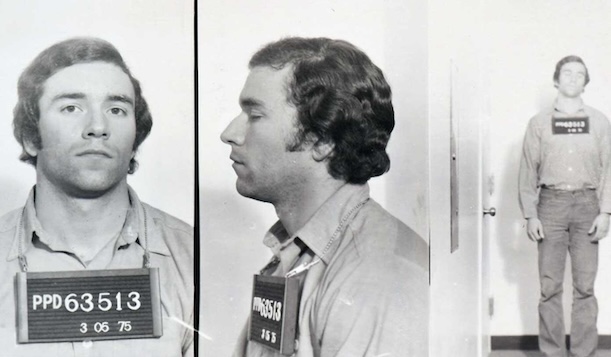
In the pantheon of American true crime, few cases are as unsettling—or as paradoxical—as that of Randall Woodfield. A man who once chased professional football dreams would instead become one of the most feared serial predators on the West Coast, terrorizing communities along Interstate 5 and leaving behind a trail of violence that investigators are still unraveling decades later.
From NFL Prospect to Criminal Suspect: Before the headlines and manhunt, Woodfield looked like a success story in the making. A standout wide receiver at Portland State University, he had the size, speed, and charisma scouts coveted. In 1974, he was drafted by the Green Bay Packers—a moment that should have marked the beginning of a professional career.
Visit the 24/7 Sports memorabilia GARAGE SALE over at our eBay store!!!
But the dream unraveled quickly. Woodfield never played a regular-season game, cut during training camp amid concerns about both performance and troubling behavior, including prior arrests for indecent exposure.
That early pattern—charm masking something darker—would define the next phase of his life.
The Descent: Early Crimes and Escalation: By the mid-1970s, Woodfield’s criminal behavior had escalated from exposure incidents to armed robbery and sexual assault. In 1975, he was arrested after a series of knife-point attacks in Portland and served time in prison before being paroled in 1979.
What followed his release was not rehabilitation—but acceleration.
Between 1980 and early 1981, Woodfield embarked on a spree of violence that stretched along the Interstate 5 corridor through Oregon, Washington, and California. His crimes—robberies, rapes, kidnappings, and murders—often took place near highway exits, rest stops, and small businesses, giving rise to the chilling nickname: “The I-5 Killer.”
Victims were frequently young women, targeted in moments of vulnerability. His methods were calculated: disguises like fake beards, sudden attacks, and the use of firearms or knives. The crimes escalated rapidly, with little cooling-off period—an intensity that alarmed investigators.
Though only one murder would ultimately lead to conviction, authorities believe his true victim count may be far higher—possibly dozens.
The Hunt Along Interstate 5: By late 1980, law enforcement agencies across multiple states realized they were dealing with a single, mobile predator. The geographic spread—over 500 miles of highway—complicated the investigation.
Patterns began to emerge:
- Crimes clustered near I-5 exits
- Similar descriptions of a suspect
- Repeated use of weapons and disguises
Police circulated composite sketches and coordinated across jurisdictions—no small feat in an era before modern digital databases. The case drew increasing media attention, heightening public fear. The breakthrough would come not from forensic science alone, but from survival.
The Break That Cracked the Case: On January 18, 1981, Woodfield attacked two women at a workplace in Salem, Oregon. One victim, Shari Hull, was killed. The other, Beth Wilmot, survived—and her testimony proved pivotal.
Wilmot’s identification of Woodfield gave investigators what they desperately needed: a living witness who could tie the suspect directly to the crimes.
From there, the case moved quickly. Visit the 24/7 GARAGE SALE over at our eBay store!!!
Capture and Conviction: On March 7, 1981, authorities arrested Woodfield, bringing an end to the immediate wave of violence.
He was soon convicted of murder, attempted murder, and multiple sexual offenses. The sentence: life imprisonment plus decades more—effectively ensuring he would never walk free again.
Despite the conviction, Woodfield never confessed. His lack of remorse and refusal to accept responsibility frustrated investigators and victims’ families alike.
A Dark Legacy Still Unfolding: In true crime history, few narratives are as chilling as the I-5 Killer’s—not just because of the crimes themselves, but because of the life that preceded them… and how quickly it all unraveled.
What makes the Woodfield case particularly haunting is its incompleteness. Advances in DNA technology decades later have linked him to additional crimes, suggesting his full toll may never be known.
The story of Randall Woodfield is a study in contradiction. A man who once stood on the cusp of the NFL became instead a symbol of predation and violence. His athletic past—his time with the Green Bay Packers—only deepens the unease, a reminder that outward success can obscure inner darkness.
He remains incarcerated at the Oregon State Penitentiary, a former athlete whose name is now synonymous not with touchdowns—but terror.
Visit the 24/7 Sports memorabilia GARAGE SALE over at our eBay store!!!


