Tag Archives: NHL

Gloves Off: Ranking the Top 3 Fights in NHL Playoff History

The Stanley Cup Playoffs are hockey’s annual reminder that civilization is a fragile social construct. For roughly two months every spring, grown men with titanium dental work and a concerning disregard for personal safety strap knives to their feet and politely attempt to vaporize one another into the boards.

And while the NHL officially markets playoff hockey as a showcase of speed, skill, and precision, everyone knows there’s another sacred tradition: playoff fights. These are not your standard regular-season “let’s get this over with before the second intermission” dustups. Playoff fights carry the emotional weight of an entire city, the fury of seven games’ worth of cheap shots, and the raw chaos of a man who’s been cross-checked in the kidneys 14 consecutive shifts.

CHEAP MEMORABILIA @ FreeSportsMag’s 24/7 GARAGE SALE on eBay!!!!!!!!!!!!!!!!!!!!!!!!!!!!!!!

After careful review, several YouTube rabbit holes, and enough old-school hockey footage to make a laptop smell faintly of cigarette smoke and arena nachos, here are the Top Three Fights in NHL playoff history.

3. Tie Domi vs. Bob Probert (1994 Playoffs)

    This wasn’t a fight. This was an industrial accident.

    When Toronto’s Tie Domi squared off with Detroit’s Bob Probert, it was essentially a fire hydrant challenging a freight train to mutual destruction. Probert looked like he was carved out of Michigan steel mills. Domi looked like he had been genetically engineered in a Toronto basement specifically for uppercuts.

    The beauty of this tilt was the pure absence of hesitation. No theatrical circling. No jersey-adjusting. No “you sure?” nod.

    They just grabbed hold and started throwing enough haymakers to alter nearby weather patterns.

    At one point it looked less like hockey and more like two men trying to settle a labor dispute in a parking lot outside a Canadian Tire.

    This fight lands at number three because it perfectly captured playoff hockey’s central philosophy: if finesse isn’t working, become a demolition crew.

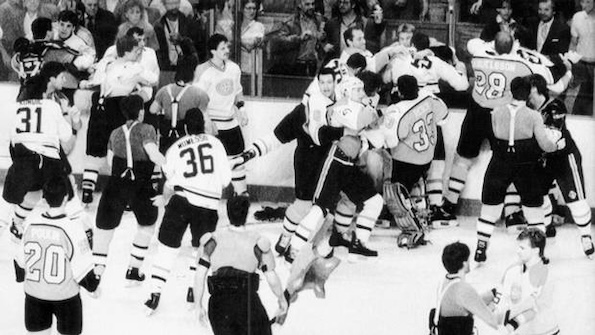
    2. The Good Friday Massacre: Quebec Nordiques vs. Montreal Canadiens (1984)

      Calling this a “fight” is like calling the Trojan War “a disagreement over property lines.”

      The legendary Good Friday Massacre between the Canadiens and Nordiques featured multiple bench-clearing brawls, enough penalties to require advanced accounting, and enough hostility to make family Thanksgiving arguments seem emotionally healthy.

      The rivalry was already nuclear. Add playoff tension, provincial hatred, and the collective decision by every player involved to temporarily abandon civilized behavior, and you got one of hockey’s all-time masterpieces of mayhem.

      Players fought. Then they got sent off. Then somehow they came back out and fought again. That’s commitment. That’s craftsmanship. This game proved the NHL playoffs are the only sporting event where “the officials have completely lost control” is often viewed as glowing praise.

      1. The Revenge Fight: Claude Lemieux vs. Darren McCarty (1997)

        This remains the undisputed heavyweight champion because it had everything — storyline, payoff, historical stakes, and the kind of raw energy that made viewers at home instinctively check whether they’d somehow been punched too. If hockey fights had a Hall of Fame wing with dramatic lighting and orchestral music, this would be the centerpiece. This wasn’t just a playoff fight. This was a Shakespearean revenge epic on ice.

        VISIT OUR eBay STORE and shop for sports and movie collectibles 24/7!!!!!!!!!!!

        After Lemieux’s infamous hit on Detroit’s Kris Draper the year before ignited one of the nastiest rivalries in sports, the Red Wings spent months waiting for justice like medieval knights preparing for battle.

        And when Darren McCarty finally got his hands on Claude Lemieux, it felt less like a fight and more like destiny cashing a very old check.

        The crowd in Detroit lost its collective mind. The benches erupted. Goalies joined in.

        It was playoff hockey distilled into its purest form: vengeance, chaos, and enough emotional intensity to register on seismographs.

        What are your thoughts? Are we missing any fights? Drop a comment below.

        Manon Rhéaume Broke Barriers as NHL’s First Female Player

        Manon Rhéaume is a trailblazing figure in ice hockey, best known for being the first woman to play in a major North American men’s professional sports league. Born on February 24, 1972, in Beauport, Quebec, Rhéaume made history in 1992 when she played as a goaltender for the Tampa Bay Lightning in an NHL preseason game. This marked the first and only time a woman competed in an NHL game, breaking barriers in a sport dominated by men.

        Rhéaume had a successful career as a goaltender in women’s ice hockey as well. She represented Canada in international competition, winning silver medals at the Women’s World Championships and earning a silver medal at the 1998 Winter Olympics in Nagano, the first-time women’s ice hockey was included in the Olympics.

        Her achievements have made her a symbol of progress in sports, inspiring many female athletes to pursue their goals regardless of traditional gender norms in competitive fields.

        Manon Rhéaume’s groundbreaking appearance in an NHL game was the result of a combination of her exceptional talent and a strategic move by the Tampa Bay Lightning to generate publicity for their newly formed franchise. Here’s how it came to pass…

        Rhéaume had already made a name for herself as a highly skilled goaltender. In 1991, she became the first woman to play in a men’s major junior hockey game, suiting up for the Trois-Rivières Draveurs in the Quebec Major Junior Hockey League (QMJHL). Her performance in men’s leagues drew attention and proved her ability to compete at a high level. She had also excelled in women’s hockey, leading the Canadian national team to world championships and establishing herself as one of the top female goaltenders in the world.

        In 1992, the Tampa Bay Lightning were preparing for their inaugural season in the NHL. Team general manager Phil Esposito, a Hall of Fame player, saw an opportunity to make a splash and attract attention to the new team so he invited Rhéaume to the Lightning’s training camp. While the decision was seen by some as a publicity stunt, Rhéaume’s skills and accomplishments justified the invitation. Esposito later insisted that the move was not just a gimmick; Rhéaume had shown she was good enough to play at a high level, and she had earned the chance.

        So that’s how it came to be that, on September 23, 1992, Rhéaume made history when she played in a preseason game for the Lightning against the St. Louis Blues. She played one period, stopping seven of nine shots in a solid performance.

        Although Rhéaume didn’t continue with the Lightning in the regular season, her participation in the game was a major milestone. She was later signed by minor league teams and continued her career in professional and international women’s hockey through the 1990s and early 2000s. She represented Canada in international competition, including winning a silver medal at the 1998 Nagano Winter Olympics, the first-time women’s ice hockey was included in the Games. She officially retired from professional hockey in 2009. However, her competitive playing career had already slowed down before that point.

        After retiring as a player, Rhéaume has remained active in the world of hockey, working in various coaching and mentoring roles. Her legacy continues to inspire many, especially young female players. As of recent years, Rhéaume has been particularly involved in developing youth hockey programs, with a focus on growing opportunities for girls in the sport. She has worked as a coach and mentor for young players, inspiring the next generation of female athletes. She has worked with organizations like the Detroit Red Wings to promote hockey through outreach and youth programs and has served as an ambassador for women’s hockey, frequently appearing at events to support the sport’s growth.

        Rhéaume also started the Manon Rhéaume Foundation, which provides scholarships and financial aid to young girls who want to play hockey but face financial barriers. The foundation’s mission aligns with her lifelong dedication to empowering women and girls in sports.

        And if all that wasn’t enough, Rhéaume is also active as a motivational speaker, where she shares her story of breaking barriers in the NHL and encourages young people, especially girls, to pursue their dreams, regardless of traditional gender expectations and she occasionally appears in media to discuss her career and to comment on the state of women’s hockey. Manon Rhéaume’s NHL appearance was significant not only for its historical value but also because it opened doors and brought visibility to women’s participation in traditionally male-dominated sports. She will forever remain a significant figure in the NHL, even though she only played in one game.