Tag Archives: sports

The Greatest Christmas Day Game in Sports History

The assertion that the Miami Dolphins versus Kansas City Chiefs game in the NFL Divisional Playoff on December 25, 1971, stands as the greatest professional sports contest ever played on Christmas Day is compelling because of its historic significance, extraordinary drama, and enduring legacy. More than just a football game, the “Christmas Day Classic” has become a symbol of athletic endurance and competitive will, setting a standard that few holiday matchups in any sport have rivaled.

First, the game’s historical context elevates its importance. It was the first NFL playoff game ever played on Christmas Day, marking a bold step for the league into holiday sports broadcasting. At a time when Christmas was traditionally reserved for family gatherings rather than professional football, this matchup captured national attention and demonstrated that the NFL could command the spotlight even on America’s most cherished holiday. The stakes were immense: a trip to the AFC Championship Game. That combination of novelty and consequence ensured the contest would be remembered long after the decorations came down.

Second, the game’s sheer drama and endurance make it legendary. The Dolphins and Chiefs battled for 82 minutes and 40 seconds of game time, making it the longest game in NFL history at the time, stretching into double overtime. Neither team could pull away, and every possession felt decisive. Fans watched as players pushed through exhaustion, injuries, and the emotional weight of a holiday playoff. When Garo Yepremian finally kicked the winning field goal to give Miami a 27–24 victory, it felt less like the end of a game and more like the conclusion of an epic test of will.

Third, the level of talent on the field underscores why this contest transcends ordinary holiday games. The matchup featured future Hall of Famers and iconic figures such as Dolphins coach Don Shula and Chiefs coach Hank Stram, along with standout players who defined an era of football. The strategic battle between two great coaches and the execution by elite athletes added layers of quality to the spectacle. This was not simply a novelty game played on Christmas; it was top-tier professional football at its highest level.

Moreover, the legacy of the 1971 Dolphins–Chiefs game continues to shape how fans and media view Christmas Day sports. While the NBA has since made Christmas a marquee date filled with high-profile matchups, and the NFL has returned to scheduling games on the holiday, none have quite matched the mythic status of this playoff duel. The phrase “longest game ever” still evokes images of that frigid Kansas City night, when families delayed Christmas dinners and gathered around televisions, united by the drama unfolding on the field.

When considering everything mentioned above, the Miami Dolphins versus Kansas City Chiefs game on December 25, 1971, earns its place as the greatest Christmas Day game in professional sports because it combined historical firsts, unforgettable drama, elite competition, and a lasting cultural impact. It was not merely a contest played on a holiday; it became part of the holiday’s sporting identity. Decades later, it remains the benchmark against which all Christmas Day games are measured, a testament to the power of sport to create timeless moments—even on Christmas.

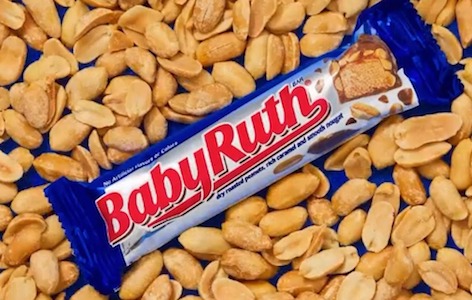
Baby Ruth Bar Not Named After Babe Ruth (but really it is)

If you’ve ever unwrapped a Baby Ruth candy bar, you might have wondered: Who on earth is Baby Ruth? Was it Babe Ruth, the home run king? Was it some long-lost child celebrity? Or was it just a clever way to sell chocolate, caramel, peanuts, and nougat without admitting it? As it turns out, the true origin of the Baby Ruth bar is a story filled with sugar, baseball bats, and a little bit of corporate trickery.

The Baby Ruth bar was introduced in 1921 by the Curtiss Candy Company. At that time, Babe Ruth was smashing baseballs into orbit and basically becoming America’s first real sports superstar. So naturally, people thought, “Oh, this candy must be named after Babe Ruth.” Logical, right? Wrong—or at least, that’s what the candy company claimed. Instead, Curtiss Candy swore on a stack of nougat that the candy was actually named after President Grover Cleveland’s daughter, Ruth. This would’ve been a fine explanation, except for one small detail: poor Ruth Cleveland had been dead for 17 years by the time the candy bar came out. It’s hard to believe America was clamoring for a caramel-and-peanut tribute to a child they hadn’t thought about since the 1890s.

So why the cover-up? Well, Babe Ruth wasn’t exactly thrilled about having his name slapped on a candy bar without his permission. Rumor has it he asked for royalties, and the candy company responded with a very polite version of “Nice try, slugger.” By insisting the bar was about Ruth Cleveland instead of Babe Ruth, they dodged paying the Sultan of Swat a single peanut. A crafty move, considering candy companies are very protective of their nougat margins.

The irony of the whole situation is that Babe Ruth himself actually tried to launch his own candy bar in the 1920s, called the Ruth’s Home Run Bar. Unfortunately, it struck out almost immediately because Baby Ruth was already dominating the shelves. Imagine trying to sell a soda called “Coca-Kola” after Coke already existed—it just wasn’t going to work. So while Babe Ruth may have been the king of baseball, he was benched in the candy aisle.

Today, the Baby Ruth remains a staple in the world of candy, even though most people still assume it was named after Babe Ruth. In a way, it’s the greatest inside joke in American snack history: a candy bar that everyone thinks honors a baseball legend but officially commemorates a president’s long-deceased daughter. If anything, that’s proof that nougat mixed with caramel and peanuts can cover up a lot—including a suspicious backstory.

So the next time you bite into a Baby Ruth, just remember: you’re not just enjoying a candy bar—you’re unwrapping a century-old argument between a candy company and a baseball legend. And if that doesn’t make it taste sweeter, at least you can laugh knowing America once pretended it was nostalgic for a president’s kid just to avoid cutting Babe Ruth a check.

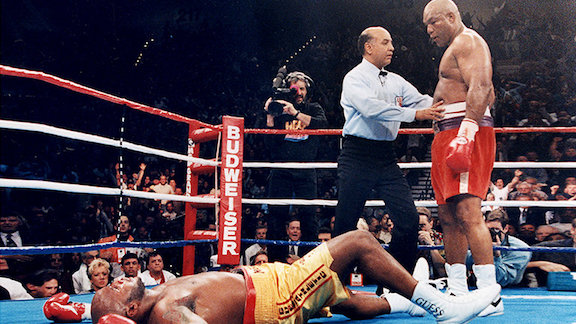
George Foreman's 1994 upset of Michael Moorer

The Three Acts of George Foreman

The Rumble in the Jungle wasn’t just a boxing match—it was the catalyst for one of the greatest transformations in sports history. Instead of breaking George Foreman, the loss ultimately made him a legend in an entirely new way while proving people can actually change. In tribute to the recently departed boxing and pop-culture icon, FreeSportsMagazine.com presents the Three Acts of George Foreman.

Act I: Mean George Foreman

On October 30, 1974, George Foreman entered the ring in Kinshasa, Zaire, as the undefeated heavyweight champion, set to defend his title against Muhammad Ali in what would become one of the most famous boxing matches in history: The Rumble in the Jungle. Foreman, known for his overwhelming power and intimidation, was a heavy favorite. However, by the end of the night, he found himself not only defeated but also on a path that would reshape his life in ways no one could have predicted.

Foreman had dominated his previous opponents, including Joe Frazier and Ken Norton, both of whom he had destroyed in less than two rounds. Many believed Ali wouldn’t last against Foreman’s brutal strength.

However, Ali executed a brilliant strategy—the rope-a-dope—leaning against the ropes, absorbing Foreman’s powerful blows, and letting the younger champion tire himself out. By the eighth round, a drained Foreman left an opening, and Ali capitalized, landing a rapid combination that sent Foreman crashing to the canvas. The world watched in shock as the referee counted Foreman out, giving Ali one of the greatest victories in boxing history.

Losing to Ali was devastating for Foreman. He had built his reputation on invincibility, and this loss shattered his confidence. Foreman later admitted he was deeply depressed following the fight. He struggled to accept the loss, making excuses about unfair conditions, including the heat and a biased referee.

Determined to reclaim his place as champion, Foreman continued fighting. He won several matches but suffered another major defeat to Jimmy Young in 1977. After the Young fight, Foreman claimed he had a near-death experience in the locker room, where he felt as if he was dying and had visions of himself in hell. This moment led him to abandon boxing and dedicate his life to religion.

Act II: Born Again George Foreman

Following his locker-room experience from the Young fight, Foreman retired from boxing at age 28 and became a born-again Christian. He spent the next decade preaching, helping troubled youth, and running a church in Houston, Texas. Many saw this as a shocking transformation for a man once feared as a brutal knockout artist. Even some family members were skeptical.

In need of funds for his youth center, Foreman made an unexpected return to boxing a decade later in 1987. Instead of the scowling destroyer of the ‘70s, he was now “Big George,” a smiling and cheerful fan-favorite known for his humor and humility. He slowly worked his way back into contention and in 1994, at age 45, he completed his redemption arc by knocking out Michael Moorer to regain the heavyweight title, becoming the oldest champion in history. His comeback story was seen as one of the greatest in sports history.

Act III: Spokesman George Foreman

In the midst of this inspiring comeback, Salton, Inc. developed a sloped-surface grill designed to drain fat while cooking. Looking for a marketable celebrity, they approached Foreman, whose friendly, charismatic persona and reputation for power made him the perfect spokesman. Foreman embraced the product, lending his name and image while delivering the famous tagline: “It knocks out the fat!”

The grill became an instant hit, selling millions of units worldwide. At its peak, it was selling 6 million units per year, and in total, over 100 million grills were sold. Foreman’s endorsement deal originally earned him 40% of the profits, but in 1999, he sold his naming rights to Salton for a lump sum of $137.5 million. In total, Foreman made an estimated $200–250 million from the grill—far surpassing his boxing earnings.

Epilogue

George Foreman’s defeat to Ali was the turning point of his life. Though it was painful at the time, it set him on a path to becoming a spiritual leader, comeback hero, and successful businessman. In a heartfelt Instagram post after his passing, Foreman’s family described him as a “devout preacher,” “protector of his legacy,” and a “force for good.”

A Quick History of the First Slam Dunk Contest(s)

Did you know there were two “first-ever” slam dunk contests in the history of professional basketball?

The first first-ever NBA Slam Dunk Contest took place during the 1976 ABA All-Star Game, not in the NBA itself. It was held in Denver, Colorado, as a way to showcase the flashier style of play that the ABA was known for before it merged with the NBA. The NBA then officially introduced their first-ever contest in 1984 during All-Star Weekend, also in the city in Denver. Both contests played a huge role in making dunking an essential part of basketball culture.

Julius “Dr. J” Erving’s free-throw line dunk in the 1976 ABA Slam Dunk Contest is one of the most iconic and influential dunks in basketball history. It was a defining moment that cemented dunking as an art form and set the stage for future high-flyers like Michael Jordan, Vince Carter, and Zach LaVine. For that reason alone, the ABA’s first-ever dunk contest is more significant than the NBA’s first effort (even though a 34-year-old Dr. J performed the same dunk in that one as well). However, it’s unquestionable that once Michael Jordan started participating, the NBA took dunk contests to a whole other level.  

Key Moments of the 1976 ABA Slam Dunk Contest:

  • Julius “Dr. J” Erving won the contest with his iconic free-throw line dunk, which later inspired future dunkers like Michael Jordan.
  • Other participants included David Thompson, Artis Gilmore, George Gervin, and Larry Kenon.
  • The contest was not a head-to-head elimination format, but rather a point-based system where each player attempted five dunks.
  • Dr. J’s free-throw line dunk was the highlight, as it was the first time a player had attempted such a dunk in a major event.

Key Moments of the NBA Slam Dunk Contest (1984)

  • Larry Nance won, defeating Julius Erving in the final round.
  • Nance introduced the two-ball dunk, where he dunked two basketballs in one leap.
  • The contest was structured as a head-to-head elimination tournament.

Now, go forth and conquer (slam dunk videos on YouTube.com we mean).

FREE STICKERS

Super Bowl LIX: That’s a Lot of Wings!

With the Big Game upon us FreeSportsMagazine.com was wondering just how much football food is consumed on super Sunday. The results? We weren’t shocked (though we probably should have been). Check out how much food Americans consume during the Super Bowl and try not to get a stomach ache this year:

For starters, it’s estimated that around 11 million pounds of potato chips are consumed in the U.S. on Super Bowl Sunday.

About 8 million pounds of guacamole are consumed which goes hand-in-hand with all those chips the fans are munching on. Stating the obvious here – Super Bowl weekend is one of the biggest times of the year for avocado sales.

Another staple of the big game, Americans consume an estimated 1.45 billion chicken wings! That’s enough to circle the Earth three times if you lined them up end to end. Wings are definitely a game day MVP alongside chips and guac! Do you like them hot?

To quench their thirst, Americans drink an estimated 325 million gallons of beer while watching the Super Bowl. That’s enough to fill about 500 Olympic-sized swimming pools. Beer is the go-to beverage for many fans, perfectly pairing with all those wings, chips, and guac.

When looking at “main courses”, it’s estimated that around 14 million hamburgers and 10 million hot dogs are consumed in the U.S. during the Super Bowl. While burgers and hot dogs may not be quite as popular as wings and chips, they’re often the only option for hosts firing up the grill! As a side note, t’s estimated that several million pounds of condiments—including ketchup, mustard, and mayonnaise—are used during the big game.

Finally, pizza is often the forgotten food of Super Bowl parties. Americans consume about 12.5 million pizzas during the big game. It’s one of the top game-day foods, with chains like Domino’s and Pizza Hut reporting it as their busiest day of the year.

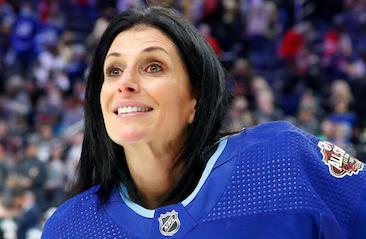
Manon Rhéaume Broke Barriers as NHL’s First Female Player

Manon Rhéaume is a trailblazing figure in ice hockey, best known for being the first woman to play in a major North American men’s professional sports league. Born on February 24, 1972, in Beauport, Quebec, Rhéaume made history in 1992 when she played as a goaltender for the Tampa Bay Lightning in an NHL preseason game. This marked the first and only time a woman competed in an NHL game, breaking barriers in a sport dominated by men.

Rhéaume had a successful career as a goaltender in women’s ice hockey as well. She represented Canada in international competition, winning silver medals at the Women’s World Championships and earning a silver medal at the 1998 Winter Olympics in Nagano, the first-time women’s ice hockey was included in the Olympics.

Her achievements have made her a symbol of progress in sports, inspiring many female athletes to pursue their goals regardless of traditional gender norms in competitive fields.

Manon Rhéaume’s groundbreaking appearance in an NHL game was the result of a combination of her exceptional talent and a strategic move by the Tampa Bay Lightning to generate publicity for their newly formed franchise. Here’s how it came to pass…

Rhéaume had already made a name for herself as a highly skilled goaltender. In 1991, she became the first woman to play in a men’s major junior hockey game, suiting up for the Trois-Rivières Draveurs in the Quebec Major Junior Hockey League (QMJHL). Her performance in men’s leagues drew attention and proved her ability to compete at a high level. She had also excelled in women’s hockey, leading the Canadian national team to world championships and establishing herself as one of the top female goaltenders in the world.

In 1992, the Tampa Bay Lightning were preparing for their inaugural season in the NHL. Team general manager Phil Esposito, a Hall of Fame player, saw an opportunity to make a splash and attract attention to the new team so he invited Rhéaume to the Lightning’s training camp. While the decision was seen by some as a publicity stunt, Rhéaume’s skills and accomplishments justified the invitation. Esposito later insisted that the move was not just a gimmick; Rhéaume had shown she was good enough to play at a high level, and she had earned the chance.

So that’s how it came to be that, on September 23, 1992, Rhéaume made history when she played in a preseason game for the Lightning against the St. Louis Blues. She played one period, stopping seven of nine shots in a solid performance.

Although Rhéaume didn’t continue with the Lightning in the regular season, her participation in the game was a major milestone. She was later signed by minor league teams and continued her career in professional and international women’s hockey through the 1990s and early 2000s. She represented Canada in international competition, including winning a silver medal at the 1998 Nagano Winter Olympics, the first-time women’s ice hockey was included in the Games. She officially retired from professional hockey in 2009. However, her competitive playing career had already slowed down before that point.

After retiring as a player, Rhéaume has remained active in the world of hockey, working in various coaching and mentoring roles. Her legacy continues to inspire many, especially young female players. As of recent years, Rhéaume has been particularly involved in developing youth hockey programs, with a focus on growing opportunities for girls in the sport. She has worked as a coach and mentor for young players, inspiring the next generation of female athletes. She has worked with organizations like the Detroit Red Wings to promote hockey through outreach and youth programs and has served as an ambassador for women’s hockey, frequently appearing at events to support the sport’s growth.

Rhéaume also started the Manon Rhéaume Foundation, which provides scholarships and financial aid to young girls who want to play hockey but face financial barriers. The foundation’s mission aligns with her lifelong dedication to empowering women and girls in sports.

And if all that wasn’t enough, Rhéaume is also active as a motivational speaker, where she shares her story of breaking barriers in the NHL and encourages young people, especially girls, to pursue their dreams, regardless of traditional gender expectations and she occasionally appears in media to discuss her career and to comment on the state of women’s hockey. Manon Rhéaume’s NHL appearance was significant not only for its historical value but also because it opened doors and brought visibility to women’s participation in traditionally male-dominated sports. She will forever remain a significant figure in the NHL, even though she only played in one game.

Going to Cooperstown in 1999

I Can’t Wait! We Are Going to Cooperstown

My heart soared. We were going to take another trip to The Baseball Hall of Fame. One of my favorite places on earth. Just like the first trip to Upstate New York. I wanted to see the likes of Babe Ruth, Lou Gehrig, Honus Wagner, Mickey Mantle, Ty Cobb and Yogi Berra. one more time.

What I saw that day has stayed with me at the depths of my being, to this very day. More about that later.

As we walked into the building in the spring of 1999 I was greeted by two giant size replicas of two great hitters Ted Williams and Babe Ruth. I loved seeing the Babe again. “My friend Babe Ruth. Hello. Hey Ted, you look pretty good.” I remember saying. I found it very interesting that I and most people (if you stood under seven foot five inches) would have to look up to see these two sculptured figures.

My wife and I strolled through the museum looking at the artifacts. We adored the old gloves, spikes, balls, bats and uniforms that were encased in their glass display bins. These items brought me back to a time and place before television, radar guns and luxury boxes. I was getting very nostalgic.

We soon entered the wing that housed the Sammy Sosa, and Mark McGwire artifacts. This Home Run Wing was abundant with Sosa and McGwire memorabilia. This was like being in a home run baseball fantasy park. There were huge posters of both men. There were posters of each man’s list of home runs.. When they hit them and what pitcher gave up that particular home run. There were bats they used in games and balls they hit over the fences Amazing. Never had two major league men hit so many home runs in one year. Upon leaving that wing I could not help but feel overwhelmed by the slugging feats of these two huge men. One a Cub and one a Cardinal.

We continued to stroll through the hall until we came up to a narrow wing that I did not remember from my previous visit. I looked down the left side of the corridor and saw a group of pictures. Hanging from wires, these colorful paintings were displayed at my eye level. Perfect for me. I had to see these pictures. I was compelled. to walk down this aisle. The first picture as I entered the area was of Babe Ruth. His bat was over his shoulder. His face was wrought with age. He looked a little old, a wee bit tired heavy and somewhat overweight. As I stared at the picture I got very sad. I could see that his career was about to end.

Next painting was of Lou Gehrig. A smiling Lou Gehrig. I felt so happy just to be in the presence of one of my all time heroes. Even if it was just a picture. Then there was one of Joe DiMaggio and Ted Williams standing on the dugout steps Their bodies were angled toward each other. I enjoyed the joy they seemed to have just being there. Ready to play another game. There were other paintings one of Jackie Robinson, another of Ty Cobb and another of Honus Wagner that I loved.

Gazing toward the end of the row of paintings I saw a glass case with what looked like a tan baseball glove inside. This seemed very weird in that all the players that were depicted in the paintings were from an era when dark brown gloves were used. . I felt confused. This mitt did not seem to belong here. I just had to see whose glove this was.

I could not believe my eyes. It was not a glove. It was a sculpture of a glove. Perfect in size. Detailed so exact that the grayish colored seams were complete in length width and color. The depth of this piece was ideal What this sculptor had captured amazed me. I thought about the time he invested in creating this piece. About how much this person must have loved baseball that he took the time to mold a piece equipment. I visualized he sitting in his workroom playing with clay to make this piece real. I called my wife to come see this incredible piece. We both were moved. I even cried.

I was given a glimpse of one of the greatest pieces of art I had ever seen. I have been to major museums and have seen painting by Van Gough, Picasso, and Dahli… I have seen the Thinker by Rodin. I have never been moved like I was by the glove.

Whenever I think of the Hall of Fame my mind jumps to the glove. I do not know if this piece is there any more. It did have a price tag of $8500 when I was there so it may have been moved.

But if you get the chance to see the glove I suggest you take a look.

Author Bio
Aron Wallad has been a baseball lover for over 45 years. You will love his honesty and his passion. You will be touched by the heartwarming stories. The unusual statistics will amaze you and the quotes will make you laugh…sometimes. He is the creator of the now defunct ezine www.baseballsprideandjoy.com.

FSM Editorial: COVID & Angels

With COVID-19 forcing people to social distance, our country’s beloved national parks have received a much-needed boost in foot traffic. One of these parks offers a healthy dose of danger and excitement and is more accessible than you might think…

Angels Landing located at Zion National Park in Utah is perhaps the most semi-famous hike in the United States. Many hikers I’ve encountered during my travels have “kind of” heard of it. Common responses are, “That’s the one with the big walls right?” or “The one where people always fall off and die?” My answer to these and similar questions is usually, “Well…kinda.”

Anyone in half decent shape shouldn’t have trouble completing this hike. There is nothing overly strenuous about this trail. The switchbacks leading up to the final leg of the trail are steep but they are also paved which is extremely helpful (not to mention a rarity on this kind of trek).  This section is affectionately known as Walton’s Wiggles. As you hike up the wiggles, you will have solid canyon wall to your left.  To your right, you will have a sliver of a view of the bigger canyon you find yourself in. Depending on the time of day, you will see a different mix of orange, red, and maroon in the rocks with random greenery sprinkled throughout. An avid hiker would probably spend no more than 60 minutes completing this trail through the end of Walton’s Wiggles.

The WW switchbacks lead to a narrow trail that eventually ascends like a staircase to the point of the trail known as Scout’s Lookout. This is where first timers will have an initial glimpse of the behemoth they are about to take on. This is also where people usually start thinking about turning back. I mentioned earlier that this hike is not strenuous which is true. The emotional component to completing this hike cannot be understated however. When you are standing on Scout’s Lookout, gazing at the thin strip of trail that leads up to Angel’s Landing, looking at the thousands of feet of drop-off on each side, there is a good chance your nerves will make the decision of quitting or going on for you. Don’t make a hasty decision though. Use the random outhouse at the lookout if you need a second to compose yourself. Take reassurance knowing that the number of people who have died trying to reach the top is not even in double digits. My point is that’s an extremely low number.

Admittedly, there are a few spots on the way to the top of Angels Landing that could use some chains. But the final portion of trail is well constructed and safe overall. Hold on to the chains whenever available, watch where you step, and resist the urge to take in the scenery until you summit. Once you make it to the top, there is plenty of space to relax safely and admire the beautiful views: giant walls of multi colored rock on both sides with a river curving its way through the canyon floor.

Don’t let any initial fears at Scout’s Lookout prevent you from completing this hike. If you exercise caution and respect your environment, you should be fine. The payoff for crossing the finish line is twofold. You get treated to unimaginable views that few will ever see form that vantage point and you gain the satisfaction of completing what most consider a daunting task. The trail is properly named. If a landing strip for angels really exists in Utah, there is good chance this is it.