Tag Archives: magazine subscriptions

An Extremely Scientific and Not-At-All-Overly-Dramatic Investigation of the Madden Curse

For decades, football fans have debated one of the most important questions in sports—not whether overtime rules are fair, not whether the NFL should bring back those aggressively shiny 2000s jerseys, but something far more urgent: Does the Madden Curse really exist? And more importantly, should star players start refusing EA Sports’ calls the way we all avoid extended car warranties? Let us examine the evidence…

The Case For the Curse

The Madden Curse, in theory, is simple: a player appears on the cover of Madden, and something catastrophic happens the following season. Injury. Bad stats. A sudden inability to catch footballs, or in some cases, the sudden ability to catch only footballs thrown by the other team.

Some examples have become legendary. You can’t talk about the curse without mentioning the dramatic tales of players who went from “unstoppable MVP machine” to “guy on the sideline Googling physical therapy clinics.” Even skeptics have to admit the pattern can look a little spooky—like a sports-themed ghost whispering, “Nice ACL you got there… shame if something happened to it.”

The Case Against the Curse

Skeptics argue that star players get hurt because football is, scientifically speaking, a sport where enormous humans collide at highway speeds. They claim injuries are “normal” and “predictable” and not the result of a digital box with a picture of you pointing heroically into the middle distance.

These skeptics are, of course, no fun at parties.

Scientific Investigation (Not Peer Reviewed; Honestly Not Even Self Reviewed)

In conducting our personal research, we employed cutting-edge methodologies:

* Watching YouTube highlight compilations

* Googling “Is the Madden Curse real??”

* Squinting dramatically at spreadsheets

Our findings are groundbreaking: sometimes players get better after being on the cover. Sometimes they get worse. Sometimes they become memes. In other words, the Madden Curse behaves exactly like my houseplants—occasionally thriving, occasionally collapsing, and completely unpredictable.

Final Verdict

Does the Madden Curse truly exist? Maybe. Maybe not. But it’s definitely fun to blame when your favorite player suddenly forgets how ankles work.

And until science proves otherwise, we should all treat the Madden cover like a mysterious ancient artifact—admire from afar, but maybe don’t touch it unless you’ve recently updated your insurance policy.

So yes, the Madden Curse exists, at least in our hearts, our memes, and the overly dramatic sports takes we write on the internet.

Hakuna Matata: The True Crime Story of Bison Dele in Four Short Chapters

The story of Bison Dele’s death reads like the final chapter of a noir thriller—sun-soaked paradise masking dark secrets, a charismatic ex-athlete yearning for peace, and someone whose jealousy would turn deadly. It’s a story of fame, escape, and the ultimate betrayal, set not in the cold alleys of a city but on the endless blue of the South Pacific.

Chapter 1: The Disappearing Star

Bison Dele wasn’t just another basketball player. Born Brian Carson Williams in 1969, he was a gifted, soulful giant who seemed both drawn to and haunted by fame. After stints with the Orlando Magic, Denver Nuggets, Los Angeles Clippers, and Chicago Bulls—where he won an NBA championship in 1997—Dele walked away at just 30 years old. He turned down millions, choosing freedom over fortune. He traveled the world, learned to play saxophone, and sailed from port to port, often unreachable, as if trying to erase the celebrity that had once defined him.

By 2002, Dele had settled into a quiet life aboard his beloved catamaran, the Hakuna Matata, named for the Swahili phrase meaning “no worries.” He sailed with his girlfriend, Serena Karlan, and occasionally with his older brother, Miles Dabord. Where Bison was introspective and gentle, his brother Miles could be restless, jealous, and increasingly unstable at times.

Chapter 2: Setting Sail

In early July 2002, Dele, Karlan, and Miles departed from Tahiti with their captain, Bertrand Saldo. It was supposed to be a short voyage—just a few days of island hopping. But when the Hakuna Matata failed to return, family and friends began to worry. No distress signals were sent. No sightings were reported. The ocean had seemingly swallowed four people whole.

Then, days later, the Hakuna Matata reappeared—mysteriously docked in Tahiti, piloted by a single man. He called himself “Arlando”—but fingerprints told a darker truth. It was Miles Dabord, alone.

Chapter 3: The Impostor

Dabord told conflicting stories to anyone who would listen. He said the others were “in Tahiti,” and that there had been an “accident.” But his behavior told another story. He forged his brother’s signature to withdraw money from Dele’s accounts. He bought gold. He changed his identity. And when investigators pressed him, his tangled web began to unravel.

Authorities pieced together a chilling narrative: somewhere in the remote waters between Tahiti and Honolulu, Miles had snapped. An argument escalated—possibly over money or control of the boat. In a fit of rage, he struck Serena. When the captain intervened, he was killed too. Finally, Bison—who had always tried to protect those around him—was murdered as well.

Miles, left alone with the aftermath, allegedly weighted their bodies and cast them into the sea, letting the Pacific become their grave.

Chapter 4: The Final Act

By September 2002, the truth was closing in. U.S. authorities tracked Dabord to a hotel in Tijuana, Mexico. He was found unconscious after an apparent insulin overdose—an act of apparent suicide. He never regained consciousness. When he died, so too did any chance of recovering the full truth.

The bodies of Bison Dele, Serena Karlan, and Bertrand Saldo were never found.

Epilogue: The Dream That Sank

In life, Bison Dele sought peace—a life far from the noise of arenas and headlines. He chased freedom across continents, only to be betrayed by a person he trusted to share the journey.

His death remains one of sport’s most haunting mysteries—a story of blood and brotherhood on the high seas, where jealousy drowned love, and paradise turned to nightmare.

The Pacific still rolls on, indifferent and endless. Somewhere beneath it, the echoes of Bison Dele’s final voyage drift with the tides—a reminder that even in paradise, darkness can find its way aboard.

Teddy Roosevelt: The First MMA President?

Theodore “Teddy” Roosevelt, the 26th president of the United States, was a lifelong advocate of physical fitness and athleticism. Throughout his life, he engaged in a wide array of sports—from hiking, horseback riding, and rowing to tennis and jiu-jitsu. However, the sport he was arguably best at—and most passionate about—was boxing. He also had a love for wrestling and the martial arts. This begs the question, was Teddy Roosevelt the first ever MMA president?

Roosevelt began boxing as a student at Harvard University, where he competed as a lightweight. Though he never won any titles, he was known for his grit, determination, and surprising toughness in the ring. He continued boxing recreationally into adulthood, often sparring with younger, more skilled opponents during his political career—even while serving in the White House.

One famous story tells of Roosevelt engaging in a White House sparring match with a young Army artillery officer. The future president, well into his 40s at the time, took a punch so hard that it left him permanently blind in one eye. Yet, he never made a fuss and only quietly stopped boxing afterward, shifting to other sports like jiu-jitsu and hiking.

Boxing symbolized Roosevelt’s philosophy of the “strenuous life”—a belief that hard physical labor and rugged living built character and leadership. While he enjoyed many sports, none captured his spirit of tenacity, courage, and self-discipline quite like boxing.

As previously mentioned, Roosevelt eventually moved away from boxing in favor of other activities such as hiking, climbing, and wrestling. Roosevelt enjoyed jiu-jitsu in particular because much like boxing, it aligned perfectly with his philosophy centered on discipline, toughness, and constant self-improvement. He saw the martial art not only as a form of physical exercise but as a way to sharpen the mind, build character, and cultivate personal courage.

Additionally, being president during a time of increasing U.S.-Japan relations, Roosevelt’s interest in jiu-jitsu reflected his fascination with Japanese culture and martial tradition. He even brought in Japanese experts—like Yoshiaki Yamashita—to teach him and members of his inner circle at the White House.

Roosevelt was the first U.S. president known to study and participate in martial arts. His enthusiasm helped generate early American interest in jiu-jitsu and, later, judo. It’s not a stretch to say he planted the seeds for MMA’s modern day popularity and that if he were president today, he would he be sitting front row at the big UFC events.

Chestnut’s Ban Lifted, Will Return to Hot Dog Contest this Year

The Nathan’s Hot Dog Eating Contest is a uniquely American spectacle—a competitive eating event held every Fourth of July at the original Nathan’s Famous restaurant on Coney Island in Brooklyn, New York. Over the decades, it has grown from a local novelty into a nationally televised cultural event. Its history is a curious blend of patriotism, marketing savvy, and extreme physical endurance.

According to Nathan’s lore, the first contest was held in 1916 when four immigrants competed to prove who was the most patriotic by eating the most hot dogs. While this origin story has since been debunked as a clever piece of marketing invented in the 1970s, it nonetheless set the tone for the contest’s mythology.

The modern era of the contest began in earnest in the early 2000s, when ESPN started broadcasting it live. The rise of competitive eating as entertainment coincided with the reign of Takeru Kobayashi, a Japanese competitor who revolutionized the sport with his technique and stamina. Kobayashi’s arrival in 2001, and his subsequent record-breaking performances, put Nathan’s on the map internationally.

The next chapter in the contest’s evolution was written by Joey Chestnut, a California native who dethroned Kobayashi in 2007 and ushered in a new era of dominance. Chestnut’s feats were nothing short of extraordinary. From 2007 to 2023, he won the contest 16 times, setting multiple world records in the process—including his astonishing 76 hot dogs in 10 minutes in 2021.

Chestnut became synonymous with the event. His relentless training, competitive fire, and ability to perform under pressure earned him the nickname “Jaws” and made him a household name. His duels with other top eaters added drama, but Chestnut often proved untouchable. He became the face of Nathan’s contest and competitive eating itself.

In 2024, however, Joey Chestnut’s long association with the Nathan’s contest came to a sudden and unexpected end. Major League Eating (MLE), the organization that sanctions the event, announced that Chestnut would not be competing due to a sponsorship conflict. Chestnut had signed a promotional deal with Impossible Foods, a company known for its plant-based meat alternatives, including vegan hot dogs.

Nathan’s Famous and MLE viewed this sponsorship as a direct conflict of interest. Nathan’s, which promotes its traditional all-beef hot dogs, reportedly asked Chestnut to drop the Impossible Foods partnership if he wanted to compete. Chestnut declined, stating that he should be able to work with other brands and that he was not under a formal contract that restricted such agreements. This impasse led to his exclusion from the 2024 event.

The public reaction was swift and largely supportive of Chestnut. Many fans and commentators criticized Nathan’s and MLE for what they saw as a shortsighted business decision that prioritized brand protection over honoring the contest’s most iconic figure. Some likened it to banning Michael Jordan from the NBA Finals or Tom Brady from the Super Bowl.

Nathan’s Hot Dog Eating Contest has always been about more than just food—it’s about American tradition, spectacle, and the quirky pursuit of glory. Joey Chestnut embodied that spirit for nearly two decades. For many, Chestnut was a part of their Fourth of July celebrations which is something MLE and Nathan’s probably came to realize when they decided to lift his ban.

In mid‑June, Chestnut confirmed on social media (X) and through various outlets like ESPN, ABC News, and CBS Sports that he will compete in the 2025 contest after missing the 2024 event due to the sponsorship dispute. Chestnut explained that he partners with a variety of companies, including some that are plant‑based, but none of them conflict with his love for hot dogs, and that Nathan’s is the only hot dog brand he’s ever endorsed.

MLE’s president voiced enthusiasm, stating they’re “extremely excited to welcome Joey back…for what will surely be the greatest Nathan’s Famous Hot Dog Eating Contest of all time.”

Chestnut will be pursuing a record 17th title. Fox Sports notes he is the heavy favorite to exceed 71.5 hot dogs in the 10‑minute contest, reflecting strong betting odds.

The Time RoboCop Tried Professional Wrestling

The transition from the 80’s to the 90’s was a wild time. Some would say the best of both worlds were colliding and everyone was along for the ride. Part of that ride was RoboCop’s arrival in World Championship Wrestling (WCW). How can we even begin to explain this? Robocop, a fictional character from the movies, was now somehow real and decided to fight crime in a real sports organization that was really just a fictional sports organization.  

RoboCop showed up in World Championship Wrestling during the 1990 Capital Combat: Return of RoboCop pay-per-view event. This bizarre crossover happened mainly for marketing reasons. At the time, Orion Pictures was about to release the movie RoboCop 2. WCW and Orion worked out a promotional tie-in in which RoboCop would make an appearance at the wrestling event to hype up the film.

In the storyline, RoboCop helped Sting, who was one of WCW’s top stars, fend off an attack from the villainous group known as the Four Horsemen. RoboCop came down to ringside, “bent” the bars of a cage to rescue Sting, and helped him chase the bad guys off.

Fans and critics heavily mocked the segment, and it’s still remembered as one of the most embarrassing and absurd moments in pro wrestling history. The “action” was slow and obviously fake. RoboCop was being portrayed by a guy in a heavy suit (probably not Peter Weller) who could barely move.

So what’s the big deal? Fort starters, RoboCop is a fictional cyborg from a dystopian sci-fi movie — totally out of place in a wrestling environment that, even by 1990s standards, tried to maintain some realism. Arn Anderson was a major member of the Four Horsemen and one of the guys involved in the RoboCop segment. He thought the whole idea was “embarrassing” and made wrestling look like a “clown show”. Arn described the whole thing as “cartoonish” and something that hurt WCW’s credibility, especially when the company was trying to be seen as a more serious alternative to WWF’s over-the-top characters at the time.

Arn Anderson has gone on the record during his “ARN” podcast to share his true thoughts about the infamous RoboCop moment:

“I knew it was horsesh*t from the get-go. How do you fight a robot? Are we supposed to punch him and knock his head off? Are we supposed to sell for him? Run from him? He can’t move! It was one of the most embarrassing things I’ve ever been part of.”

Not pile on, but professional wrestling historian extortionate Jim Cornette also did not hold back when talking about the subject on an old “Kayfabe Commentaries” podcast.  

“It was the stupidest goddamn thing I’d ever seen. Who in the f*** thought RoboCop would draw money in wrestling? It made everyone look like idiots — the wrestlers, the announcers, the fans who had to sit through it. I was embarrassed to even be in the same building.”

Even the eternal optimist Sting (who Robocop saved during the segment) had trouble finding the silver lining. During the episode of “WWE Untold: Sting”, the wrestling icon had this to say about what went down that fateful day:

“I was standing there thinking, ‘Man, I hope nobody I know is watching this.”

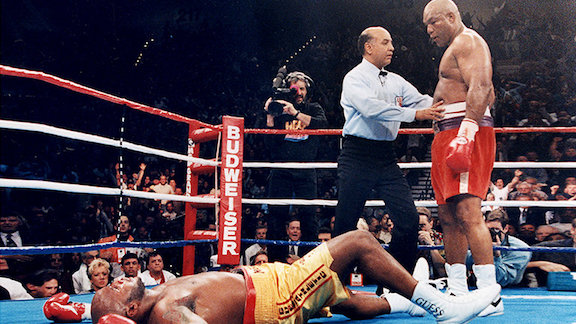
George Foreman's 1994 upset of Michael Moorer

The Three Acts of George Foreman

The Rumble in the Jungle wasn’t just a boxing match—it was the catalyst for one of the greatest transformations in sports history. Instead of breaking George Foreman, the loss ultimately made him a legend in an entirely new way while proving people can actually change. In tribute to the recently departed boxing and pop-culture icon, FreeSportsMagazine.com presents the Three Acts of George Foreman.

Act I: Mean George Foreman

On October 30, 1974, George Foreman entered the ring in Kinshasa, Zaire, as the undefeated heavyweight champion, set to defend his title against Muhammad Ali in what would become one of the most famous boxing matches in history: The Rumble in the Jungle. Foreman, known for his overwhelming power and intimidation, was a heavy favorite. However, by the end of the night, he found himself not only defeated but also on a path that would reshape his life in ways no one could have predicted.

Foreman had dominated his previous opponents, including Joe Frazier and Ken Norton, both of whom he had destroyed in less than two rounds. Many believed Ali wouldn’t last against Foreman’s brutal strength.

However, Ali executed a brilliant strategy—the rope-a-dope—leaning against the ropes, absorbing Foreman’s powerful blows, and letting the younger champion tire himself out. By the eighth round, a drained Foreman left an opening, and Ali capitalized, landing a rapid combination that sent Foreman crashing to the canvas. The world watched in shock as the referee counted Foreman out, giving Ali one of the greatest victories in boxing history.

Losing to Ali was devastating for Foreman. He had built his reputation on invincibility, and this loss shattered his confidence. Foreman later admitted he was deeply depressed following the fight. He struggled to accept the loss, making excuses about unfair conditions, including the heat and a biased referee.

Determined to reclaim his place as champion, Foreman continued fighting. He won several matches but suffered another major defeat to Jimmy Young in 1977. After the Young fight, Foreman claimed he had a near-death experience in the locker room, where he felt as if he was dying and had visions of himself in hell. This moment led him to abandon boxing and dedicate his life to religion.

Act II: Born Again George Foreman

Following his locker-room experience from the Young fight, Foreman retired from boxing at age 28 and became a born-again Christian. He spent the next decade preaching, helping troubled youth, and running a church in Houston, Texas. Many saw this as a shocking transformation for a man once feared as a brutal knockout artist. Even some family members were skeptical.

In need of funds for his youth center, Foreman made an unexpected return to boxing a decade later in 1987. Instead of the scowling destroyer of the ‘70s, he was now “Big George,” a smiling and cheerful fan-favorite known for his humor and humility. He slowly worked his way back into contention and in 1994, at age 45, he completed his redemption arc by knocking out Michael Moorer to regain the heavyweight title, becoming the oldest champion in history. His comeback story was seen as one of the greatest in sports history.

Act III: Spokesman George Foreman

In the midst of this inspiring comeback, Salton, Inc. developed a sloped-surface grill designed to drain fat while cooking. Looking for a marketable celebrity, they approached Foreman, whose friendly, charismatic persona and reputation for power made him the perfect spokesman. Foreman embraced the product, lending his name and image while delivering the famous tagline: “It knocks out the fat!”

The grill became an instant hit, selling millions of units worldwide. At its peak, it was selling 6 million units per year, and in total, over 100 million grills were sold. Foreman’s endorsement deal originally earned him 40% of the profits, but in 1999, he sold his naming rights to Salton for a lump sum of $137.5 million. In total, Foreman made an estimated $200–250 million from the grill—far surpassing his boxing earnings.

Epilogue

George Foreman’s defeat to Ali was the turning point of his life. Though it was painful at the time, it set him on a path to becoming a spiritual leader, comeback hero, and successful businessman. In a heartfelt Instagram post after his passing, Foreman’s family described him as a “devout preacher,” “protector of his legacy,” and a “force for good.”

Murder, Suicide, and the Pro Football Hall of Fame

Jim Tyrer was an American professional football offensive tackle, widely regarded as one of the most dominant players of his era. Born on February 25, 1939, in Newark, Ohio, he attended Newark High School, excelling in track, basketball, and football. He played college football at Ohio State University under head coach Woody Hayes, earning All-America honors.

In 1961, Tyrer signed with the American Football League’s Dallas Texans, who later became the Kansas City Chiefs. Over 13 seasons with the franchise, he played in 180 consecutive games, starting every game of his 11 seasons in Kansas City. Tyrer was a nine-time Pro Bowl selection and a six-time first-team All-Pro. He was instrumental in the Chiefs’ victory in Super Bowl IV, where he and guard Ed Budde opened holes for Chiefs running backs against the Minnesota Vikings’ defensive line.

Following his retirement from football, Tyrer faced financial difficulties. He ran his own company, Pro Forma, representing professional athletes in commercial ventures, which eventually failed. He then worked as a manufacturer’s representative, operated flea market booths, and managed Crown Tire and Alignment, a gas station/tire store, which also failed. In the last months of his life, Tyrer and his wife, Martha, deeply in debt, sold Amway products.

Tragically, in the early morning hours of September 15, 1980, Tyrer shot and killed his wife, Martha, before taking his own life. Three of their four children were in the home at the time. In 2024, research suggested that Tyrer likely suffered from chronic traumatic encephalopathy (CTE) at the time of his death, a condition linked to repeated head injuries.

The revelation of a likely CTE diagnosis led to Tyrer’s consideration as a Seniors finalist for the Pro Football Hall of Fame’s Class of 2025. The nomination alone brings him one step closer to induction, pending approval from at least 80% of the Hall’s Selection Committee during their annual meeting, which will take place in advance of the class unveiling during Super Bowl LIX week in New Orleans.

Advocates for induction, including many former teammates, historians, and fans, argue that Tyrer’s tragic actions at the end of his life were likely influenced by CTE. They contend that understanding CTE provides context for his behavior and should not overshadow his professional accomplishments, which were many. Additionally, many supporters emphasize the importance of recognizing players from the American Football League (AFL) era, during which Tyrer was a main standout.

The skeptics, including some Hall of Fame voters, remain hesitant, citing the lasting impact of his final actions. The circumstances of Tyrer’s death—killing his wife and then himself—make some uncomfortable with honoring him, as it raises questions about the morality of celebrating his legacy. Critics argue that the Hall of Fame should consider a player’s entire legacy, both on and off the field, and that Tyrer’s actions could overshadow his football achievements. Many also worry about setting a precedent for inducting individuals with controversial or criminal histories.

The debate is ongoing, and the decision rests with the Hall of Fame’s Selection Committee next month. The outcome will likely reflect broader discussions about balancing professional achievements with personal conduct in honoring athletes. How would you vote?

The Real-Life Flint Tropics and the Greatest Deal in TV History

The Flint Tropics basketball team from Will Ferrell’s sports comedy classic Semi-Pro is based on an amalgamation of all the teams from the eccentric American Basketball Association (ABA). However, it’s hard to deny that there is one ABA team in particular that seems to make up most of the Tropics’ DNA. While only existing for 2 years, the Spirits of St. Louis made a splash on the sports world during their brief time and somehow ended up with a broadcast television deal that still pays out to this day (more on that later).

Based in St. Louis, Missouri, and playing their home games at the St. Louis Arena, the Spirits existed in the ABA from 1974 to 1976. They were actually one of the last teams to join the ABA. The team’s name was a nod to the Gateway Arch and the city’s aviation history, referencing Charles Lindbergh’s famous plane, the Spirit of St. Louis.

The Spirit team became notable for its colorful players and high-scoring games, consistent with the ABA’s flashy style. The organization’s more entertaining personalities included great player but troubled human, Marvin “Bad News” Barnes and the energetic fledgling (sometimes annoying) announcer Bob Costas. Future hall of famer Moses Malone even logged some minutes with the team.

And if basketball wasn’t your thing, games often featured events for attendees like disco concerts at halftime, Ladies’ Night, or “shooting for cash”. Undoubtedly, a St. Louis version of Dukes from Semi-Pro attempted a half-court shot for cash at some point between 1974 and 1976.

The Tropics’ storyline about struggling to survive the merger with the National Basketball Association (NBA) echoes the real-life challenges faced by ABA teams in 1976. Only four ABA teams were absorbed into the NBA (the Denver Nuggets, Indiana Pacers, New York Nets, and San Antonio Spurs), leaving others to fold or relocate. The Spirits were not among the four teams absorbed. The left-out teams had to either fold or negotiate buyouts.

The owners of the Spirits, Ozzie and Daniel Silna, refused to be bought out and, we’d like to think in the style of Jackie Moon, negotiated a remarkable deal: instead of a lump sum buyout, they retained perpetual rights to a share of future TV revenues from the ABA teams that joined the NBA. The deal entitled the Silnas’ to 1/7th of the TV revenue share received by each of the four former ABA teams that joined the NBA. This worked out to approximately 2% of the NBA’s overall TV revenue.

This seemed like a bold move at the time since TV contracts were very modest and not worth much money. The Silna brothers understood the potential of future television revenue though and resisted that one-time buyout. The ABA agreed to the deal because they thought that 2% would not amount to much cash anyway and they had a merger to complete.

With the arrival of Magic Johnson, Larry Bird, and Michael Jordan, the NBA’s popularity soared and TV contracts exploded in subsequent decades. The Silnas began earning millions annually for a basketball team that no longer even existed.

The NBA naturally had been trying to get out of this deal for a while. In 2014, their wish was granted but at another great cost. A settlement was reached with the Silna brothers to end the perpetual payments. The Silnas reportedly received a lump sum of $500 million while retaining a reduced share of some revenues. It is believed they have earned close to $800 million since the original arrangement was made all those years ago.

The Silna brothers’ deal is a testament to foresight and negotiation skills, as they leveraged a long-term vision over short-term gain. The deal, often called “the greatest deal in sports,” has become a legendary example of how understanding the future potential of a growing industry can result in extraordinary financial returns. The Spirits of St. Louis may have had a short lifespan as a team, but this deal ensured their lasting legacy in sports history.

Like Pro Wrestling? There’s a Cruise for That

The Chris Jericho Cruise, officially known as “Chris Jericho’s Rock ‘N’ Wrestling Rager at Sea”, is a unique event blending professional wrestling, rock music, comedy, and pop culture into a cruise vacation experience. It was conceived by professional wrestler and musician Chris Jericho, and the event has gained a cult following due to its novelty and crossover appeal.

Jericho, a multi-talented entertainer known for his wrestling career in WWE, WCW, AEW, and his band Fozzy, had long been a fan of cruises and wanted to create an event that combined his passions for wrestling, music, and entertainment. The idea was to offer fans a one-of-a-kind experience with live wrestling matches, concerts, meet-and-greets with wrestlers and musicians, podcasts, and comedy shows, all while cruising on the open sea.

The first Chris Jericho Cruise set sail in October 2018 and was a major success, leading to it becoming an annual event. Each cruise typically features a themed name, such as “Part Deux: Second Wave” (2019) and “Triple Whammy” (2021). The event has helped bring wrestling fans and rock enthusiasts together, creating a loyal following. The intimate setting on the cruise ship allows fans to experience their favorite wrestlers and performers in a much more personal and relaxed atmosphere than traditional live shows.

Jericho’s involvement in AEW helped elevate the cruise’s profile even more. AEW has held Dynamite episodes on the cruise, bringing televised matches to the event. This connection has made the Chris Jericho Cruise a significant event for both wrestling and entertainment fans, adding an even greater level of excitement and exposure.

People attending the cruise can look forward to 4 key things that have remained consistent throughout the years and that undoubtedly contribute to the event’s success:

  1. Professional Wrestling Shows: The cruise features live wrestling matches on an outdoor ring set up on the ship’s deck. AEW (All Elite Wrestling) has played a key role in these matches, especially after Jericho joined AEW. Wrestling promotions like Ring of Honor (ROH) and independent promotions also participate. Fans get the chance to witness these matches in a very intimate and unique setting, something they wouldn’t experience in a regular arena.
  2. Music Performances: Jericho’s band Fozzy typically headlines the musical performances. Other bands from the rock and metal scene, as well as guest musicians, perform during the cruise. It’s a big draw for fans of both wrestling and hard rock.
  3. Celebrity Guests and Entertainment: Aside from wrestlers and musicians, the cruise features a variety of other entertainment forms. Guests include comedians, podcasters, and TV personalities, with live shows and panels catering to pop culture fans. Jericho’s own podcast, Talk Is Jericho, often has live episodes recorded on the ship with special guests.
  4. Fan Interaction: One of the highlights of the cruise is the fan interaction. Passengers have opportunities to meet and hang out with wrestlers, musicians, and celebrities. There are autograph signings, meet-and-greets, Q&A panels, and even themed costume nights.

Overall, the Chris Jericho Cruise is a reflection of Jericho’s eclectic career, combining his love for wrestling, music, and entertainment into a unique, highly successful, and fan-centric experience. Find out more at www.chrisjerichocruise.com.

Was the 1988 Death of Bruiser Brody Murder or Self-Defense?

Bruiser Brody, whose real name was Frank Goodish, was a legendary professional wrestler known for his brawling style and wild persona. He was one of the most influential figures in the wrestling industry, especially in Japan and the United States. However, his life was tragically cut short under mysterious and controversial circumstances, leaving pro wrestling fans outraged up to this day.

On July 16, 1988, Bruiser Brody was scheduled to wrestle in a show for the World Wrestling Council (WWC) in Bayamón, Puerto Rico. Before the show, a confrontation occurred between Brody and fellow wrestler José González, who wrestled masked under the name Invader I, in the locker room shower. The details of what transpired during this confrontation are still disputed by all parties, but what is not in dispute is that it ended with González stabbing Brody in the stomach with a knife. Brody was severely injured and was taken to a local hospital, but due to the severity of his injuries and the delay in getting him medical attention, he died in the early hours of July 17, 1988. He was 42 years old.

According to various accounts from witnesses present in the locker room, González asked Brody to come into the shower area to discuss something privately. Shortly afterward, wrestlers heard screams, and when they rushed to the area, they found Brody clutching his stomach, having been stabbed. González was holding the knife, and Brody was in critical condition.

The content of the conversation between Brody and González, and what led González to stab Brody, remains a matter of speculation, as no clear or consistent explanation has ever been provided.

The exact reasons behind why José González, also known as Invader I, killed Bruiser Brody (Frank Goodish) also remain unclear, as the true motivations have never been definitively established. However, there are several theories and pieces of speculation within the wrestling community that attempt to explain the incident.

Some believe that the stabbing was premeditated, while others think it may have been a spur-of-the-moment act driven by anger or fear. The trial and acquittal of González only added to the controversy, as many within the wrestling community felt that justice was not served, partly due to key witnesses not being called to testify.

In the years since the incident, various wrestlers and insiders have given their perspectives, but the true reasons behind why González killed Bruiser Brody remain a mystery, shrouded in the complex and often murky world of professional wrestling politics.

González claimed that he acted in self-defense, and during the trial, he was acquitted of the charges. The trial was seen by many as flawed, with key witnesses, including wrestlers Tony Atlas and Dutch Mantel, who were present during the incident, not being called to testify. Over the years, many possible motives have emerged and continue to be discussed by the wrestling community. The main ones are presented below:

Personal Grudges and Tensions: There were longstanding rumors of personal animosity between Brody and González. Some accounts suggest that Brody and González had a strained relationship due to past professional disagreements or personal issues when Gonzalez tried out for the WWF. In the wrestling business, it’s not uncommon for tensions to arise due to conflicts over booking decisions, pay, or the way matches were conducted.

Brody’s Reputation: Bruiser Brody was known for being a difficult personality in the wrestling business. He was fiercely independent and protective of his character and brand, often clashing with promoters and other wrestlers over how he was booked or how matches were conducted. It’s possible that González, who was also involved in booking for the World Wrestling Council (WWC), felt threatened or disrespected by Brody’s behavior.

Money and Business Disputes: Some have speculated that financial disagreements might have played a role. Brody was a top draw in the territories where he worked, and there could have been disputes over pay or the distribution of earnings, leading to heightened tensions. Some rumors even have him owing up to 5% of the Puerto Rican wrestling promotion.

Fear and Self-Defense: During the trial, González claimed that he acted in self-defense, stating that Brody had become aggressive and that he feared for his life. Given Brody’s size and reputation as a tough and intimidating figure, González’s defense was that he felt physically threatened. That still does not explain why he brought the knife into the shower (wrapped in a towel) before asking Brody to enter the shower and chat.

Professional wrestling fans were deeply affected by Brody’s death. Many wrestlers expressed their belief that justice was not served, and the incident cast a long shadow over the wrestling industry, particularly in Puerto Rico. Brody’s death is still a topic of discussion and debate among wrestling fans and professionals.

Despite the tragic end to his life, Bruiser Brody’s legacy in professional wrestling remains strong. He is remembered as one of the toughest and most influential wrestlers of his era, with a style that has inspired many wrestlers who came after him. His death also served as a reminder of the darker side of the wrestling business and the need for greater protection and rights for wrestlers.

Brody was posthumously inducted into several wrestling halls of fame, including the WWE Hall of Fame in 2019. His influence is still felt in the wrestling world, and his story continues to be told as a cautionary tale of the dangers that can lurk behind the scenes in professional wrestling.