Tag Archives: wwe

The Time RoboCop Tried Professional Wrestling

The transition from the 80’s to the 90’s was a wild time. Some would say the best of both worlds were colliding and everyone was along for the ride. Part of that ride was RoboCop’s arrival in World Championship Wrestling (WCW). How can we even begin to explain this? Robocop, a fictional character from the movies, was now somehow real and decided to fight crime in a real sports organization that was really just a fictional sports organization.  

RoboCop showed up in World Championship Wrestling during the 1990 Capital Combat: Return of RoboCop pay-per-view event. This bizarre crossover happened mainly for marketing reasons. At the time, Orion Pictures was about to release the movie RoboCop 2. WCW and Orion worked out a promotional tie-in in which RoboCop would make an appearance at the wrestling event to hype up the film.

In the storyline, RoboCop helped Sting, who was one of WCW’s top stars, fend off an attack from the villainous group known as the Four Horsemen. RoboCop came down to ringside, “bent” the bars of a cage to rescue Sting, and helped him chase the bad guys off.

Fans and critics heavily mocked the segment, and it’s still remembered as one of the most embarrassing and absurd moments in pro wrestling history. The “action” was slow and obviously fake. RoboCop was being portrayed by a guy in a heavy suit (probably not Peter Weller) who could barely move.

So what’s the big deal? Fort starters, RoboCop is a fictional cyborg from a dystopian sci-fi movie — totally out of place in a wrestling environment that, even by 1990s standards, tried to maintain some realism. Arn Anderson was a major member of the Four Horsemen and one of the guys involved in the RoboCop segment. He thought the whole idea was “embarrassing” and made wrestling look like a “clown show”. Arn described the whole thing as “cartoonish” and something that hurt WCW’s credibility, especially when the company was trying to be seen as a more serious alternative to WWF’s over-the-top characters at the time.

Arn Anderson has gone on the record during his “ARN” podcast to share his true thoughts about the infamous RoboCop moment:

“I knew it was horsesh*t from the get-go. How do you fight a robot? Are we supposed to punch him and knock his head off? Are we supposed to sell for him? Run from him? He can’t move! It was one of the most embarrassing things I’ve ever been part of.”

Not pile on, but professional wrestling historian extortionate Jim Cornette also did not hold back when talking about the subject on an old “Kayfabe Commentaries” podcast.  

“It was the stupidest goddamn thing I’d ever seen. Who in the f*** thought RoboCop would draw money in wrestling? It made everyone look like idiots — the wrestlers, the announcers, the fans who had to sit through it. I was embarrassed to even be in the same building.”

Even the eternal optimist Sting (who Robocop saved during the segment) had trouble finding the silver lining. During the episode of “WWE Untold: Sting”, the wrestling icon had this to say about what went down that fateful day:

“I was standing there thinking, ‘Man, I hope nobody I know is watching this.”

AEW Finds Success in the Land Down Under

AEW Grand Slam: Australia, held on February 15, 2025, at the Brisbane Entertainment Centre, achieved notable success both financially and in terms of viewership. The event generated a gate revenue of $1.3 million, ranking as the third-highest in All Elite Wresting’s history. Attendance figures indicate that approximately 11,000 to 12,000 tickets were distributed, nearing the venue’s capacity of 13,500.

Originally slated for the 52,000-seat Suncorp Stadium, the event was relocated to the Brisbane Entertainment Centre due to reportedly sluggish ticket sales. Despite this change, the event’s financial performance remained strong.

In terms of viewership, the broadcast drew 502,000 viewers, with one million tuning in for the match featuring Kenny Omega and Will Ospreay versus Konosuke Takeshita and Kyle Fletcher. AEW’s leadership expressed satisfaction with these numbers, highlighting the positive momentum leading into the event.

However, some fans expressed dissatisfaction with the event’s promotion and venue change, feeling misled about the scale and nature of the show. Despite these concerns, the event delivered strong financial results and viewership (hitting millions of dollars and at one point millions of viewers), indicating overall success.

AEW Grand Slam: Australia featured several high-profile matches. Below are the results…

AEW Women’s World Championship: “Timeless” Toni Storm defeated Mariah May to capture her record-setting fourth AEW Women’s World Championship.

Tag Team Match: Will Ospreay and Kenny Omega overcame The Don Callis Family’s Konosuke Takeshita and Kyle Fletcher.

TBS Championship: Mercedes Moné successfully defended her title against Harley Cameron.

Brisbane Brawl: Jon Moxley and Claudio Castagnoli defeated Adam Copeland and Jay White in a hard-hitting encounter.

AEW Continental Championship: Kazuchika Okada retained his title against Buddy Matthews.

Was the 1988 Death of Bruiser Brody Murder or Self-Defense?

Bruiser Brody, whose real name was Frank Goodish, was a legendary professional wrestler known for his brawling style and wild persona. He was one of the most influential figures in the wrestling industry, especially in Japan and the United States. However, his life was tragically cut short under mysterious and controversial circumstances, leaving pro wrestling fans outraged up to this day.

On July 16, 1988, Bruiser Brody was scheduled to wrestle in a show for the World Wrestling Council (WWC) in Bayamón, Puerto Rico. Before the show, a confrontation occurred between Brody and fellow wrestler José González, who wrestled masked under the name Invader I, in the locker room shower. The details of what transpired during this confrontation are still disputed by all parties, but what is not in dispute is that it ended with González stabbing Brody in the stomach with a knife. Brody was severely injured and was taken to a local hospital, but due to the severity of his injuries and the delay in getting him medical attention, he died in the early hours of July 17, 1988. He was 42 years old.

According to various accounts from witnesses present in the locker room, González asked Brody to come into the shower area to discuss something privately. Shortly afterward, wrestlers heard screams, and when they rushed to the area, they found Brody clutching his stomach, having been stabbed. González was holding the knife, and Brody was in critical condition.

The content of the conversation between Brody and González, and what led González to stab Brody, remains a matter of speculation, as no clear or consistent explanation has ever been provided.

The exact reasons behind why José González, also known as Invader I, killed Bruiser Brody (Frank Goodish) also remain unclear, as the true motivations have never been definitively established. However, there are several theories and pieces of speculation within the wrestling community that attempt to explain the incident.

Some believe that the stabbing was premeditated, while others think it may have been a spur-of-the-moment act driven by anger or fear. The trial and acquittal of González only added to the controversy, as many within the wrestling community felt that justice was not served, partly due to key witnesses not being called to testify.

In the years since the incident, various wrestlers and insiders have given their perspectives, but the true reasons behind why González killed Bruiser Brody remain a mystery, shrouded in the complex and often murky world of professional wrestling politics.

González claimed that he acted in self-defense, and during the trial, he was acquitted of the charges. The trial was seen by many as flawed, with key witnesses, including wrestlers Tony Atlas and Dutch Mantel, who were present during the incident, not being called to testify. Over the years, many possible motives have emerged and continue to be discussed by the wrestling community. The main ones are presented below:

Personal Grudges and Tensions: There were longstanding rumors of personal animosity between Brody and González. Some accounts suggest that Brody and González had a strained relationship due to past professional disagreements or personal issues when Gonzalez tried out for the WWF. In the wrestling business, it’s not uncommon for tensions to arise due to conflicts over booking decisions, pay, or the way matches were conducted.

Brody’s Reputation: Bruiser Brody was known for being a difficult personality in the wrestling business. He was fiercely independent and protective of his character and brand, often clashing with promoters and other wrestlers over how he was booked or how matches were conducted. It’s possible that González, who was also involved in booking for the World Wrestling Council (WWC), felt threatened or disrespected by Brody’s behavior.

Money and Business Disputes: Some have speculated that financial disagreements might have played a role. Brody was a top draw in the territories where he worked, and there could have been disputes over pay or the distribution of earnings, leading to heightened tensions. Some rumors even have him owing up to 5% of the Puerto Rican wrestling promotion.

Fear and Self-Defense: During the trial, González claimed that he acted in self-defense, stating that Brody had become aggressive and that he feared for his life. Given Brody’s size and reputation as a tough and intimidating figure, González’s defense was that he felt physically threatened. That still does not explain why he brought the knife into the shower (wrapped in a towel) before asking Brody to enter the shower and chat.

Professional wrestling fans were deeply affected by Brody’s death. Many wrestlers expressed their belief that justice was not served, and the incident cast a long shadow over the wrestling industry, particularly in Puerto Rico. Brody’s death is still a topic of discussion and debate among wrestling fans and professionals.

Despite the tragic end to his life, Bruiser Brody’s legacy in professional wrestling remains strong. He is remembered as one of the toughest and most influential wrestlers of his era, with a style that has inspired many wrestlers who came after him. His death also served as a reminder of the darker side of the wrestling business and the need for greater protection and rights for wrestlers.

Brody was posthumously inducted into several wrestling halls of fame, including the WWE Hall of Fame in 2019. His influence is still felt in the wrestling world, and his story continues to be told as a cautionary tale of the dangers that can lurk behind the scenes in professional wrestling.
A Legend in Pro Wrestling Also Had A Small Hollywood Career

Terry funk was a legend in the professional ring. He truly loved the sport and wrestled well into his golden years. After his passing last month, fans have been coming together to share their favorite Terry funk stories and moments. Chainsaw Charlie has been mentioned more than a few times. Many are surprised to find out Funk had small career in Hollywood which included stunt work on Sylvester Stallone’s film Rocky III. Since there are already many stories out there dedicated to Funk’s life and career in the squared circle, FSM is ranking Terry Funk’s Top 4 Movie Roles:

4. The Ringer – In this 2005 comedy, Funk plays a debt collector who gets a little physical with the main character’s (Johnny Knoxville) uncle in order to get some cash that is owed.  

3. Road House – Funk appeared in the 1989 action film Road House in the role of Morgan, a tough bouncer and one of the henchmen working for the film’s antagonist, Brad Wesley, played by Ben Gazzara. Most notably, the film also stars Patrick Swayze as a bouncer named Dalton who is hired to clean up a rowdy bar. Terry Funk’s presence in the film certainly added to the action and intensity of some of the fight scenes.

2. Over the Top – Funk’s role in the 1987 Sylvester Stallone film Over the Top was the character Ruker, a fellow arm wrestler and antagonist to Stallone’s main character, Lincoln Hawk. Over the Top is a sports drama film centered around the world of professional arm wrestling, and Terry Funk’s appearance added to the fighting atmosphere of the movie. The film has become a bit of a cult classic over the years.

1. Paradise Alley – In the film, Terry Funk’s character, Frankie the Thumper, is a professional wrestler. Frankie is one of the wrestlers in the local wrestling circuit that the Carboni brothers, played by Sylvester Stallone (Cosmo), Armand Assante (Lenny), and Lee Canalito (Victor), are involved with. Frankie the Thumper is known for his wrestling skills and is part of the wrestling world that the Carboni brothers navigate as they pursue their dreams and get involved in various wrestling matches and events throughout the film. The film portrays their interactions and challenges within the wrestling community in New York City’s Hell’s Kitchen during the 1940s. Funk also served as the stunt coordinator.

Which was your favorite Terry Funk movie? Did it make our list?

FreeSportsMagazine.com Pays Tribute to the Iron Sheik

The sports world lost a legend on June 7th, 2023 when the Iron Sheik departed the squared circle of life. At 82 years of age, he led a full but often complicated life. What was undisputable was that he was appropriately hated during his time actively wrestling and appropriately beloved during his time after. Free Sports Magazine is proud to offer this tribute to the #1 Jabroni:

The Iron Sheik, born Hossein Khosrow Ali Vaziri on March 15, 1942, is an Iranian-born professional wrestler and former Olympic wrestler. Known for his flamboyant personality and his portrayal of a villainous character in the wrestling world, the Iron Sheik enjoyed a successful career that spanned several decades.

Vaziri’s journey began in his native Iran, where he developed a passion for wrestling. He competed in various international tournaments and even represented Iran in the 1968 Olympic Games. After immigrating to the United States, he continued his wrestling career and gained prominence in the professional wrestling circuit.

In the 1980s, the Iron Sheik rose to superstardom as a member of the World Wrestling Federation (now WWE). With his signature move, the Camel Clutch, and his provocative interviews, he quickly became one of the most hated villains in the industry. His intense rivalry with Hulk Hogan, which culminated in Hogan dethroning him for the WWF Championship in 1984, is often remembered as a defining moment in wrestling history.

Beyond his in-ring persona, the Iron Sheik faced personal struggles, including substance abuse issues, which impacted his career and personal life. However, in later years, he embarked on a path of recovery and found renewed popularity through social media, where his outspoken and often humorous posts endeared him to a new generation of fans.

Perhaps one of the Sheik’s most infamous moments occurred outside the ring. This moment can be revisited with smiles so many years after the fact. It’s One of those crazy stories that undoubtedly get shared at funerals or when friends get together to remember loved ones lost.

In January 1987, a highly publicized incident involving the Iron Sheik (Hossein Khosrow Ali Vaziri) and Jim Duggan occurred, commonly referred to as “The Busted Incident” or “The Sheik-Duggan Arrest.” The incident took place during a time when professional wrestling promotions had a vested interest in preserving the illusion of the wrestlers’ characters outside the ring.

The story goes that on January 23, 1987, Vaziri and Duggan were traveling together in a car for a World Wrestling Federation (now WWE) event. However, they were pulled over by the police in New Jersey for suspected drug possession. During the search, marijuana was found in the vehicle, leading to their arrest.

This incident caused a significant scandal within the wrestling industry at the time. The media coverage exposed the scripted nature of professional wrestling and brought negative attention to the wrestlers involved. The WWF promptly took action, swiftly punishing both wrestlers for their actions.

The Iron Sheik was released from the WWF shortly after the incident, with the company citing his arrest and his behavior as the reasons for his termination. Meanwhile, Jim Duggan received a suspension from the WWF, which was also seen as a disciplinary measure.

While the incident tarnished their public image, both wrestlers eventually managed to rebuild their careers. Jim Duggan, in particular, made a successful comeback and became a beloved figure in the wrestling community. As for the Iron Sheik, he found a new level of popularity in later years, thanks to his outspoken and humorous presence on social media.

At the time of his passing, the Iron Sheik is regarded as a wrestling legend and a cultural icon. His unique blend of charisma, athleticism, and controversial antics left an indelible mark on the wrestling world. Despite the challenges he faced, his enduring legacy will continue to inspire and entertain professional wrestling fans around the globe.

Body Slam: A Forgotten Movie of the Rock ‘n’ Wrestling Era

“Rock ‘n’ Wrestling” refers to a significant crossover between the worlds of professional wrestling and rock music that took place in the 1980s. It primarily revolves around the partnership between the World Wrestling Federation (now WWE) and the music industry, particularly with the involvement of musicians and collaborations with MTV.

During this era, the WWF recognized the potential of combining the popularity of professional wrestling with the mainstream appeal of rock music to create a larger fan base. This led to various initiatives and events that blended the two worlds, resulting in a phenomenon known as “Rock ‘n’ Wrestling.”

One of the key figures in this crossover was Cyndi Lauper, a prominent pop singer of the time. Lauper’s association with professional wrestling began when she appeared as a manager for wrestler Wendi Richter. This led to a storyline feud between Richter and Lauper’s rival manager, Captain Lou Albano, which culminated in a highly publicized match at the inaugural WrestleMania event in 1985.

The success of this collaboration prompted further integration of music and wrestling. The WWF featured rock musicians in their programming, such as Rick Derringer performing “Real American” for Hulk Hogan’s entrance theme. Additionally, the WWF created animated series called Hulk Hogan’s Rock ‘n’ Wrestling, which featured animated versions of wrestlers teaming up with various rock stars in comedic adventures.

The “Rock ‘n’ Wrestling” era represented a significant period of cross-promotion and entertainment convergence, bringing together the larger-than-life personalities of professional wrestling with the energy and appeal of rock music. It played a crucial role in expanding the fanbase of both industries and capturing the pop culture zeitgeist of the 1980s.

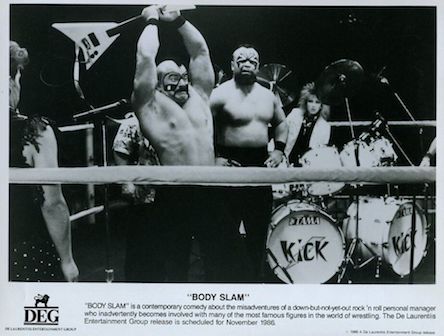
The natural progression of this awesome pairing was to bring the action of pro wrestling and sounds of rock music to the movie screen. However, this is where interest seemed to stop for most people. Perhaps purchasing a ticket and spending a day at the movies was always going to be a bit overkill for fans perfectly happy to watch Cyndi Lauper just have fun from their own living room for or parents who got a free cartoon for their kids every Saturday morning. Whatever the reasons, this effort to hit the big screen ultimately left us with movies like No Holds Barred (which Jim Ross once referred to as No Profits Allowed) and the should be cult-classic Body Slam.

Body Slam was a comedy released in 1986, revolving around a down-on-his-luck music promoter named M. Harry Smilac, played by Dirk Benedict of The A-Team fame. Smilac just happens to get involved in the world of professional wrestling and mischief ensues.

The film follows Smilac as he encounters a washed-up pro wrestler named “Quick” Rick Roberts, portrayed by Rowdy Roddy Piper. Smilac sees an opportunity to combine his love for music and wrestling by managing Quick Rick and a wrestling rock band called Kick at the same time.

With the help of his assistant Candace, played by Tanya Roberts, Smilac sets out to promote Quick Rick and his wrestling partner Tonga Tom, played by Sam Fatu. They embark on a tour with Kick, hoping to achieve success and fame by merging the worlds of music and wrestling. As the story progresses, Smilac faces challenges, including rival wrestling promoters, the constant chaos of managing a group of wrestlers and musicians, and the difficulty of putting on a show that features both live music and wrestling. Of-course the film culminates in a climactic showdown and a high-stakes wrestling match.

Body Slam combines elements of comedy, wrestling action, and music, creating an entertaining story about an unlikely group of characters trying to find success and redemption in their respective fields. Other wrestlers and personalities of note appearing in the film include Captain Lou Albano, Afa Anoai, Barbarian, Billy Barty, John Astin, Fans of The A-Team will especially enjoy this film as Dirk Benedict drives around in a Ferrari in some scenes and is essentially playing the Templeton Peck character (he juggled commitments to both projects during this time). That’s perfectly fine because Rock ‘n’ Wresting is a venture that the Face man would get into to make a buck.

Body Slam was not a financial success. The film was met with negative reviews and failed to attract a significant audience. The movie’s poor performance contributed to its status as a relatively obscure and forgotten film today. While it has gained a small following among fans of professional wrestling and ’80s movies, it hasn’t achieved the same level of cult status as some other films from the era. Its lack of critical acclaim and commercial success prevented it from attaining widespread recognition or a dedicated cult following. This isn’t surprising when thinking about the mainstream audience but perhaps a little more unexpected when considering the fandom of wrestling fans.  

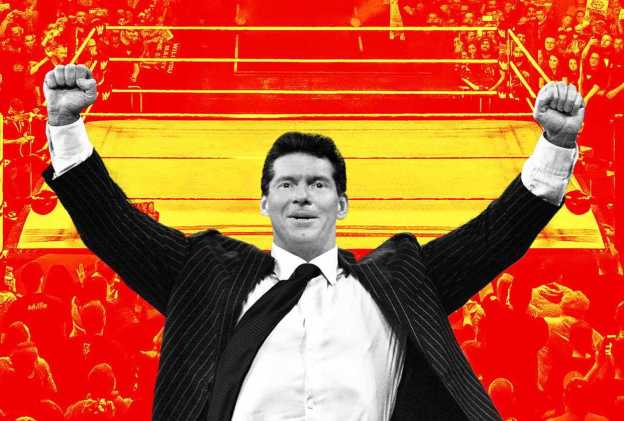
FSM First Look: Ringmaster – Vince McMahon and the Unmaking of America

Even if you’ve never watched a minute of professional wrestling, you are living in Vince McMahon’s world.

In his four decades as the defining figure of American pro wrestling, McMahon was the man behind Dwayne “The Rock” Johnson, “Stone Cold” Steve Austin, John Cena, Dave Bautista, Bret “The Hitman” Hart, and Hulk Hogan, to name just a few of the mega-stars who owe him their careers. For more than twenty-five years, he has also been a performer in his own show, acting as the diabolical “Mr. McMahon”—a figure who may have more in common with the real Vince than he would care to admit.

Just as importantly, McMahon is one of Donald Trump’s closest friends—and Trump’s experiences as a performer in McMahon’s programming were, in many ways, a dress rehearsal for the 45th President’s campaigns and presidency. McMahon and his wife, Linda, are major Republican donors. Linda was in Trump’s cabinet. McMahon makes deals with the Saudi government worth hundreds of millions of dollars. And for generations of people who have watched wrestling, he has been a defining cultural force.

Accessible to anyone, regardless of wrestling knowledge, Ringmaster is an unauthorized, independent, investigative chronicle of Vince McMahon’s origins and rise to supreme power. It is built on exclusive interviews with more than 150 people, from McMahon’s childhood friends to those who accuse him of destroying their lives. Far more than just an athletics or entertainment biography, Ringmaster uses Vince’s story as a new lens for understanding the contemporary American apocalypse.

Ringmaster will be available for purchase on March 28, 2023.

Ringmaster will be available for purchase on March 28, 2023.

FSM Scouting Report: MOX

Book/Movie Title: Mox

Total Pages/Duration: 271 pages (Hardcover)

Author/Director: Jon Moxley

Pace of Play: Inconsistent sums up the pace of this autobiography. Based on the quick hitting prologue, the reader may get the feeling they’re about to buckle in for a wild ride. However, the book ends up feeling more “stop-and-go” by the final few pages. A page turner, this is not. There is never a sense of urgency to find out what’s coming next.

Strengths: The strength of this book comes from Moxley’s raw storytelling. He adds in some jokes and adjectives, but he usually gets to his point rather quickly (it’s just that one point quickly leads to an unrelated point which leads to yet another unrelated story and so on. The good news is that all the tangents are relatively brief). For example, the chapter about the late Brodie Lee starts off simply with, “Brodie died today.” Another chapter about a bully named Scott Baio goes into violent detail about Mox’s first significant fight. 

Weaknesses: The structure of this book is that there is no real structure. At least that’s clear from the beginning which helps the reader prepare. Maybe it was done on purpose to get a sense of what it’s like in Moxley’s head but it’s definitely a weakness in this case. Reading the stream of consciousness of someone who has ADHD can be a double-edged sword. The chapter about Mox receiving his training and paying his dues was surprisingly slow and boring. The tedious detail in that chapter came from out of nowhere. Lastly, professional wrestling books are generally known for some cool glossy photos, usually in the middle of the book. Mox has none. We just get a bunch of random pictures randomly placed, with some randomly in black and white (pretty random right?).

Unique Attributes: This book is unique in that it reads like a collection of short stories about Jon Moxley. One chapter doesn’t always lead into the next (there is a chapter about how to make a sandwich which includes diagrams) but it was a nice experience to read a crazy anecdote here and there over a few weeks. While most stories aren’t about the WWE, the best ones certainly involve Seth Rollins, Roman Reigns and the creation of the Shield.

Scout’s Recommendations: Mox is definitely worth a read if you’re a fan of WWE, AEW, New Japan or any other of the many organizations that exist now. Chances are Jon Moxley has wrestled in most of them and has a story to share. If you’re not a wrestling fan, avoid this one at all costs as it’s just going to be one big confusing mess.

In Los Angeles Debut, AEW Delivers the Dynamite!

All Elite Wrestling (AEW) made its debut in Los Angeles, California last night. The fledgling wrestling organization’s flagship show AEW Dynamite was live from the Kia Forum in sunny southern California and there were definitely some explosions.

The live event came just days after AEW’s Double or Nothing Pay-Per-View which took place in Las Vegas, Nevada on Sunday at the sold-out T-Mobile Arena. Another town and another sell-out as thousands of fans packed the refurbished Kia Forum (old home of the L.A. Lakers) for 2 hours of what turned out to be darn good show.

The good vibes started in the parking lot. Fans with replica belts and t-shirts from all wrestling eras chatted as they made their way into the Forum. Everyone was excited. Everyone was power walking. This was something new and also something that doesn’t roll through Los Angeles often. The buildup to the 5pm show time felt like walking around the lobby at an All-Ages punk row show.

Then 5pm hit (the event was being broadcast live on TBS superstation) and the magic started. Cult of Personality blasted over the speaker and out came the newly crowned AEW World Champion, the hugely popular CM Punk!

CM Punk would fight in a triples tag-team match with FTR minutes later. Just some good ol’ fashioned technical wrestling to open the program and the fans loved every minute. Admittedly, The Best in The World looked winded and sloppy at times. Perhaps he twisted his ankle early on because it looked like his feet kept giving out on him. There was an instance in which Punk delivered something that resembled a power bomb but that was aimed at the bottom ropes (maybe). It’s quite possible he would have killed one of the Gunn boys had Papa Gunn not been standing on the ring apron to prevent his neck from snapping on the ropes.

Perhaps the most bizarre (yet thoroughly entertaining) moment came next. One of the AEW originals, Maxwell Jacob Friedman, or MJF as he is known, descended to the ring and unleashed a scathing promo, essentially calling his boss a loser and demanding to be fired. The bad blood between MJF and company owner Tony Khan has been spilling over into the public the last few months. In a nutshell, MJF feels he is not being paid what he is worth. Most of us can relate. As a fan watching, it was hard to tell what was fact and fiction. Especially when CM Punk limped out (he was wearing only one wrestling boot and appeared to be hurt both physically and emotionally) to try to calm him down. MJF ran out of the ring and into the audience at this point. That didn’t looked planned. Security wasn’t even looking and it was only after about 30 seconds that they were seen scrambling to find him in the crowd. These were clearly real security guards, not the guys Wardlow was beating up every week. MJF looked like he didn’t know where he was going and they never caught up with him. As a side note, we later found out that none of this aired on live television. Anyway, it’s not hyperbole to say this was a Top 10 live promo in wrestling history.

Things briefly felt weird after MJF’s tirade but the action picked up again and it was on with the show. The matches varied from fast and furious, to technical, to sports entertainment style. This brought great balance to the show. The hungry L.A. fans got a quick fix then were able to settle in. Some highlights from the event included the return of Miro, the debut of Fallen Goddess Athena Palmer, a bonkers 10-man tag match, and 2 Wardlow powerbombs.

The Jericho Appreciation Society was also on hand. Like most Jericho angles, it started out lame but is slowly growing on people. They let Judas go on a little longer than usual, maybe because it was Los Angeles!

The night ended with Jon Moxley and his ruthless aggression and a Chris Jericho run-in. A bloodied Mox helped set the stage for the upcoming Blood and Guts show.  

AEW didn’t hit a grand slam with this event but they didn’t botch it either. If this were a college course, they earned a solid A- and it’s safe to say fans left satisfied. Walking back to the car, there was no negative buzz. Of course, it always helps when a guy like Mox takes the time to acknowledge the crowd after the cameras go off.

It felt like AEW and the L.A. fans left a good first impression on each other. Hopefully that means AEW will be back sooner than later.

A Rowdy Guy Who Made Pro Wrestling Fans Smile

In 2015 the world of sports and entertainment lost a legend who passed away far too young. “Rowdy” Roddy Piper died of a heart attack at just 61 years of age. Born as Roderick George Toombs in Saskatoon, Saskatchewan, Canada in 1954, Piper was a professional wrestling superstar whose “Piper’s Pit” interviews were as legendary as his antics in and out of the ring. He was able to morph his career into many areas of entertainment including acting. He appeared in a number of on-screen roles and did cartoon voices, but Roddy is probably best known for playing John Nada in They Live, the John Carpenter science fiction classic that has developed a cult following over the years. Never one to remain in one persona very long Roddy began as a villain wrestler, but often crossed over to being a bit of a hero or good guy of sorts. He also performed as a comedian as late as 2014 and had an impressive following as a podcast show host.

Roddy was primarily of Scottish decent and proud of it as evidenced by the garb he wore into the ring. Although he became expertly adept at playing the Bagpipes at a young age, Piper says he cannot recall how that came about. Roddy does recall how he got his wrestling name. Early in his pro career he walked into the ring wearing a kilt and playing bagpipes. When the announcer forgot the last name he was using, he simply introduced the wrestler as “Roddy the Piper” and the name stuck. Piper’s life was always filled with controversy which began when he was unceremoniously kicked out of Junior High School. He later left home as a young teen after a number of arguments with his father. His dad was a member of the Royal Canadian Mounted Police and always concerned about the family’s reputation. A natural athlete who worked out regularly, Piper managed to find work in any number of gyms which gave him the cash to live in Hostels.

Roddy had a very competitive spirit and began his athletic career as an amateur wrestler, boxer and judo competitor. He eventually won the prestigious Golden Gloves Championship and received a black belt in Judo from American pro wrestler, judo expert and champion Gene LeBell. By the time Piper was just 15 years of age he was ready to turn pro and joined the American Wrestling Association where he gained a reputation as a “bad guy” wrestler. He moved on to the more affluent National Wrestling Alliance in 1975. This organization was huge at that time and produced a number of super stars which included Buddy Rogers, Killer Kowalski, Bobo Brazil, Gene Kiniski, Dory Funk, Dory Funk Jr., Harley Race, Jack Brisco, Dusty Rhodes, Great Malenko, Buddy Colt, Eddie Graham, Sting and Bobby Shane to name just a few.

In the late 1970s to 1983 Piper moved through various pro wrestling territories and went up against top stars like Ric Flair, Jack Brisco, Chavo Guerrero and many others. He was often compared to Freddie Blassie and the two actually met in Madison Square Garden when Piper was given a match in the WWF by Vince McMahon. Blassie stuffed toilet paper in Roddy’s Bagpipes so that he could not play them for the crowd. In 1984 “Rowdy” Roddy Piper moved to McMahon’s Worldwide Wrestling Federal and instantly became a pro wrestling super star due to all the TV coverage the WWF garnered. One would think he was at the top of his career, but this was just the beginning. Piper became so popular and adept at interview skills that he was given his own TV segment called “Piper’s Pit” which became a favorite of WWF fans.

Piper was involved in all sorts of orchestrated mayhem which included feuds that involved WWF stars Captain Lou Albano, Hulk Hogan, Bruno Sammartino Greg Valentine and even Cyndi Lauper. Lauper was allegedly kicked in the head by Piper during an interview and that lead to a major row with Hulk Hogan and Lou Albano (who appeared in Lauper’s “Girls Just Want To Have Fun” music video). That blew up into a major grudge match at WrestleMania. Piper also somehow managed to get into a dispute with Mr. T (from the “A Team” TV Show and the “Rocky 3” film). The two eventually settled their differences by facing off during WrestleMania II. Piper lost after being disqualified for an illegal move. Like many pro wrestling super stars, Roddy Piper was beginning to feel the pain of a few too many injuries and took a year off from the WWF. He returned in 1986 with a revenge when he discovered that his “Piper’s Pit” had been replaced by a show hosted by Adrian Adonis called “The Flower Shop”. Piper appeared on the show, destroyed the set and all this lead to several very popular grudge matches that WWF fans really enjoyed.

By 1989 Roddy was more popular than ever and even hosted a live “Piper’s Pit” during WrestleMania V. An appearance on the show by once popular TV host Morton Downey Jr. turned into a big mess when Piper pointed a fire extinguisher at the always smoking Downey and sprayed him down. As Piper’s popularity continued to grow he began co-hosting Prime Time Wrestling along side pro wrestling legend Gorilla Monsoon. After replacing Bobby Heenan as co-host for the Prime Time show, Roddy and Heenan became fast enemies. Heenan enlisted “Ravishing” Rick Rude and Brother Love to get revenge and several entertaining encounters between the four followed. Brother Love (pro wrestler Bruce Pritchard, manager of The Undertake). Love wore a while suit and had a wrestling character based on some of the more outrageous tele-evangelists of the day. Love took over the TV spot once occupied by “Piper’s Pit” which angered Roddy so much that when he appeared on the show he told Brother Love that he smelled and had bad breath. Piper threw mouthwash and toothpaste in his face.

Although he began scaling back his actual pro wrestling matches, Roddy Piper managed to stay in the thick of things by getting involved in more feuds with competitors like Ted DiBiase (the Million Dollar Man), Jerry “The King” Lawler and Brett Hart. Piper was a regular at the WrestleMania events from 1989 to 1996 and even served as a celebrity referee. Roddy moved to the World Championship Wrestling organization in 1996 and joined in the much watched “Halloween Havoc” and “Starrcade” shows with the likes of Hulk Hogan, Randy Savage and Brett Hart. Roddy later served briefly as the WCW Commissioner. During that reign he had major disputes with Rick Flair, Sid Vicious and Scott Hall. After peaking with the declining WCW, Piper found himself back with the WWF which in 2003 became Worldwide Wrestling Entertainment. That stint included a popular match with Hulk Hogan who, even after he was attacked with a steel pipe by Roddy, won the event.

During an extremely controversial appearance on HBO’s “Real Sports with Bryant Gumbel” Piper admitted that he had taken drugs to remain in the ring over the past twenty years of his career. He also intimated that all or most other pro wrestling stars did the same so that they could continue competing given the injuries they all sustained and pain they felt. This got Roddy fired from Worldwide Wrestling Entertainment. The TAW (Total Action Wrestling) group which included NWA stars, grabbed him up in 2003 despite all the controversy. The move quickly proved to be a good deal for both Piper and the TAW. So much so that Vince McMahon could not ignore Roddy’s new found popularity and soon brought him back to the now huge and still growing Worldwide Wrestling Entertainment in 2005. During that time Piper hosted yet another “Piper’s Pit” live show at WrestleMania 21. That same year he was also inducted into the Worldwide Wrestling Entertainment Wrestling Hall Of Fame. Piper often appeared on the much watched “RAW!” and “SMACKDOWN” Worldwide Wrestling Entertainment TV shows which brought his talent and craziness to the attention of a whole new generation of pro wrestling fans.

From 2003 to 2014 Piper continued to build his popularity with more “Piper’s Pit” shows and various matches and feuds with Ricky Steamboat, Zac Rider, The Miz, Dolph Ziggler and many others. Roddy had a few rough patches during this time which included some injuries he sustained from an auto accident in 2005 and a diagnosis of Hodgkin’s lymphoma in 2007. He recovered from the accident injuries and was said to have been in remission from the lymphoma in 2008 after receiving treatment for nearly a year. As his appearances on the major pro wrestling TV shows wained, Piper still appeared at a number of popular independent pro wrestling events like WrestleReunion joining other famous veterans like Bob Orton Jr. and Terry Funk. Popular MMA and UFC female star competitor Rhonda “Rowdy” Rousey (12 wins, 0 losses as of this writing) met Piper and told him she was a huge fan. She asked if she could use his “Rowdy” moniker and he happily gave her his blessing. She recently dedicated her match against Bethe Correia at UFC 190 to Piper after hearing about his death. She won the match in 34 seconds.

Piper’s final years were spent appearing on various TV shows including “Celebrity Wife Swap” while doing voice overs for popular cartoons, making comedy club appearances and taking on a few more acting gigs along with his pro wrestling duties. He never faded from from public view and even appeared on “Celebrity Ghost Stories”. During that episode he admitted having seen the ghost of his friend and fellow pro competitor Adrian Adonis in 2013. Roddy most recently lived in Portland, Oregon, with his wife Kitty. He had four children: Three daughters and a son. Piper became a Grandfather after his daughter Anastacia recently gave birth. “Rowdy” Roddy Piper passed away as a result of a heart attack on July 31, 2015. This is a common cause of death among former pro wrestling stars. After a lifetime of pushing their bodies to the limit I suppose that their hearts just eventually give out. Regardless of the cause of his death, Piper will be missed by the millions of fans who thoroughly enjoyed his skills and rowdiness in and out of the ring.

Article Source: http://EzineArticles.com/9121260

About the Author: https://ezinearticles.com/expert/William_A._Edwards/1222533