Tag Archives: movies

Rick Fox: From Hardwood to Hollywood

Rick Fox, a name synonymous with basketball during the 1990s and early 2000s, successfully transitioned from a standout NBA career to a noteworthy presence in the entertainment industry.

Born on July 24, 1969, in Toronto, Canada, Fox rose to prominence as a versatile forward for the Boston Celtics and later the Los Angeles Lakers, where he won three NBA championships. Yet, what sets Rick Fox apart from many of his athletic peers is not just his talent on the court, but his remarkable second act as a working actor in film and television.

Fox’s foray into acting began even before his retirement from basketball. He made his film debut in 1994 with a role in Blue Chips, a sports drama that also featured fellow NBA stars like Shaquille O’Neal and Penny Hardaway. This early appearance was a natural extension of his basketball fame, but it signaled the start of something deeper: a genuine interest in performing arts.

Following his retirement from the NBA in 2004, Fox increasingly devoted time to acting. He built an eclectic filmography that spanned drama, comedy, and even holiday fare. Notable roles include Chick Deagan in He Got Game (1998), directed by Spike Lee, and Clyde “Sweet Feet” Livingston in the popular family film Holes (2003). He also played Harry Belton in Tyler Perry’s Meet the Browns (2008), a role that further cemented his credibility among movie-going audiences and helped broaden his appeal beyond sports fans.

One of the most distinctive elements of Fox’s acting career is his willingness to take on diverse and sometimes unexpected roles. In the cult indie film Mini’s First Time (2006), he played a suave character named Fabrizio, showcasing his comedic timing and range. In the action-horror Navy Seals vs. Zombies (2015), he played the Vice President of the United States—a role far removed from the world of sports, reflecting his growing versatility as an actor.

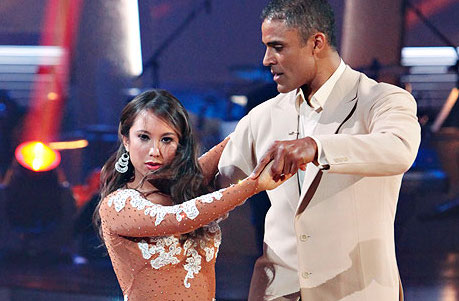
In addition to feature films, Fox has made significant appearances on television. He starred in the HBO prison drama Oz as Jackson Vahue, a storyline that tackled the challenges faced by professional athletes who fall from grace. Later, he played recurring roles on hit series like Ugly Betty and participated in reality shows such as Dancing with the Stars, which broadened his visibility and helped him reach a new generation of viewers.

Fox’s most enduring television role in recent years has been as Detective Ian Jackson in the Morning Show Mysteries series on Hallmark Movies & Mysteries, a franchise that blends suspense with lighthearted charm. His character’s consistent presence has made him a familiar face for mystery movie fans, and the role has become one of his most recognized post-NBA personas.

Rick Fox exemplifies how a career in professional sports can serve as a springboard into a second life in the arts. His journey from Lakers legend to actor is not merely a tale of celebrity crossover but a genuine narrative of reinvention. With over a dozen film roles, numerous television credits, and a steady presence in pop culture, Rick Fox stands as a rare example of a multi-talented performer who has thrived in two intensely competitive worlds.

The Real-Life Flint Tropics and the Greatest Deal in TV History

The Flint Tropics basketball team from Will Ferrell’s sports comedy classic Semi-Pro is based on an amalgamation of all the teams from the eccentric American Basketball Association (ABA). However, it’s hard to deny that there is one ABA team in particular that seems to make up most of the Tropics’ DNA. While only existing for 2 years, the Spirits of St. Louis made a splash on the sports world during their brief time and somehow ended up with a broadcast television deal that still pays out to this day (more on that later).

Based in St. Louis, Missouri, and playing their home games at the St. Louis Arena, the Spirits existed in the ABA from 1974 to 1976. They were actually one of the last teams to join the ABA. The team’s name was a nod to the Gateway Arch and the city’s aviation history, referencing Charles Lindbergh’s famous plane, the Spirit of St. Louis.

The Spirit team became notable for its colorful players and high-scoring games, consistent with the ABA’s flashy style. The organization’s more entertaining personalities included great player but troubled human, Marvin “Bad News” Barnes and the energetic fledgling (sometimes annoying) announcer Bob Costas. Future hall of famer Moses Malone even logged some minutes with the team.

And if basketball wasn’t your thing, games often featured events for attendees like disco concerts at halftime, Ladies’ Night, or “shooting for cash”. Undoubtedly, a St. Louis version of Dukes from Semi-Pro attempted a half-court shot for cash at some point between 1974 and 1976.

The Tropics’ storyline about struggling to survive the merger with the National Basketball Association (NBA) echoes the real-life challenges faced by ABA teams in 1976. Only four ABA teams were absorbed into the NBA (the Denver Nuggets, Indiana Pacers, New York Nets, and San Antonio Spurs), leaving others to fold or relocate. The Spirits were not among the four teams absorbed. The left-out teams had to either fold or negotiate buyouts.

The owners of the Spirits, Ozzie and Daniel Silna, refused to be bought out and, we’d like to think in the style of Jackie Moon, negotiated a remarkable deal: instead of a lump sum buyout, they retained perpetual rights to a share of future TV revenues from the ABA teams that joined the NBA. The deal entitled the Silnas’ to 1/7th of the TV revenue share received by each of the four former ABA teams that joined the NBA. This worked out to approximately 2% of the NBA’s overall TV revenue.

This seemed like a bold move at the time since TV contracts were very modest and not worth much money. The Silna brothers understood the potential of future television revenue though and resisted that one-time buyout. The ABA agreed to the deal because they thought that 2% would not amount to much cash anyway and they had a merger to complete.

With the arrival of Magic Johnson, Larry Bird, and Michael Jordan, the NBA’s popularity soared and TV contracts exploded in subsequent decades. The Silnas began earning millions annually for a basketball team that no longer even existed.

The NBA naturally had been trying to get out of this deal for a while. In 2014, their wish was granted but at another great cost. A settlement was reached with the Silna brothers to end the perpetual payments. The Silnas reportedly received a lump sum of $500 million while retaining a reduced share of some revenues. It is believed they have earned close to $800 million since the original arrangement was made all those years ago.

The Silna brothers’ deal is a testament to foresight and negotiation skills, as they leveraged a long-term vision over short-term gain. The deal, often called “the greatest deal in sports,” has become a legendary example of how understanding the future potential of a growing industry can result in extraordinary financial returns. The Spirits of St. Louis may have had a short lifespan as a team, but this deal ensured their lasting legacy in sports history.

Body Slam: A Forgotten Movie of the Rock ‘n’ Wrestling Era

“Rock ‘n’ Wrestling” refers to a significant crossover between the worlds of professional wrestling and rock music that took place in the 1980s. It primarily revolves around the partnership between the World Wrestling Federation (now WWE) and the music industry, particularly with the involvement of musicians and collaborations with MTV.

During this era, the WWF recognized the potential of combining the popularity of professional wrestling with the mainstream appeal of rock music to create a larger fan base. This led to various initiatives and events that blended the two worlds, resulting in a phenomenon known as “Rock ‘n’ Wrestling.”

One of the key figures in this crossover was Cyndi Lauper, a prominent pop singer of the time. Lauper’s association with professional wrestling began when she appeared as a manager for wrestler Wendi Richter. This led to a storyline feud between Richter and Lauper’s rival manager, Captain Lou Albano, which culminated in a highly publicized match at the inaugural WrestleMania event in 1985.

The success of this collaboration prompted further integration of music and wrestling. The WWF featured rock musicians in their programming, such as Rick Derringer performing “Real American” for Hulk Hogan’s entrance theme. Additionally, the WWF created animated series called Hulk Hogan’s Rock ‘n’ Wrestling, which featured animated versions of wrestlers teaming up with various rock stars in comedic adventures.

The “Rock ‘n’ Wrestling” era represented a significant period of cross-promotion and entertainment convergence, bringing together the larger-than-life personalities of professional wrestling with the energy and appeal of rock music. It played a crucial role in expanding the fanbase of both industries and capturing the pop culture zeitgeist of the 1980s.

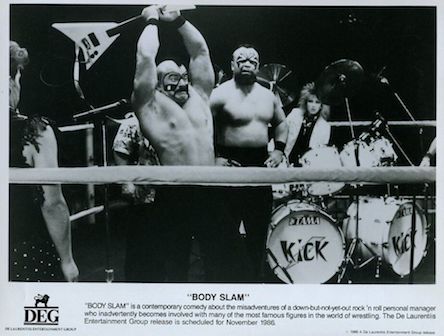
The natural progression of this awesome pairing was to bring the action of pro wrestling and sounds of rock music to the movie screen. However, this is where interest seemed to stop for most people. Perhaps purchasing a ticket and spending a day at the movies was always going to be a bit overkill for fans perfectly happy to watch Cyndi Lauper just have fun from their own living room for or parents who got a free cartoon for their kids every Saturday morning. Whatever the reasons, this effort to hit the big screen ultimately left us with movies like No Holds Barred (which Jim Ross once referred to as No Profits Allowed) and the should be cult-classic Body Slam.

Body Slam was a comedy released in 1986, revolving around a down-on-his-luck music promoter named M. Harry Smilac, played by Dirk Benedict of The A-Team fame. Smilac just happens to get involved in the world of professional wrestling and mischief ensues.

The film follows Smilac as he encounters a washed-up pro wrestler named “Quick” Rick Roberts, portrayed by Rowdy Roddy Piper. Smilac sees an opportunity to combine his love for music and wrestling by managing Quick Rick and a wrestling rock band called Kick at the same time.

With the help of his assistant Candace, played by Tanya Roberts, Smilac sets out to promote Quick Rick and his wrestling partner Tonga Tom, played by Sam Fatu. They embark on a tour with Kick, hoping to achieve success and fame by merging the worlds of music and wrestling. As the story progresses, Smilac faces challenges, including rival wrestling promoters, the constant chaos of managing a group of wrestlers and musicians, and the difficulty of putting on a show that features both live music and wrestling. Of-course the film culminates in a climactic showdown and a high-stakes wrestling match.

Body Slam combines elements of comedy, wrestling action, and music, creating an entertaining story about an unlikely group of characters trying to find success and redemption in their respective fields. Other wrestlers and personalities of note appearing in the film include Captain Lou Albano, Afa Anoai, Barbarian, Billy Barty, John Astin, Fans of The A-Team will especially enjoy this film as Dirk Benedict drives around in a Ferrari in some scenes and is essentially playing the Templeton Peck character (he juggled commitments to both projects during this time). That’s perfectly fine because Rock ‘n’ Wresting is a venture that the Face man would get into to make a buck.

Body Slam was not a financial success. The film was met with negative reviews and failed to attract a significant audience. The movie’s poor performance contributed to its status as a relatively obscure and forgotten film today. While it has gained a small following among fans of professional wrestling and ’80s movies, it hasn’t achieved the same level of cult status as some other films from the era. Its lack of critical acclaim and commercial success prevented it from attaining widespread recognition or a dedicated cult following. This isn’t surprising when thinking about the mainstream audience but perhaps a little more unexpected when considering the fandom of wrestling fans.  

Athletes that Deserve a Movie, and the Actors that Should Portray Them

(PointSpreads.com) – Not all heroes wear capes. Many of them wear football pads, cleats, sneakers, and skates, and some even carry a bat or a stick. We’re talking about transcendent athletes who can make the jump from the field of battle to the silver screen.
With the release of Air – a movie inspired by Michael Jordan – PointSpreads.com, known for its reporting on the latest sports betting news (and the latest point spreads, of course), has compiled a shortlist of athletes whose larger-than-life personas, accomplishments or backstory would be worthy of the big screen – as well as the best actor to portray each one.   Which athlete will be the subject of the next Hollywood megahit?

“That sounded like a fun bet, so we decided to put some odds to it,” says Robert Jones, a former bookmaker at a major sportsbook and senior contributor at PointSpreads. 

Tom Brady

Now that he’s retired, Brady is the glamor boy who showed the world he was much more than a pretty face. Brady had a career spanning two decades, rarely got injured, and has more records than Motown.

A handsome face and an ‘aw-shucks’ demeanor is what is needed to play the seven-time Super Bowl champ. So, who is the perfect fit? We believe Arnold Schwarzenegger’s son, Patrick, would be the man to do justice to the role, according to PointSpreads.com.

“We think Brady has great odds of a Hollywood portrayal of his life and career.  The man is a legend.  The consensus around our office would be +300, or 3-to-1 odds, just behind Kobe Bryant,” Jones says.

Kobe Bryant

The Black Mamba needs to be memorialized in film, and not just any movie, but one that will stand the test of time. An all-time classic with superb directing and cinematography worthy of capturing one of the most electrifying ball players ever to grace the hardcourt.

His tragic death, made even more heart-wrenching when his 13-year-old daughter, Gianna, and seven other souls lost their lives in a plane crash on that fateful day in January of 2020, will have the audience misty-eyed and searching for Kleenex. PointSpreads.com’s pick to play Kobe is Michael B. Jordan. 

“There must be a Kobe film coming. I’d give it +150 odds,” Jones says.

Conor McGregor

Another celebrity that is no stranger to the pages of PointSpreads.com is Conor McGregor. Love him or hate him, it’s impossible to ignore him. The Irish MMA superstar exploded onto the scene with outrageous trash-talking and a unique fighting style that seamlessly blended a hammer-fisted boxing approach with the nuanced techniques of capoeira, an Afro-Brazilian martial art rarely seen within the confines of the Octagon.

McGregor is a natural southpaw but can switch to orthodox at the drop of a dime and his Billionaire Strut, fashioned after WWE founder Vince McMahon’s imperious swagger, is cinematic gold. Tom Hardy, an acclaimed martial arts practitioner himself, gets the gig with no audition required.

“McGregor’s personality, backstory and Irish heritage appeal to a big demographic and there must be a producer in Hollywood wanting to make this happen.  I’d give it a solid +450,” Jones says.

Simone Biles

Considered to be the greatest gymnast in the history of the sport, Simone Biles is a 4’8” pixie mounted on a pair of hydraulic lifts and a body of twisted steel that allows her to do what few others have been able to do.

Seven Olympic and 25 World Championship medals comprise her gymnastics resume but the Presidential Medal of Freedom awarded to her by Joe Biden in 2022 reflects how truly transcendent and entrenched in the fabric of American culture she has become. Marsai Martin has our full support to recreate the wonder that is Simone Biles on the big screen.

“Simone captured our hearts and attention and any movie about her would most certainly be well received.  I’d give it 6-to-1, or +600 odds that we’ll be seeing a trailer with her likeness in the near future,” Jones says.   

Image credit: Brian BAHR / AFP (PointSpreads.com)

FSM Movies: Escape to Victory

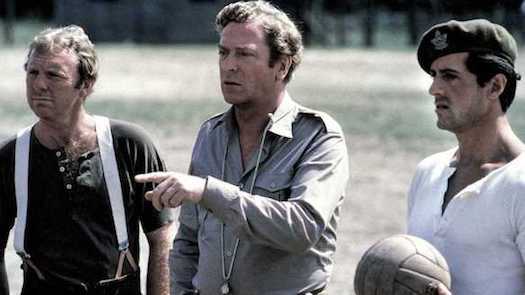
Sylvester Stallone is the gift that keeps on giving. Younger movie fans get the gift of discovering classic after classic as if each one was brand new. Older fans, who have the Rocky films memorized already, get the gift of quirky new projects and random appearances in things like the Marvel Universe. This review is more for the younger fans who may be aware that Stallone ended communism in Rocky IV but didn’t know he also helped end fascism by playing soccer in the movie Escape to Victory.

Headlined by the loveable Sir Michael Cane and directed by Hollywood legend John Huston, Victory was released to the masses in 1981. Since this film fell under the rare “War/Sport” genre, it made sense to cast Sylvester Stallone as he had recently played war hero John Rambo and boxing underdog Rocky Balboa.

In Victory, Stallone plays a World War II era prisoner-of-war named Captain Robert Hatch. He spends most days watching the cooler prisoners kick a soccer ball around before ending up as the team’s unlikely goalkeeper. These cooler prisoners were made up of actual soccer stars of the time such as Pelé, Bobby Moore, and Robin Turner.

For some strange reason in the film, a high-ranking Nazi officer played by Max von Sydow thinks it would be great for morale around the world to have these allied prisoners-of-war (who happen to be really really good at soccer) play an exhibition match against a German super team. Of course, the match is intended to be used as propaganda and perhaps a symbol of how Germany would crush the allies in war. Movie fans can probably guess that Stallone, Caine, and the rest of the allies put up a heck of a fight on the field. But a dilemma arises when the players have a chance to escape. This is when the movie gets especially enjoyable.

Victory is a pleasant ride from start to finish. The film presents many WW-II themes but with a lighter touch – something that’s perfect for a war movie about soccer! Additionally, the great chemistry of all cast members is evident from the opening few scenes. Stallone shines in a role that may have been written with him in mind. Pelé seems like a natural actor. The other professional footballers don’t try too hard (in a good way). And Michael Caine and Max von Sydow absolutely carry the movie. A younger Caine brings his spunky energy as the leader of the allies while von Sydow’s acting almost makes you feel bad for a Nazi.

While the subject matter and era are taken seriously, Victory feels like it could be the child of The Dirty Dozen and The Replacements. It’s not quite a war or sports movie and doesn’t necessarily try to inform the viewer of anything that’s not already known. But it’s a fun story you’ve probably never experienced before. Its ending is also one of the most underrated endings in sports movie history (no spoilers here except that Stallone is involved).

FSM Final Grade: B

Click here to purchase Victory today!

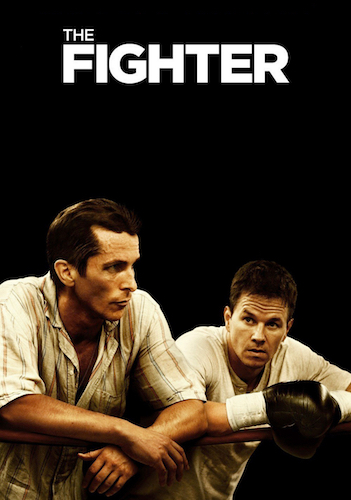
FSM Movies: The Fighter Turns 10

FSM revisits this Bostonian boxing saga nearly a decade after its release. This review was originally published on freesportsmagazine.com in December 2010.

Based on the life of boxing favorite “Irish” Mickey Ward, The Fighter fails to deliver the knockout blow which could have made it an instant classic with moviegoers this holiday season. Much like Ward’s professional career, The Fighter flirts with greatness but falls just a hair short when all is said and done.

The timeline and some of the events presented in this tale are inaccurate but nothing that is too atypical for a movie “based on a true story.” Overall, The Fighter gets the point across and the viewer leaves the theater with a good Cliff’s Notes version of the Mickey Ward story.

For a movie about a fast paced sport like boxing, this film trudges along at a snail’s pace. The fighting scenes are spectacularly exhilarating though they are few and far between and when they do pop up, they are short lived. The bulk of this film is a series of surreal interactions between Mickey Ward , his family, and of course the obligatory love interest.

This is definitely not the first boxing movie that is not about boxing. The original Rocky film did an excellent job of telling a love story using the darker side of the sport as a backdrop. The Fighter attempts to employ the same strategy but there is simply too much going on in the movie. Is this film about a dysfunctional family? A drug addict brother? A man who has lost the belief in himself? By trying to go in so many different directions, the movie spreads itself thin and ends up lacking in substance.

In terms of acting, there are a few strong performances, most notably Christian Bale as Dickie Ekland, the half-brother of Mickey Ward who is battling crack addiction. Melissa Leo (of Homicide: Life on the Street fame) also delivers as Ward’s mother who is both loveable and annoying to the viewer, often time simultaneously. And Mark Wahlberg is his typical, average, muscular self.  He does well during the tough guy scenes and fails miserably when trying to invoke that sense of drama which really would have made this flick reach the next level.

Despite all the hype and Golden Globe nominations (it seems like the only prerequisite these days to get nominated is that a film is released in December), The Fighter is a movie you can wait to see in the comfort of your own home for a fraction of the price.

FreeSportsMag gives The Fighter a grade of C+