Tag Archives: movie review

“Major League” and the Power of the Underdog

At the beginning of 1989’s Major League, the audience is shown a montage of newspaper headlines of the Cleveland Indians baseball team on a losing streak. The montage sets a pretty somber tone at first of a city in a rough spot. But more importantly it establishes the Cleveland Indians as a classic case of a rag-tag team of misfits that people, even some of their own teammates, don’t take seriously. David S. Ward said he wrote Major League because it was “the only way I would see the Indians win a World Series” and it definitely feels like a celebration of an underdog team. It transcends the traditional sports movie by, intentionally or not, becoming a story of the value of diversity in America, and while some elements haven’t aged particularly well, it’s still an interesting statement disguised as a goofy sports comedy.

The film begins with the wife of a recently deceased former owner inheriting the Cleveland Indians. She hatches a plan to move the team to Las Vegas by gathering up some of the worst players in the league. Naturally, this new move worries the actual players. The players they bring in include a convicted felon (Charlie Sheen), a voodoo priest (Dennis Haysbert), and some guy who showed up uninvited but ends up as one of the best runners in the league (Westley Snipes). It fits right in with Guardians of the Galaxy, The Suicide Squad, among other movies that are about a rag tag team of misfits working together; and despite some of the more problematic and stereotypical elements, the film still works because it depicts these people as some of the more likable players on the team. These personalities clash and create conflict that doesn’t feel unlike the types of arguments between different backgrounds of people in the United States. The main plot of a rag-tag team of misfits is as old as the country itself. One particular subplot involves the voodoo priest being harassed by another player on the team who doesn’t know how to accept other people’s religion. Despite the voodoo priest character being a stereotype, the audience is 100% on his side.

However, some of the film’s more satirical elements, specifically the character of the new owner of the team, could’ve used a couple more rewrites to make them less cartoonish. The character of Rachel Phelps, the team’s new owner, feels like a two dimensional corporate stooge, especially after a TV show like Ted Lasso retooled a similar character and made her into someone who feels like a complex but still very flawed person. She feels like she exists inside of a bubble and only interacts with members of the team for a climactic argument towards the end of the film, making her more of a plot device than a character. This is made worse by a scene involving a cardboard cutout of this character being sexually objectified.

Additionally, because this is a fantasy, this results in the film occasionally being a little too cheery for its own good despite some of the more satirical elements. The protagonist, Jake (Tom Berenger)’s ex-wife, a former athlete named Lynn (Renee Russo) is engaged to a pompous rich oaf who has no respect for her, and now that Jake has also re-entered her life, she has to contend with him being incredibly annoying in trying to win her back. His main goal in the film is to get back together with her by becoming a high ranking baseball player. It’s clear that this is a fantasy, but he doesn’t learn anything by the end of it. His wife calls off the engagement, but she should have walked away from both of these guys and gone on to become a great athlete on her own. Instead, she smiles at Jake from the crowded baseball stands, indicating the two of them are going to get back together. This subplot could have said something far deeper about the cost of ambition by providing a dark counterpoint to a goofy comedy, but it goes in a feel-good romance direction that ends up clashing against the more satirical elements. It doesn’t feel like the movie wants to fully commit to some of the ideas that could’ve made it an all time classic satire, rather than just a pretty enjoyable piece of late 80’s comedy

Overall, despite some hiccups, Major League is a more clever movie than the viewer might assume for a mainstream comedy from that time. It arguably avoids the pitfalls of 80’s comedy stereotyping in some areas by making said characters incredibly competent at the sport. And while some elements haven’t aged particularly well, it more than laid the groundwork for successful sports comedies after it.

Author: Dylan James
Body Slam: A Forgotten Movie of the Rock ‘n’ Wrestling Era

“Rock ‘n’ Wrestling” refers to a significant crossover between the worlds of professional wrestling and rock music that took place in the 1980s. It primarily revolves around the partnership between the World Wrestling Federation (now WWE) and the music industry, particularly with the involvement of musicians and collaborations with MTV.

During this era, the WWF recognized the potential of combining the popularity of professional wrestling with the mainstream appeal of rock music to create a larger fan base. This led to various initiatives and events that blended the two worlds, resulting in a phenomenon known as “Rock ‘n’ Wrestling.”

One of the key figures in this crossover was Cyndi Lauper, a prominent pop singer of the time. Lauper’s association with professional wrestling began when she appeared as a manager for wrestler Wendi Richter. This led to a storyline feud between Richter and Lauper’s rival manager, Captain Lou Albano, which culminated in a highly publicized match at the inaugural WrestleMania event in 1985.

The success of this collaboration prompted further integration of music and wrestling. The WWF featured rock musicians in their programming, such as Rick Derringer performing “Real American” for Hulk Hogan’s entrance theme. Additionally, the WWF created animated series called Hulk Hogan’s Rock ‘n’ Wrestling, which featured animated versions of wrestlers teaming up with various rock stars in comedic adventures.

The “Rock ‘n’ Wrestling” era represented a significant period of cross-promotion and entertainment convergence, bringing together the larger-than-life personalities of professional wrestling with the energy and appeal of rock music. It played a crucial role in expanding the fanbase of both industries and capturing the pop culture zeitgeist of the 1980s.

The natural progression of this awesome pairing was to bring the action of pro wrestling and sounds of rock music to the movie screen. However, this is where interest seemed to stop for most people. Perhaps purchasing a ticket and spending a day at the movies was always going to be a bit overkill for fans perfectly happy to watch Cyndi Lauper just have fun from their own living room for or parents who got a free cartoon for their kids every Saturday morning. Whatever the reasons, this effort to hit the big screen ultimately left us with movies like No Holds Barred (which Jim Ross once referred to as No Profits Allowed) and the should be cult-classic Body Slam.

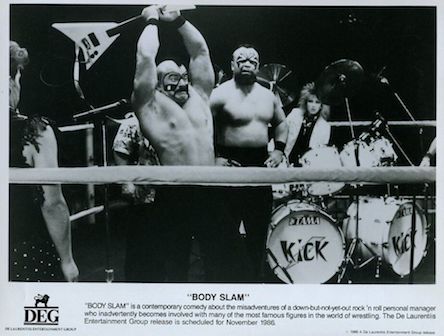
Body Slam was a comedy released in 1986, revolving around a down-on-his-luck music promoter named M. Harry Smilac, played by Dirk Benedict of The A-Team fame. Smilac just happens to get involved in the world of professional wrestling and mischief ensues.

The film follows Smilac as he encounters a washed-up pro wrestler named “Quick” Rick Roberts, portrayed by Rowdy Roddy Piper. Smilac sees an opportunity to combine his love for music and wrestling by managing Quick Rick and a wrestling rock band called Kick at the same time.

With the help of his assistant Candace, played by Tanya Roberts, Smilac sets out to promote Quick Rick and his wrestling partner Tonga Tom, played by Sam Fatu. They embark on a tour with Kick, hoping to achieve success and fame by merging the worlds of music and wrestling. As the story progresses, Smilac faces challenges, including rival wrestling promoters, the constant chaos of managing a group of wrestlers and musicians, and the difficulty of putting on a show that features both live music and wrestling. Of-course the film culminates in a climactic showdown and a high-stakes wrestling match.

Body Slam combines elements of comedy, wrestling action, and music, creating an entertaining story about an unlikely group of characters trying to find success and redemption in their respective fields. Other wrestlers and personalities of note appearing in the film include Captain Lou Albano, Afa Anoai, Barbarian, Billy Barty, John Astin, Fans of The A-Team will especially enjoy this film as Dirk Benedict drives around in a Ferrari in some scenes and is essentially playing the Templeton Peck character (he juggled commitments to both projects during this time). That’s perfectly fine because Rock ‘n’ Wresting is a venture that the Face man would get into to make a buck.

Body Slam was not a financial success. The film was met with negative reviews and failed to attract a significant audience. The movie’s poor performance contributed to its status as a relatively obscure and forgotten film today. While it has gained a small following among fans of professional wrestling and ’80s movies, it hasn’t achieved the same level of cult status as some other films from the era. Its lack of critical acclaim and commercial success prevented it from attaining widespread recognition or a dedicated cult following. This isn’t surprising when thinking about the mainstream audience but perhaps a little more unexpected when considering the fandom of wrestling fans.  

FSM Scouting Report: 30 For 30 Shark

Book/Movie Title: 30 For 30: Shark

Total Pages/Duration: 76 minutes

Author/Director: Jason Hehir & Thomas Odelfelt

Pace of Play: Watching this documentary is similar to playing 18 holes of golf. Kind of dull for the most part but you do get some great moments of interest and excitement mixed in. While this doc clocks in just under 80 minutes, it feels like you’ve been watching for 2 hours by the time the credits roll.

Strengths: The strength of this documentary lies in the accessibility of Greg Norman. He takes on all questions about “choking” and even takes a literal walk through the Master’s course at Augusta, home of his 1996 heartbreak. He’s honest but also seems like he’s in denial. An honest denial? While the viewer gets a condensed back story and buildup, this documentary is really all about that 1996 choke job.

Weaknesses: Maybe we were spoiled by The Last Dance because there was no true drama in this doc. At times, things got boring. Norman’s low volume monotone voice didn’t help matters.

Unique Attributes: One the director’s is the same person who directed The Last Dance. There are some noticeable similarities in styles of each film.

The loveable Jack Nicklaus makes appearances throughout this documentary with some great insights. Always classy never sassy. Scott Van Pelt (SVP) also pops up often.

A montage of Norman driving Ferraris and riding on to golf courses on helicopters was perfectly set to ZZ Top’s Sharp Dressed Man. Some would say it’s the highlight of the entire film.  

Scout’s Recommendations: Subscribers of ESPN+ have access to this film and should definitely consider giving it a stream. It’s not really a film just for golf fans – most people will be able to relate to that moment of truth in their own life. Did they pull through under pressure or did they just pull a Shark?

Find out more about 30 For 30: Shark by clicking here.

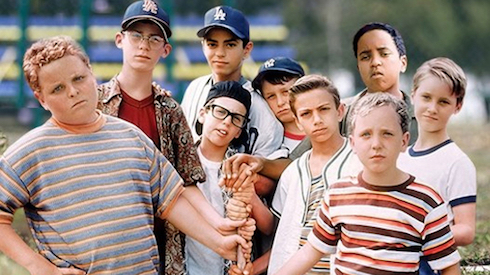
You’re Killing Me, Smalls! “The Sandlot” Movie Review

(spoilers)

Some movies find a place in a boy’s heart and just never let go. The Sandlot is one of those movies that still demands repeated viewings to this day because of the memorable quotes and unforgettable characters. Every boy remembers the hot, dry days of summer when time seemed to drag on, but it didn’t matter because he had his buddies. From being afraid of the neighborhood dog to having a crush on the unreachable girl, The Sandlot manages to touch on all of the great boyhood memories.

The movie begins with Scotty Smalls moving to a new town with his mother and stepfather, Bill. His mother has high hopes that he’ll make new friends, but Smalls doesn’t feel like he’s ever been good at anything, and that extends to his inability to fit in with kids his own age. He asks his new stepdad, who is touchingly portrayed by Denis Leary, to teach him to play catch, but Bill always seems to be too busy to make time. Anyone who has grown up with divorced parents will be sympathetic to the dynamic of this relationship.

Smalls eventually runs into a group of kids playing sandlot baseball. They are in need of a ninth player, so this is Small’s chance to be one of the guys. Unfortunately, his first outing doesn’t go so well. He has a chance to catch a fly ball, but the ball bounces off his head. He follows up that embarrassment by being unable to throw the ball to the correct player, and his chance to join a new group of friends is almost over before it began. Luckily for Smalls, Benny Rodriguez decides that he should be given another chance. There doesn’t seem to be any duplicity in Benny’s compassion, and that’s one of the great things about this movie-the boys just get along.

Since Benny is the best ball player on the lot, he takes Smalls under his wing and teaches him the basics. Things turn around when Benny gets an incredible hit, and Smalls makes an equally incredible catch and throw to the infield. The gang decides that Smalls is okay after all, and their summer of adventures begins. The main focus of the boys is baseball, and their secondary focus is dreaming of Wendy Peffercorn, the local lifeguard and frequent visitor in their daydreams. After one of the guys pulls off an elaborate hoax in order to steal a kiss from Wendy, the boys lose their pool privileges for the summer. It’s all too easy to remember the early days of noticing the opposite sex during these hilarious scenes.

After the boys are banned from the pool, they continue to devote their time to being the best baseball team around. This draws the attention of the Tigers-a real team with a real field-who live on the other side of town. The Tigers are embarrassed on their home field, and the sandlot boys feel like the kings of the world. This is another refreshing aspect of this movie. The game wasn’t the climax of the movie. This is not a typical “win at all costs” sports movie; it’s just a movie about a group of kids who had an unforgettable summer. Had they lost, it wouldn’t have changed the feeling of the movie at all.

One day, as the kids are playing ball, a powerful hit by Benny ruins the only ball they have. Smalls decides to borrow his stepdad’s prized, autographed baseball, but it soon gets hit over the fence. The biggest problem with that is that The Beast controls the area beyond the fence. The Beast is the biggest, meanest dog that anyone has ever seen, so the boys try a number of clever plans in order to retrieve the ball. Finally, Benny decides that he will retrieve the ball with his superior speed provided by his PF Flyers. Benny manages to get the ball, but a hilarious high-speed chase ensues between him and The Beast. This scene-and the whole movie-is over-the-top and perfectly filmed. Nothing is as big as the imagination of a group of boys, and the recollections in this movie are all handled in an exquisitely exaggerated manner.

Of course, the dog turns out to be friendly. Of course, the dog’s owner turns out to be an ex-baseball player who saves the day. A movie like “The Sandlot” is expected to have good news for everyone. That’s what makes it such an important movie in the memories of anyone who watched it as a kid.

When people think back to their childhoods, there is often a glowing filter around those memories. Nothing bad seemed to happen back then, and anything that was perceived to be devastating usually turned out okay. That’s the kind of warm feeling this movie imparts. The Sandlot just celebrated its twentieth anniversary in April, and it’s just as fun to watch today as it was back then.

By Zack Mandell

About the Author / Article Source: https://EzineArticles.com/expert/Zack_Mandell/1396543

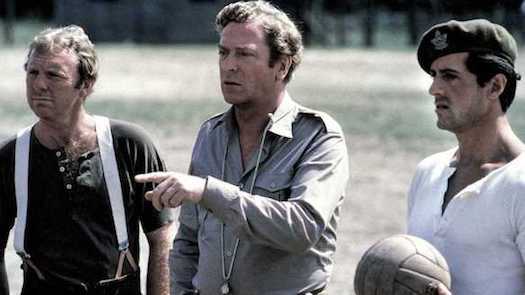
FSM Movies: Escape to Victory

Sylvester Stallone is the gift that keeps on giving. Younger movie fans get the gift of discovering classic after classic as if each one was brand new. Older fans, who have the Rocky films memorized already, get the gift of quirky new projects and random appearances in things like the Marvel Universe. This review is more for the younger fans who may be aware that Stallone ended communism in Rocky IV but didn’t know he also helped end fascism by playing soccer in the movie Escape to Victory.

Headlined by the loveable Sir Michael Cane and directed by Hollywood legend John Huston, Victory was released to the masses in 1981. Since this film fell under the rare “War/Sport” genre, it made sense to cast Sylvester Stallone as he had recently played war hero John Rambo and boxing underdog Rocky Balboa.

In Victory, Stallone plays a World War II era prisoner-of-war named Captain Robert Hatch. He spends most days watching the cooler prisoners kick a soccer ball around before ending up as the team’s unlikely goalkeeper. These cooler prisoners were made up of actual soccer stars of the time such as Pelé, Bobby Moore, and Robin Turner.

For some strange reason in the film, a high-ranking Nazi officer played by Max von Sydow thinks it would be great for morale around the world to have these allied prisoners-of-war (who happen to be really really good at soccer) play an exhibition match against a German super team. Of course, the match is intended to be used as propaganda and perhaps a symbol of how Germany would crush the allies in war. Movie fans can probably guess that Stallone, Caine, and the rest of the allies put up a heck of a fight on the field. But a dilemma arises when the players have a chance to escape. This is when the movie gets especially enjoyable.

Victory is a pleasant ride from start to finish. The film presents many WW-II themes but with a lighter touch – something that’s perfect for a war movie about soccer! Additionally, the great chemistry of all cast members is evident from the opening few scenes. Stallone shines in a role that may have been written with him in mind. Pelé seems like a natural actor. The other professional footballers don’t try too hard (in a good way). And Michael Caine and Max von Sydow absolutely carry the movie. A younger Caine brings his spunky energy as the leader of the allies while von Sydow’s acting almost makes you feel bad for a Nazi.

While the subject matter and era are taken seriously, Victory feels like it could be the child of The Dirty Dozen and The Replacements. It’s not quite a war or sports movie and doesn’t necessarily try to inform the viewer of anything that’s not already known. But it’s a fun story you’ve probably never experienced before. Its ending is also one of the most underrated endings in sports movie history (no spoilers here except that Stallone is involved).

FSM Final Grade: B

Click here to purchase Victory today!