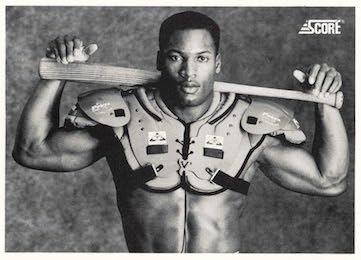
Book/Movie Title: The Last Folk Hero: The Life and Myth of Bo Jackson
Total Pages/Duration: 430 pages (hardcover)
Author/Director: Jeff Pearlman
Pace of Play: This book is certainly not a page-turner and feels more like a low-scoring baseball game that keeps going into another extra inning. That doesn’t mean this book is boring in anyway, just that you will be provided with a lot of different information about many different things related to the Bo Jackson universe. The pace of play here is slow.
Strengths: The author does not hide the type of person Bo Jackson was as a child. Admittedly, it was hard to root for Jackson after reading the first chapter of The Last Folk Hero. There will be times in that chapter you might ask yourself, “Why am I reading about this sociopath?” Keep reading and you’ll eventually get to a place of acceptance though you’ll probably never feel like rooting for the guy. There are some cool stories throughout subsequent chapters discussing huge acts of kindness that (just barely) balance things out. In addition to Bo Jackson’s suspect personality and charity work, the reader is also treated to multiple “Bo” nickname origin stories and reoccurring tales about bizarre interactions with autograph seekers.
Weaknesses: Reading, “There is a Bo story you won’t believe” or some variation of that sentence starts feeling a little redundant after the first handful of stories. The premise of this book gets proven over and over and over and over and…well you get the point.
Unique Attributes: This book is peppered with George Brett anecdotes from Bo Jackson’s time playing in the MLB for the Kansas City Royals.There is also extensive discussion of Jackson’s track and field career in college which is something that is often overlooked.
Scout’s Recommendations: The Last Folk Hero will take some time to read but the journey will be worth it in the end. Even die-hard Bo Jackson fans (if they exist) will learn something new by reading this book. The story of Bo Jackson is more than just someone who played in both the MLB and NFL at the same time and Jeff Pearlman captures that in his latest work. Based on the information in this FSM scouting report, FreeSportsMagazine.com recommends this book for fans of all sports.
Reggie Jackson earned the “Mr. October” nickname during the 1977 World Series when he played for the New York Yankees. In Game 6 of that series, on October 18, 1977, Jackson had one of the most remarkable single-game performances in baseball history. He hit three home runs on three consecutive pitches from three different pitchers (Burt Hooton, Elias Sosa, and Charlie Hough) of the Los Angeles Dodgers. His incredible power display led the Yankees to an 8-4 victory, clinching the World Series title.
After his performance in Game 6 of the 1977 World Series, Jackson was given the nickname “Mr. October” by the media for his ability to come through when it mattered most—in the high-stakes, high-pressure postseason. The name has stuck with him ever since, symbolizing his clutch hitting during baseball’s most important month
Baseball historians also note Reggie Jackson is an ego-maniac so we offer our apologies to him – this story is about “Mr. November”.
The 2001 MLB season was disrupted by the tragic events of September 11, 2001, which led to the postponement of games for about a week. As a result, the playoffs and World Series were pushed back, extending the postseason into November for the first time in Major League Baseball history.
In Game 4 of the 2001 World Series between the New York Yankees and the Arizona Diamondbacks, the game went into extra innings. It was late on October 31, 2001, and the clock struck midnight, officially turning the calendar to November 1.
In the bottom of the 10th inning, with the score tied 3-3, Derek Jeter came to the plate. He hit a walk-off home run off Arizona’s Byung-Hyun Kim, giving the Yankees a dramatic 4-3 victory. Since it was the first time any game in MLB history had been played in November, and Jeter’s home run won the game, the crowd and media began to call him “Mr. November,” a play on the nickname “Mr. October,” which had been famously given to Reggie Jackson for his own postseason heroics previously discussed.
Although the Yankees eventually lost the 2001 World Series to the Diamondbacks in seven games, the moment cemented Jeter’s status as a clutch performer and earned him one of the most iconic nicknames in baseball history. The name “Mr. November” symbolizes his ability to deliver in high-pressure moments on the biggest stage.
At the beginning of 1989’s Major League, the audience is shown a montage of newspaper headlines of the Cleveland Indians baseball team on a losing streak. The montage sets a pretty somber tone at first of a city in a rough spot. But more importantly it establishes the Cleveland Indians as a classic case of a rag-tag team of misfits that people, even some of their own teammates, don’t take seriously. David S. Ward said he wrote Major League because it was “the only way I would see the Indians win a World Series” and it definitely feels like a celebration of an underdog team. It transcends the traditional sports movie by, intentionally or not, becoming a story of the value of diversity in America, and while some elements haven’t aged particularly well, it’s still an interesting statement disguised as a goofy sports comedy.
The film begins with the wife of a recently deceased former owner inheriting the Cleveland Indians. She hatches a plan to move the team to Las Vegas by gathering up some of the worst players in the league. Naturally, this new move worries the actual players. The players they bring in include a convicted felon (Charlie Sheen), a voodoo priest (Dennis Haysbert), and some guy who showed up uninvited but ends up as one of the best runners in the league (Westley Snipes). It fits right in with Guardians of the Galaxy, The Suicide Squad, among other movies that are about a rag tag team of misfits working together; and despite some of the more problematic and stereotypical elements, the film still works because it depicts these people as some of the more likable players on the team. These personalities clash and create conflict that doesn’t feel unlike the types of arguments between different backgrounds of people in the United States. The main plot of a rag-tag team of misfits is as old as the country itself. One particular subplot involves the voodoo priest being harassed by another player on the team who doesn’t know how to accept other people’s religion. Despite the voodoo priest character being a stereotype, the audience is 100% on his side.
However, some of the film’s more satirical elements, specifically the character of the new owner of the team, could’ve used a couple more rewrites to make them less cartoonish. The character of Rachel Phelps, the team’s new owner, feels like a two dimensional corporate stooge, especially after a TV show like Ted Lasso retooled a similar character and made her into someone who feels like a complex but still very flawed person. She feels like she exists inside of a bubble and only interacts with members of the team for a climactic argument towards the end of the film, making her more of a plot device than a character. This is made worse by a scene involving a cardboard cutout of this character being sexually objectified.
Additionally, because this is a fantasy, this results in the film occasionally being a little too cheery for its own good despite some of the more satirical elements. The protagonist, Jake (Tom Berenger)’s ex-wife, a former athlete named Lynn (Renee Russo) is engaged to a pompous rich oaf who has no respect for her, and now that Jake has also re-entered her life, she has to contend with him being incredibly annoying in trying to win her back. His main goal in the film is to get back together with her by becoming a high ranking baseball player. It’s clear that this is a fantasy, but he doesn’t learn anything by the end of it. His wife calls off the engagement, but she should have walked away from both of these guys and gone on to become a great athlete on her own. Instead, she smiles at Jake from the crowded baseball stands, indicating the two of them are going to get back together. This subplot could have said something far deeper about the cost of ambition by providing a dark counterpoint to a goofy comedy, but it goes in a feel-good romance direction that ends up clashing against the more satirical elements. It doesn’t feel like the movie wants to fully commit to some of the ideas that could’ve made it an all time classic satire, rather than just a pretty enjoyable piece of late 80’s comedy
Overall, despite some hiccups, Major League is a more clever movie than the viewer might assume for a mainstream comedy from that time. It arguably avoids the pitfalls of 80’s comedy stereotyping in some areas by making said characters incredibly competent at the sport. And while some elements haven’t aged particularly well, it more than laid the groundwork for successful sports comedies after it.
My heart soared. We were going to take another trip to The Baseball Hall of Fame. One of my favorite places on earth. Just like the first trip to Upstate New York. I wanted to see the likes of Babe Ruth, Lou Gehrig, Honus Wagner, Mickey Mantle, Ty Cobb and Yogi Berra. one more time.
What I saw that day has stayed with me at the depths of my being, to this very day. More about that later.
As we walked into the building in the spring of 1999 I was greeted by two giant size replicas of two great hitters Ted Williams and Babe Ruth. I loved seeing the Babe again. “My friend Babe Ruth. Hello. Hey Ted, you look pretty good.” I remember saying. I found it very interesting that I and most people (if you stood under seven foot five inches) would have to look up to see these two sculptured figures.
My wife and I strolled through the museum looking at the artifacts. We adored the old gloves, spikes, balls, bats and uniforms that were encased in their glass display bins. These items brought me back to a time and place before television, radar guns and luxury boxes. I was getting very nostalgic.
We soon entered the wing that housed the Sammy Sosa, and Mark McGwire artifacts. This Home Run Wing was abundant with Sosa and McGwire memorabilia. This was like being in a home run baseball fantasy park. There were huge posters of both men. There were posters of each man’s list of home runs.. When they hit them and what pitcher gave up that particular home run. There were bats they used in games and balls they hit over the fences Amazing. Never had two major league men hit so many home runs in one year. Upon leaving that wing I could not help but feel overwhelmed by the slugging feats of these two huge men. One a Cub and one a Cardinal.
We continued to stroll through the hall until we came up to a narrow wing that I did not remember from my previous visit. I looked down the left side of the corridor and saw a group of pictures. Hanging from wires, these colorful paintings were displayed at my eye level. Perfect for me. I had to see these pictures. I was compelled. to walk down this aisle. The first picture as I entered the area was of Babe Ruth. His bat was over his shoulder. His face was wrought with age. He looked a little old, a wee bit tired heavy and somewhat overweight. As I stared at the picture I got very sad. I could see that his career was about to end.
Next painting was of Lou Gehrig. A smiling Lou Gehrig. I felt so happy just to be in the presence of one of my all time heroes. Even if it was just a picture. Then there was one of Joe DiMaggio and Ted Williams standing on the dugout steps Their bodies were angled toward each other. I enjoyed the joy they seemed to have just being there. Ready to play another game. There were other paintings one of Jackie Robinson, another of Ty Cobb and another of Honus Wagner that I loved.
Gazing toward the end of the row of paintings I saw a glass case with what looked like a tan baseball glove inside. This seemed very weird in that all the players that were depicted in the paintings were from an era when dark brown gloves were used. . I felt confused. This mitt did not seem to belong here. I just had to see whose glove this was.
I could not believe my eyes. It was not a glove. It was a sculpture of a glove. Perfect in size. Detailed so exact that the grayish colored seams were complete in length width and color. The depth of this piece was ideal What this sculptor had captured amazed me. I thought about the time he invested in creating this piece. About how much this person must have loved baseball that he took the time to mold a piece equipment. I visualized he sitting in his workroom playing with clay to make this piece real. I called my wife to come see this incredible piece. We both were moved. I even cried.
I was given a glimpse of one of the greatest pieces of art I had ever seen. I have been to major museums and have seen painting by Van Gough, Picasso, and Dahli… I have seen the Thinker by Rodin. I have never been moved like I was by the glove.
Whenever I think of the Hall of Fame my mind jumps to the glove. I do not know if this piece is there any more. It did have a price tag of $8500 when I was there so it may have been moved.
But if you get the chance to see the glove I suggest you take a look.
Author Bio Aron Wallad has been a baseball lover for over 45 years. You will love his honesty and his passion. You will be touched by the heartwarming stories. The unusual statistics will amaze you and the quotes will make you laugh…sometimes. He is the creator of the now defunct ezine www.baseballsprideandjoy.com.
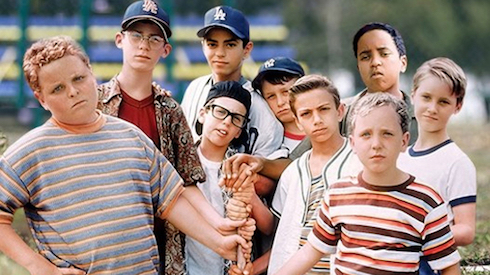
Some movies find a place in a boy’s heart and just never let go. The Sandlot is one of those movies that still demands repeated viewings to this day because of the memorable quotes and unforgettable characters. Every boy remembers the hot, dry days of summer when time seemed to drag on, but it didn’t matter because he had his buddies. From being afraid of the neighborhood dog to having a crush on the unreachable girl, The Sandlot manages to touch on all of the great boyhood memories.
The movie begins with Scotty Smalls moving to a new town with his mother and stepfather, Bill. His mother has high hopes that he’ll make new friends, but Smalls doesn’t feel like he’s ever been good at anything, and that extends to his inability to fit in with kids his own age. He asks his new stepdad, who is touchingly portrayed by Denis Leary, to teach him to play catch, but Bill always seems to be too busy to make time. Anyone who has grown up with divorced parents will be sympathetic to the dynamic of this relationship.
Smalls eventually runs into a group of kids playing sandlot baseball. They are in need of a ninth player, so this is Small’s chance to be one of the guys. Unfortunately, his first outing doesn’t go so well. He has a chance to catch a fly ball, but the ball bounces off his head. He follows up that embarrassment by being unable to throw the ball to the correct player, and his chance to join a new group of friends is almost over before it began. Luckily for Smalls, Benny Rodriguez decides that he should be given another chance. There doesn’t seem to be any duplicity in Benny’s compassion, and that’s one of the great things about this movie-the boys just get along.
Since Benny is the best ball player on the lot, he takes Smalls under his wing and teaches him the basics. Things turn around when Benny gets an incredible hit, and Smalls makes an equally incredible catch and throw to the infield. The gang decides that Smalls is okay after all, and their summer of adventures begins. The main focus of the boys is baseball, and their secondary focus is dreaming of Wendy Peffercorn, the local lifeguard and frequent visitor in their daydreams. After one of the guys pulls off an elaborate hoax in order to steal a kiss from Wendy, the boys lose their pool privileges for the summer. It’s all too easy to remember the early days of noticing the opposite sex during these hilarious scenes.
After the boys are banned from the pool, they continue to devote their time to being the best baseball team around. This draws the attention of the Tigers-a real team with a real field-who live on the other side of town. The Tigers are embarrassed on their home field, and the sandlot boys feel like the kings of the world. This is another refreshing aspect of this movie. The game wasn’t the climax of the movie. This is not a typical “win at all costs” sports movie; it’s just a movie about a group of kids who had an unforgettable summer. Had they lost, it wouldn’t have changed the feeling of the movie at all.
One day, as the kids are playing ball, a powerful hit by Benny ruins the only ball they have. Smalls decides to borrow his stepdad’s prized, autographed baseball, but it soon gets hit over the fence. The biggest problem with that is that The Beast controls the area beyond the fence. The Beast is the biggest, meanest dog that anyone has ever seen, so the boys try a number of clever plans in order to retrieve the ball. Finally, Benny decides that he will retrieve the ball with his superior speed provided by his PF Flyers. Benny manages to get the ball, but a hilarious high-speed chase ensues between him and The Beast. This scene-and the whole movie-is over-the-top and perfectly filmed. Nothing is as big as the imagination of a group of boys, and the recollections in this movie are all handled in an exquisitely exaggerated manner.
Of course, the dog turns out to be friendly. Of course, the dog’s owner turns out to be an ex-baseball player who saves the day. A movie like “The Sandlot” is expected to have good news for everyone. That’s what makes it such an important movie in the memories of anyone who watched it as a kid.
When people think back to their childhoods, there is often a glowing filter around those memories. Nothing bad seemed to happen back then, and anything that was perceived to be devastating usually turned out okay. That’s the kind of warm feeling this movie imparts. The Sandlot just celebrated its twentieth anniversary in April, and it’s just as fun to watch today as it was back then.



 FreeSportsMagazine.com