Tag Archives: March Madness

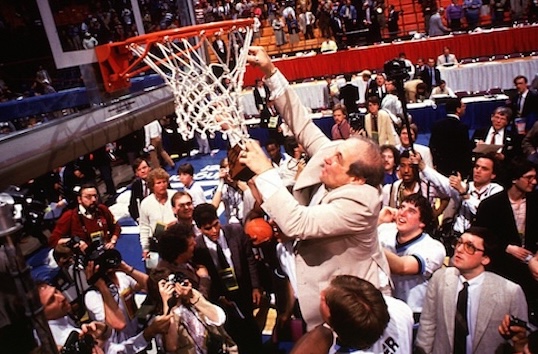
Cinderella Story: The Lowest Seed Ever to Win March Madness 

In a tournament built on chaos, one story still towers above them all.

On a spring night in April at Rupp Arena in Lexington, Kentucky, the No. 8-seeded Villanova Wildcats delivered what many still call the greatest upset in college basketball history, defeating the heavily favored and defending national champion Georgetown Hoyas 66–64 to win the 1985 NCAA Tournament.

It remains, to this day, the lowest seed ever to win a national title.

Coached by Rollie Massimino, the Wildcats shot an astonishing 78.6% from the field (22-of-28), a number almost unheard of in a championship setting. Every possession was deliberate, every shot carefully chosen. It wasn’t flashy—it was surgical. Villanova played nearly flawless basketball which was necessary if they wanted to win. 

Georgetown, led by Hall of Fame center Patrick Ewing, entered the game as a dominant force. The Hoyas had bullied opponents all season with defense and intimidation, and few gave Villanova much of a chance. It was David versus Goliath.

CHECK OUT THE FREESPORTSMAGAZINE.COM GARAGE SALE ON EBAY 

But from the opening tip, it was clear something unusual was unfolding. The Wildcats were trying to slay the giant but on their terms. 

Villanova slowed the pace to a crawl, frustrating Georgetown and limiting possessions. The Wildcats refused to be rattled, matching every Georgetown run with poise and precision. In the final minutes, clutch free throws sealed a victory that stunned the basketball world. Forward Ed Pinckney led the way with 16 points and was named Most Outstanding Player, anchoring a disciplined effort that neutralized Georgetown’s size and physicality.

Unlike modern tournaments filled with double-digit seed surprises, Villanova’s Cinderella run wasn’t filled with blowouts or buzzer-beaters. Instead, it was a methodical climb in which they embraced the underdog role, controlled tempo in every game, and executed with near-perfect efficiency when it mattered most. By the time they reached the championship, they weren’t just surviving—they were peaking.

In today’s expanded 64+ team tournament era, no team seeded lower than No. 8 has ever won it all. While teams like the 2014 UConn Huskies (7-seed) have come close, Villanova’s 1985 run remains unmatched and is a legacy that still stands for now. 

More than four decades later, every March brings new Cinderella hopefuls. But none have quite replicated what Villanova accomplished that night in 1985—a reminder that, in college basketball, perfection for just one game can rewrite history forever.
The Origin Story of Saying “March Madness”

Every March, office pools explode, brackets bust, and underdogs become legends. The phrase “March Madness” now feels inseparable from the National Collegiate Athletic Association (NCAA) men’s basketball tournament—but its roots stretch back further than most fans realize. Long before billion-dollar TV deals and wall-to-wall coverage, March Madness belonged to high school basketball.

In 1939, Illinois high school official Henry V. Porter used the term in an essay to describe the emotional frenzy surrounding the annual state basketball tournament. Porter, who worked with the Illinois High School Association, wrote about the electricity in small-town gyms, the packed crowds, and the statewide obsession that peaked every March. To him, “March Madness” captured the chaos, passion, and community pride of tournament time.

At the time, the college game was still growing. That same year—1939—the first NCAA men’s basketball tournament was held, won by the Oregon Ducks men’s basketball team. But the phrase hadn’t yet attached itself to the college bracket. Fast forward to the 1980s. College basketball had become a television spectacle. As the tournament expanded and Cinderella stories multiplied, broadcasters searched for language big enough to match the moment.

Enter Brent Musburger.

While calling NCAA tournament games for CBS in the early 1980s, Musburger began using the term “March Madness” on national broadcasts. His booming delivery and prime-time platform cemented the phrase in the American sports vocabulary. What had once described Illinois high school gyms now echoed across the country.

The NCAA eventually trademarked “March Madness,” formally tying it to the Division I basketball tournament held every year. The phrase fits perfectly considering the structure of the NCAA tournament demands drama. Unlike professional playoffs that stretch over series, the college game offers no safety net. Survive and advance—or vanish. Add in buzzer-beaters, 15-seeds toppling 2-seeds, and brackets shredded before the Sweet 16 and it’s hard to deny this emotional whiplash packed into three weeks.

Today, “March Madness” represents more than just college basketball games being played. It means office bracket pools, billion-dollar TV contracts, Cinderella stories, alumni pride, and three weeks when productivity mysteriously declines nationwide What began as poetic wording in a 1939 essay evolved into one of the most powerful brands in American sports.

And that’s fitting. Because every year, when the ball tips in mid-March and dreams hang on every possession, madness doesn’t feel like exaggeration. It feels accurate.