Category Archives: FSM Editorials

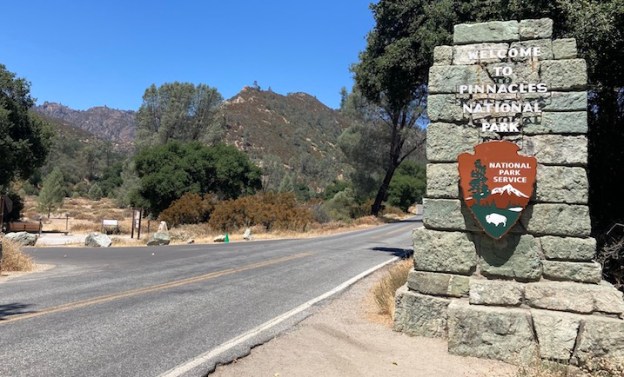
FSM Exclusive: Intro to Pinnacles National Park

For the wanderers out there considering a visit to Pinnacles National Park, Free Sports Mag takes a quick look at California’s newest park in this exclusive 30-minute video.

But first, some cool background information about Pinnacles directly from the NPS website:

Some 23 million years ago multiple volcanoes erupted, flowed, and slid to form what would become Pinnacles National Park. What remains is a unique landscape. Travelers journey through chaparral, oak woodlands, and canyon bottoms. Hikers enter rare talus caves and emerge to towering rock spires teeming with life: prairie and peregrine falcons, golden eagles, and the inspiring California condor.

The most recent update to Pinnacles is its redesignation from National Monument to National Park when in 2013, Pinnacles became the 59th National Park. It was originally designated as a monument because of its unique geologic features such as rock spires and crags that are remnants of volcanic activity millions of years ago. However, the abundance of cultural and natural resources in the park, including its many federally protected species, made it an appropriate candidate for a National Park. The United States Senate and President Obama passed the bill that redesignated Pinnacles to a National Park which included a 3,000 acre expansion of wilderness to be named the Hain wilderness, in honor of the homesteader Schuyler Hain who worked to protect it in the early 1900s. The redesignation has also increased visitation and tourism to nearby communities.

Click here to see FSM’s quick review of the park and campsite!

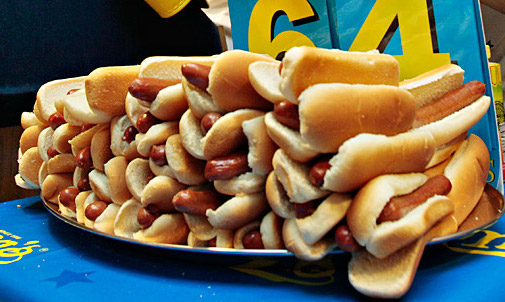
The History of Nathan’s Hot Dog Eating Contest

The Nathan’s Hot Dog eating contest has become a legendary annual event held on July 4th at Coney Island, New York. The origins of this contest can be traced back to a friendly competition among immigrants in the early 20th century.

The contest’s roots can be found in the tradition of settling disputes among working-class men on Coney Island. According to popular legend, in 1916, a group of four immigrants—Irish immigrant James Mullen, Polish immigrant Max Bruck, German immigrant Chris Nicoll, and an unidentified man—decided to hold a hot dog eating contest to settle an argument about who was the most patriotic among them. As the story goes, they gathered in front of Nathan’s Famous, a popular hot dog stand owned by Nathan Handwerker, and began consuming as many hot dogs as possible in a set amount of time.

Nathan Handwerker saw the potential in this spectacle and embraced it as a promotional opportunity for his business. The contest gained attention and became an annual event at Nathan’s Famous. Over the years, it grew in popularity and attracted participants from various backgrounds.

In 1972, the contest took a hiatus but was revived in 1974 by PR man Max Rosey, who wanted to use the event to generate publicity for Nathan’s Famous. The contest has been held every year since then and has become a cherished tradition, drawing thousands of spectators to witness competitive eaters from around the world battle it out to consume the most hot dogs in a given time period.

Today, the Nathan’s Hot Dog eating contest is organized by Major League Eating (MLE), a professional competitive eating organization, and has gained international recognition as one of the most prestigious events in the competitive eating circuit. It is broadcast live on television every 4th of July and has catapulted many participants to fame in the world of competitive eating.

The origins of Major League Eating can be traced back to the early 1990s and the efforts of brothers George and Richard Shea. In 1997, George and Richard Shea, who were public relations professionals, were hired by the owners of Nathan’s Famous to rebrand and promote the Nathan’s Hot Dog eating contest. Recognizing the potential for competitive eating as a spectator sport, the Shea brothers sought to elevate it to a professional level and establish a governing body to oversee the events.

Later that same year, the brothers founded the International Federation of Competitive Eating (IFOCE) as the governing body for competitive eating. The IFOCE was responsible for establishing rules, rankings, and standards for various eating contests. They aimed to transform competitive eating into a legitimate sport and attract sponsors, media coverage, and public interest.

Under the IFOCE, the Shea brothers worked to expand the competitive eating circuit, organize events, and attract top eaters. They introduced a structured ranking system and established guidelines for competitions to ensure fairness and safety. Over time, the IFOCE gained recognition as the leading authority in the world of competitive eating.

In 2001, the IFOCE was rebranded as Major League Eating (MLE) to reflect its professional approach and enhance its marketability. MLE continued to expand its reach and popularity by organizing and sanctioning eating contests across the United States and internationally. The Nathan’s Hot Dog eating contest remained one of MLE’s flagship events, drawing significant media attention and shaping the perception of competitive eating as a competitive sport.

Major League Eating continues to oversee and promote competitive eating events, maintain rankings and records, and collaborate with sponsors, broadcasters, and participants to elevate the sport’s profile. It has played a significant role in popularizing and professionalizing competitive eating, turning it into a recognized and respected form of competition.

The first champion of the Nathan’s Hot Dog eating contest under the organization of Major League Eating (MLE) was Takeru Kobayashi. Kobayashi, a competitive eater from Japan, made his debut in the contest in 2001 and quickly revolutionized the sport with his unique eating technique and extraordinary capacity.

In his first year, Kobayashi shattered the existing world record by consuming 50 hot dogs and buns in 12 minutes, doubling the previous record. His incredible performance not only earned him the title but also captured the attention of the media and spectators, propelling competitive eating into the mainstream.

Kobayashi went on to dominate the Nathan’s Hot Dog eating contest for the next six years, winning the championship from 2001 to 2006. His unorthodox “Solomon Method,” which involved separating the hot dog from the bun and consuming them separately, allowed him to eat at an astonishing pace and set multiple records.

However, in 2007, Kobayashi’s reign as the champion came to an end when he was defeated by Joey Chestnut, an American competitive eater. Chestnut consumed 66 hot dogs and buns, surpassing Kobayashi’s previous record of 63. This marked the beginning of Chestnut’s own dominant era in the contest, as he went on to win the Nathan’s Hot Dog eating contest for several consecutive years.

It’s worth noting that in recent years, Kobayashi has not competed in the Nathan’s Hot Dog eating contest due to contractual disputes with Major League Eating. Nonetheless, his contributions to the sport and his initial victories played a crucial role in establishing the contest’s popularity and setting the stage for future champions.

Joey Chestnut is the reigning champion of the Nathan’s Hot Dog eating contest under Major League Eating (MLE). Chestnut has been a dominant force in the competitive eating world and has held the title for numerous consecutive years. His record-breaking streak began in 2007 when he defeated Kobayashi (ending his six-year reign as champion). Since then, Chestnut has continued to dominate the competition, consistently consuming a large number of hot dogs and securing the championship year after year. Think you beat him? You can start practicing this Independence Day!

Find ways to watch this year’s contest by clicking here.

FreeSportsMagazine.com Pays Tribute to the Iron Sheik

The sports world lost a legend on June 7th, 2023 when the Iron Sheik departed the squared circle of life. At 82 years of age, he led a full but often complicated life. What was undisputable was that he was appropriately hated during his time actively wrestling and appropriately beloved during his time after. Free Sports Magazine is proud to offer this tribute to the #1 Jabroni:

The Iron Sheik, born Hossein Khosrow Ali Vaziri on March 15, 1942, is an Iranian-born professional wrestler and former Olympic wrestler. Known for his flamboyant personality and his portrayal of a villainous character in the wrestling world, the Iron Sheik enjoyed a successful career that spanned several decades.

Vaziri’s journey began in his native Iran, where he developed a passion for wrestling. He competed in various international tournaments and even represented Iran in the 1968 Olympic Games. After immigrating to the United States, he continued his wrestling career and gained prominence in the professional wrestling circuit.

In the 1980s, the Iron Sheik rose to superstardom as a member of the World Wrestling Federation (now WWE). With his signature move, the Camel Clutch, and his provocative interviews, he quickly became one of the most hated villains in the industry. His intense rivalry with Hulk Hogan, which culminated in Hogan dethroning him for the WWF Championship in 1984, is often remembered as a defining moment in wrestling history.

Beyond his in-ring persona, the Iron Sheik faced personal struggles, including substance abuse issues, which impacted his career and personal life. However, in later years, he embarked on a path of recovery and found renewed popularity through social media, where his outspoken and often humorous posts endeared him to a new generation of fans.

Perhaps one of the Sheik’s most infamous moments occurred outside the ring. This moment can be revisited with smiles so many years after the fact. It’s One of those crazy stories that undoubtedly get shared at funerals or when friends get together to remember loved ones lost.

In January 1987, a highly publicized incident involving the Iron Sheik (Hossein Khosrow Ali Vaziri) and Jim Duggan occurred, commonly referred to as “The Busted Incident” or “The Sheik-Duggan Arrest.” The incident took place during a time when professional wrestling promotions had a vested interest in preserving the illusion of the wrestlers’ characters outside the ring.

The story goes that on January 23, 1987, Vaziri and Duggan were traveling together in a car for a World Wrestling Federation (now WWE) event. However, they were pulled over by the police in New Jersey for suspected drug possession. During the search, marijuana was found in the vehicle, leading to their arrest.

This incident caused a significant scandal within the wrestling industry at the time. The media coverage exposed the scripted nature of professional wrestling and brought negative attention to the wrestlers involved. The WWF promptly took action, swiftly punishing both wrestlers for their actions.

The Iron Sheik was released from the WWF shortly after the incident, with the company citing his arrest and his behavior as the reasons for his termination. Meanwhile, Jim Duggan received a suspension from the WWF, which was also seen as a disciplinary measure.

While the incident tarnished their public image, both wrestlers eventually managed to rebuild their careers. Jim Duggan, in particular, made a successful comeback and became a beloved figure in the wrestling community. As for the Iron Sheik, he found a new level of popularity in later years, thanks to his outspoken and humorous presence on social media.

At the time of his passing, the Iron Sheik is regarded as a wrestling legend and a cultural icon. His unique blend of charisma, athleticism, and controversial antics left an indelible mark on the wrestling world. Despite the challenges he faced, his enduring legacy will continue to inspire and entertain professional wrestling fans around the globe.

Poker And Getting Rid of Your First Time Nerves

By: Tim Jeffries

I really have sympathy for you if you’ve decided to play poker for the first time and you’ve decided that you’re brave enough to try playing against live players. I wish you all the luck and offer our condolences in advance…

I am kidding!

Of course, we’re not here to grieve for your losses in poker in advance. If you’re a first time player and you want to play against live players, then good for you. And we’re here to help by providing you with useful tips that just may be the keys you need to survive round after round of poker.

Now, first time players are what most poker veterans refer to as “calling stations”. If you’re wondering about the logic behind the term, it’s basically because most first time poker players have the tendency to call almost all bets without even sparing a moment’s thought on their decisions.

Obviously, if you don’t want to be viewed as a “calling station” (egad!), gain the respect of your fellow poker players and maybe a share of their chips also, think before you act. Poker is not just any card game. It’s a mental game, a strategic competition between several players.

If you feel that your nerves are getting the better of you, here are some tips to get rid of cold feet.

Don’t pressure yourself by comparing your skills to other players’. That’s a futile exercise. Naturally, you can’t compare. You’re playing for the first time and they’re, what, celebrating their one millionth game? If you accept that, there’s nothing to lose yet there’s no harm in trying, you’ll feel much better later on and be able to concentrate more on the game.

Don’t turn your fellow players into gods. Okay, so you’ve heard about your opponents’ reputations. Say, one is called The Crocodile because of his ability to snatch you out of the game in seconds and the other one’s called The Rampaging Elephant because he’s always aggressive when it comes to bets. Remind yourself that before they got their monickers, they were also, once in their lives, christened as “calling stations”… just like you. If it helps, mentally replace their faces with funny looking ones to lessen your feelings of inferiority.

And lastly… relax. I know, it’s easier said than done, but you truly have to relax. Block out everything except for the cards you’re holding and mentally hum a happy song to yourself. If you let external factors get the better of you, you’re dead meat. But if you succeed in relaxing and focusing completely on your game, you may just have gotten rid of your nerves for the final time.

What the Hatha!? Learning About Hatha Yoga

Yoga was originally meant to be a spiritual treatment of the mind and the soul. It has, in today’s world, become more of a physical treatment than anything else. Hatha yoga is the type of yoga that prepares your body for its spiritual journey. This is mainly done with physical and breathing exercises as well as asceticism. This type of yoga requires the most physical exercise than any of the other types of yoga.

A few of the main factors for Hatha yoga are concentration on your breathing and your posture. This type of concentration can be more difficult than you think. Once you try this for yourself and see what this type of concentration can do, you will want to continue with this type of yoga. The purpose of practicing a great posture is to practice great meditation. You need to find a position that you can sit in for a long period of time. If you cannot be comfortable in your meditation and yoga positions, then you will be unsuccessful. The more postures and positions that you can acquire, a better meditative state will result.

Hatha is the form of yoga that anyone should begin with. Hatha begins with the basics of yoga and teaches you the inner workings of meditation and how you should begin. Once you master your own postures and positions of meditation comfort, it is time to master your breathing patterns. If you can master your own breathing patterns, than mastering your mind is not far out of reach for you. It takes many steps to reach these different levels of meditation and yoga. With practice and concentration anyone can do it.

If you are beginning your new adventure with yoga, Hatha is the form of yoga that you should begin with. If you want your yoga career to be successful you must begin with the proper steps and then learn in the right order. If you only learn the superficial methods of yoga, then you will not experience the desired results from this amazing technique of holistic meditation.

In today’s world, Hatha yoga mostly used for its physical exercise. We do not take advantage of the other benefits that Hatha yoga can give to us. It is a form of yoga that if done properly, can heal you in the most holistic way possible. Hatha yoga does evolve from its physical exercises. It is these exercises that begin and promote the mind and soul healing. No matter why you are participating in yoga, you can receive all of these benefits. The only way you can recognize them or use them to your benefit is to practice the other side of yoga, meditation. If you are unaware that these features, they will be of no use to you. When practicing yoga, you need to be aware of everything going on within you. Pay attention to yourself and you will instantly be able to see the changes that are going on within you.

Hatha yoga can be easy to learn if you are open minded and want to learn. It is a technique that can be mastered if you put all your energy and concentration into it. By learning the techniques of Hatha yoga, you are well on your way to an alternative way of healing in the most holistic way possible.

By Krishan Bakhru

Leo Ferris: The Man Who Saved The NBA

The early days of basketball often seen slow fan-unfriendly low scoring matches that often left spectators bored. Games often only got into the 40’s and many of the best players averaged less than 15 points a game. Many early basketball games looked more like a glorified version of the children’s game of keep-away than an action packed professional sport. This style of play culminated in a game between Minneapolis and Fort Wayne, where the Pistons of Fort Wayne held the ball most of the second half nursing a 1 point lead over the Lakers. The Pistons would win 19-18 in the lowest scoring game in NBA history. Prior to that the fewest points ever score 33 points, just 4 fewer than both teams scored, and that game was one the opening night of the NBA, or BAA as it was called back then.

This pace bored fans, many of whom were promised an action packed fun experience and attendance and interest in the new league had begun to dip. The NBA needed a solution and needed it fast. The solution was an ingenious one and one that would revolutionize the game as we know it. A simple clock, with just 24 seconds on it would forever change the game.

The clock was the brain child of Syracuse Nationals general manager Leo Ferris, a man that the NBA has long forgotten in one of the biggest travesties in the games history. Ferris, is as important to the early days of the NBA as anyone and one could argue that without Ferris there would be no NBA today; and there definitely would be no Atlanta Hawks, or Philadelphia 76ers. The NBA would look much different today without Ferris’s input all those years ago.

Ferris got his start with basketball not in the NBA but in the NBL when in 1946 he helped found the Buffalo Bisons. The Bisons were pretty much a failure in upstate New York and after only 13 games the Bisons picked up and left the shores of Lake Erie and heated to the American Heartland in Molina, Illinois. Technically, the team played in Molina and Rock Island, Illinois and Davenport, Iowa but most of their games were played in Molina. The team was called the Tri-Cities Blackhawks and while they struggled the foundation of one of the longest tenured NBA teams was laid. The Blackhawks would eventually move to Milwaukee, where they took on the moniker Hawks, and than move to St Louis and finally to Atlanta.

Shortly after the team moved to Tri-Cities Ferris would go on to make one of his first major shake ups of the basketball world when he signed Pop Gates for the all-black New York Ren’s to a contract. African-American players had played in the NBL before, but only during the early 1940s when World War II had taken a lot of the white players from the NBL. Gates was the first black player signed to a contract when there was not a necessity for them, and the first one signed because of his skill and talent and not because the league needed players. Gates would re-join the Rens when they joined the NBL as the Dayton Rens two years later.

After only a season with the Blackhawks, Ferris returned to his native upstate New York and began as the general manager of the NBL’s Syracuse Nationals. As manager of the Nationals he scored a huge coup for the Nationals and the NBL when he lured highly coveted big man Dolph Schayes away from the New York Knicks of the upstart BAA.

The BAA and NBL rivalry only got worse, with the BAA stealing away most of the best players from the NBL and starting in 1948 the BAA started taking the best teams as well. In 1947 the Minneapolis Lakers, Rochester Royals and Indianapolis Kautskies left the NBL for the BAA. The Nationals were now in an uncertain league and they and the NBL desperately needed to find a solution, and Leo Ferris would find that solution.

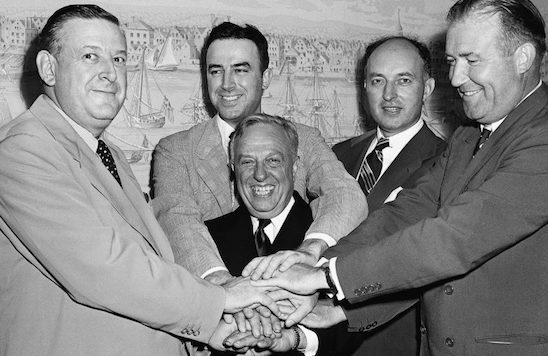
Starting in the spring of 1949 Ferris started meeting with executives of the BAA, at first it was an attempt to possible get the Nationals into the growing league, but would soon expand to merging the two leagues. The talks ended in August of 1949 when an agreement was reached to merge the NBL and BAA and form the NBA. The BAA only wanted to absorb two teams; the Nationals, and the upstart Indianapolis Olympians; who would replace the Jets. Ferris managed to talk the BAA into accepting both of those teams, as well as the Denver Nuggets, Sheboygan Redskins, Anderson Packers and the Blackhawks. He originally wanted the merger to include Oshkosh, Hammond and Dayton, but financial backing ruined Oshkosh’s attempt to relocate to Milwaukee and Hammond was thought too close to Chicago where the BAA already had a team. The Rens of Dayton were not allowed to join because their players consisted of black players. In addition to the Rens not being allowed to join, black players on Syracuse also had to be let go.

The merge proved successful as the 17 team NBA seen initial success, but the old NBL teams had given up too much power in the merger and despite Ferris’s best efforts the league kicked out 5 of the former NBL teams the next season.

The 1950 season saw the Lakers continue their dominance and the Pistons thought the only way to stop them was to hold on to a one point lead and the ball. This was the event that usurer in Leo Ferris’s clock or more commonly known as the shot clock. Ferris had always liked math and had been good at it, and he used math to come up with the 24 second clock. He took the number of seconds in a 48-minute game (2,880) and divided that by the average number of shots in a game (120) to get to 24 seconds.

It took 4 more years for the league to implement the shot clocks and when they did the league seen a jump in scoring by nearly 20 points a game and gone were the days of games ending up in the 40s. In fact, since the introduction of the shot clock there has been only 20 regular season games were a team has scored less than 60 points, and only one were a team scored less than 50 and only one playoff game were a team scored less then 60 points.

The introduction of the shot clock caused the game to enter into an era of frenzied paces, with teams scoring what were once thought of as impossible number of points. In 1954-55 Neil Johnston lead the NBA in scoring with 22 points a game, seven years later Wilt Chamberlain would set the NBA record by averaging 50 points a game.

Ferris would only stick around the NBA for one season after his clock was introduced before permanently leaving the league and the game to develop real-estate. It was a shockingly short career for someone who would have such a profound impact on the game.

Despite all that he accomplished, Ferris has yet to be introduced into the Naismith Hall-of-Fame. He has been a finalist multiple times but never made it to the enshrinement portion. This is likely due to the utter and complete disregard and disdain that the NBA has often shown towards the NBL and its former players and staff.

Excluding Ferris has been one of the worst tragedies that the NBA has done in its 70 plus years of existence. Many people are in the Hall-of-Fame who have lesser resumes than Ferris and yet Ferris gets overlooked time and again. Maybe, hopefully, 2018 will be the year for the man who may have saved the NBA.

Resources and references come from http://nbahoopsonline.com/

Article Source: http://EzineArticles.com/9883795

Photo Credit: John Lent/AP

An Adventure into the Wild: The National Parks of Sri Lanka

Are you a fellow wildlife enthusiast? Then visiting the National Parks is a must when you’re in Sri Lanka. The country is blessed with a number of these jungle-clad areas housing diverse species of flora and fauna. Read on to discover some of the most popular National Parks of Sri Lanka. Our friends from the Travellanka Connection break down the top 5!

Wilpattu National Park

Located 30 kilometers west of Anuradhapura, Wilpattu National Park has declared a wildlife sanctuary in 1905. It was later elevated to “National Park” status. Spanning an area of no less than 131,693 hectares, this is the largest National Park in Sri Lanka. Wilpattu National Park has a unique topography; a complex of around 50 wetlands known as “Villus”. Surrounded by open, grassy plains, “Villus” are shallow lakes filled with rainwater. The best time to visit this National Park is the dry season between May to September. One would be able to spot an array of wildlife species including sambar deer, crocodiles, wild boars, wild elephants, and especially the elusive Sri Lankan leopard.

Yala National Park

Book a Sri Lanka Holiday Package to explore the famous Yala National Park; the second-largest wildlife reserve and one of the first protected sanctuaries to have been established in the tear-drop island nation. This National Park is home to over 31 mammals and more than 124 species of birds. The terrain boasts lush, green environs, and is home to its fair share of reptiles and other lagoon fauna. Embark on a jeep safari to spot the elusive leopard. These safaris are available during early morning and evening hours. Travel Lanka Connection and similar other reputed travel companies will put together carefully curated itineraries to suit all your travel needs – and this can include a safari to Yala National Park as well!

Kumana National Park

Kumana National Park is nestled on the eastern fringes of Yala National Park; however, it is considered a wildlife hub in its own right. Famous among avid birders and ornithologists, this National Park is blessed with a number of magnificent bird species. A few of the most prized bird species that one can spot here include the rare, black-necked storks, egrets, hawk eagles, godwits, and ibises. The park is also a prime location to spot many wildlife species such as sambar deer and elephants.

Minneriya National Park

Minneriya National Park is located in the middle of the famous cultural triangle of Sri Lanka. It is mostly famous for “The Gathering”, which is believed to be the world’s largest congregation of Asian elephants. The best time to witness this spectacular phenomenon is during the dry season, which spans from July to October; hundreds of elephants gather around the lake in search of water, creating a majestic scenery for the onlookers. Apart from the elephants, many inhabitants call this relatively small National Park their home, and these include the purple-faced langur monkeys, spotted deer, sambar, and macaques.

Wasgamuwa National Park

Located approximately 225 kilometres away from Colombo, Wasgamuwa National Park is bordered by two rivers – Mahaweli Ganga and Amban Ganga (‘ganga’ translates to ‘river’ in English). The park is dominated by a dry-mixed evergreen forest and is characterized by tall trees such as Weera, Palu, and Burutha. From November to May, tourists can spot large herds of elephants. These gentle giants migrate to the nearby Minneriya and Kaudulla National Parks during the dry season. Apart from mammals such as purple-faced langur monkeys and wild boars, Wasgamuwa National Park is famous for birds such as the endemic red-faced mal koha, Ceylon jungle fowl, and lesser adjutant stork.

How To Speak The Language Of Disc Golf

By popular demand, Disc Golf blogger Steven Pease breaks down the language barrier for FSM readers…

Most people who play disc golf know the regular terms and language. There are lots of other words that people use for describing things that happen on the course. Words not in the dictionary, or in the general vocabulary for disc golf. I have gathered some interesting terms from other players, and from what I’ve read that other players use. I will share the common ones, and some better ones that are not common that I have found.

I got a great story sent to me a couple years ago. A player who was new went out to play a round with his dad, there was a reporter and a photographer at the course from the local paper. He asked if you could take a couple pictures for a story they were doing on disc golf; the guy said sure. The photographer got into position about 50 feet up the edge of the fairway; the guy let loose with his drive and hit the photographer square in the chest with his driver.

Very embarrassing and funny now, but no one wants to do that. I love this story because it shows exactly why everyone wants to get better. I put together terms that I have learned over the past 30 years of playing disc golf. Terms that will make you feel that you know what others are talking about. Disc golf is one of the fastest growing sports in the world. One of the main reasons for its popularity is players of almost any age and ability can play.

I play with guys half my age and I consistently beat them. I am 62 years old and in good shape. I know people older that still play. There are no limitations. If you can get around the course, you can play. If you have never played, you should. If you play now, keep on playing. It’s great exercise, and it’s a great way to socialize. As far as sports go, it is also very inexpensive. You can start with as few as three discs. A driver, a midrange and a putter. For just around $30 you can get started. Most courses are free to play.

Common disc golf language

  • Ace Getting the disc in the basket on the first shot
  • Hyzer Releasing the disc with he edge closest to your body highest than the other edge.
  • Anhyzer The outside is higher than the inside edge.
  • Overstable The disc wants to hyzer into the ground when you release it. To make it not hyzer, you must snap it and throw it hard with a slight anhyzer.
  • Understabe Can throw with less spin, less snap to fly straight.
  • Turnover When you throw the disc hard with good snap; it will turn opposite the way it normally will turn. If you’re throwing right hand back hand it will turn to the right.
  • S Curve The flight of the disc starts as an anhyzer, then will hyzer at the end of the flight.
  • Snap The amount of spin on the disc at release from your hand.
  • Driving The throw from the tee box.
  • Approach The shot from the drive to the basket.
  • Putt Throwing the disc into the basket.
  • Grip How you hold the disc when you’re throwing.

Player Invented Disc Golf Terms

  • Dead man When your putt hits the side of the basket and drops to the ground.
  • Chain smoking Several great putts in a row.
  • Bogey Sandwich A scorecard with a par bogey bogey par.
  • Black ace Acing the wrong hole.
  • Cabbage The weeds in the rough.
  • Chastity belt The yellow band on the Innova baskets.
  • Clank The sound that a putt makes when in hits the chastity belt.
  • Hit the nickel A putt that hits the number plate.
  • Horking A huge long throw.
  • Locals route Taking an unconventional path to get you to the basket.
  • Lumber jacking When you’re hitting every tree.
  • Mirkwood Very thick woods.
  • Nickel A score of 5 on a hole.
  • Nuclear shule Very thick rough.
  • Fly by Putt correct height, but sails by the basket.
  • Fluke deuce A two from something very lucky happening.
  • Gaack Missed a short putt.
  • Grenade A shot that is high and falls fast to the ground.
  • Head Banger When your drive lands under the basket and you might bang your head on the basket as you pick it up.

More Disc Golf Terms

  • Paper plate An understable disc.
  • pig putt A putt that’s really bad.
  • Pinball A shot that hits several trees.
  • Pinball Wizard Continually hitting multiple trees.
  • Rooted When the tree root stops you shot from skipping.
  • Saturn A score of 6 (saturn is the 6th planet)
  • Shank Any shot that does not do what you wanted.
  • Shule Heavy weeds off the fairway.
  • Sneak In flight instruction to the disc.
  • Snob A throw with the nose of the disc up.
  • Snowman A score of 8.
  • Spinach Bushes, trees, and undergrowth.
  • Taco To hit a tree so hard it folds like a taco.
  • Tombstone A disco golf disc that hits the ground, and remains standing on the edge.
  • Treefelction The tree gives you a good deflection.
  • Valet service When you park your drive under the basket.
  • CRF Candy fundraiser.
  • CTP Closest drive to the pole.
  • DL Dead last in the order of throwing.
  • FAT When you hit the first available tree.
  • LB Lucky bounce.
  • SED Seeing eye disc.
  • YSA You’re still away.
  • Gust from the Gods When the wind blows the disc way off line.
  • Getting greasy Sneaking through the trees.
  • Lawn dart A disco that has landed partially buried in the ground.
  • Merked When you get hit in the head from someones throw off of a tree.
  • Tombstone For those discs that stick on edge in muddy ground.
  • Helicopter A shot that needs to come straight down at the end without curving.
  • A rip The perfect drive.

The terms in the top section are ones you need to know. These terms will help you understand the game and how to play and how to play better. The rest are just temps other players use when they are playing.

6 Tips for Tracking Your Fitness

You have decided to bring the body into shape and regular workouts have become your usual routine. Still, after one or two weeks of such physical activity, you don’t see wishful results in the mirror and stepping on the scale just confirms it. For that reason, you give up, abandon set goals and return to a sports lifestyle only when a certain time passes. It is high time to break this vicious circle!

The most crucial thing here is to understand that changes are not a matter of one week. It takes time to achieve progress, so you should gain patience and keep motivated along the way. The best solution for following fitness goals is results-tracking.

Body alterations and how you feel constantly performing physical activities are the greatest motivators for moving ahead. By tracking your fitness, the possibility of reaching goals significantly rises and promotes you working and spending your time yet more efficiently. That way, our key task is to identify what ways of fitness progress measuring are the most fruitful and worth incorporating into the sports agenda. Let’s figure it out.

1. Keeping a Workout Journal 

Tracking your fitness results may be easy as a pie with steady journal keeping. Noting your exercising and meals is not time-consuming, but it will certainly give a clear vision of the advance. Do it the most convenient for you. It can be a usual notebook, notes on your device, or even Excel spreadsheets – it is up to you.

The essential is to be precise with writing down workouts. Try to include what exercises you did with the sets and reps number. If your workouts were of strength type, fix the used weight. In case you did running, record miles and performance time. No less important is the well-being after physical activity. So, point out how you feel after the workout: exhausted or energized, whether it was harsh or easy.

The journal is also perfect for diet tracking. Exercising is requisite, but it loses its sense without proper nutrition. Thus, you will succeed only by blending these two components. Still, you have to be careful since tracking your daily ratio may turn into obsessive calorie counting. To avoid this, we recommend just analyzing your eating habits and based on them, excluding or including specific products in your meals.

2. Fitness Trackers or Apps Appliance

Living in the modern world, we may benefit from various tech novelties, and it also relates to the fitness area. Track your results just in a few moments with smart fitness trackers or apps on your phone. There is a variety to choose from, and X-wrist is the name of one the leading. 

If you still count your steps and manually monitor your heart rate – stop doing this. Currently, such measurements are effortless with the fitness tracker. Select your best fitting application and your workout progress control will become a sheer pleasure. X-wrist is the app empowering you to make healthy choices. Its AI-based building system will allow you to log your meals, set diet goals and plan further nutrition. What’s more, this tracker may monitor your sports activity both at home and in the gym. You can also record workouts and create upcoming exercises routine here. 

So, fitness tracker usage is vital as besides providing info about physical achievements, it helps take care of your health and become the best version of yourself. 

3. Clothes Fitting

As practice shows, an appealing mirror look can be the highest motivation. The best way to get a dose of inspiration is by trying clothes on. For example, find a pair of jeans you have strived for so long to fit into and dress them. Wearing jeans will give an insight into how successful are your sports accomplishments and how far you are from your goals. 

Pay attention to your feelings: whether clothing sits looser or tighter. To attain the most accurate outcome, we offer to pick one specific piece of clothing and measure your progress in keeping with it monthly.

4. Taking Measurements 

Sometimes scale figures may be deceiving, so you should keep in mind that muscles weigh more fat. So it is significant not to limit scaling but to do the measuring to explore gradual changes.

It is worth steering clear of daily measurements. Record your neck, shoulders, waist, biceps, chest, thighs and hips sizes with a tape measure weekly, no sooner. Moreover, the time and conditions of measurements play an extremely important role, so be sure they are the same every time.

5. Blood Pressure Check

Fitness progress means more than an attractive body shape. No matter what goals you pursue: losing weight or gaining muscles, your blood pressure can present you with the overall picture of your health condition. Heart health directly depends on blood pressure that is consequently influenced by physical activity, nutrition and stress levels. 

With regular workouts, both your body and cardiovascular system stand stronger. That way, the blood pressure can be a pointer for diminishing heart and chronic disease risks. A blood pressure watch is the best decision for keeping abreast of your blood pressure indexes.

6. Progression Photos

Some may consider post-workout photos a waste of time. However, it is doubtless a valuable experience. Every day mirror-looking may totally change our body perception. Still, it can be challenging to trace the ultimate progress throughout the path, so pictures will come in handy here. Taking photos weekly will show you incredible differences already in half a year.

All you need to enjoy such contrast over time is to picture within the same conditions, light and angles. Remember that daily weight is floating and the photo taken in the morning will differ from one after the meal. Lighting is also the key point. Poor light can generate shadows and emphasize your drawbacks, hiding the apparent results. In addition, dressing in similar outfits in each month’s photos may confuse and prevent you from noticing differences.

After taking pictures, don’t compare them to two days ago. It makes no sense. The most appropriate checking frames are from four to six weeks.

Final Words

Being fit is not always a synonym for muscular body shape. It is about health, well-being and fulfillment. Regular exercising and proper nutrition will gift you the body of your dream, together with decreasing health hazards and improving mental health. You can’t do without tracking your fitness progress to get this with flying colors. So stick to our tips and the first considerable results won’t be long in coming.

Duck, Duck, Goose! Restored Wetlands Thriving

(NewsUSA) – As the sun rises in middle America, nature comes to life. Ducks, geese and other birds emerge from a marsh, taking flight into a golden sky, while prairie grasses whisper in the morning breeze and insects begin to hum.     

The growing cacophony of honks, quacks, chirps and splashes is music to Jason Black’s ears. As public land manager of the McPherson Valley Wetlands in central Kansas, they are proof that this habitat is thriving.     

“This is a special place,” says Black. “I get to watch it grow through the seasons, watch the birds come and go. Everything from our state bird, the meadowlark, to whooping cranes to a number of species of ducks and geese and shorebirds when water conditions and migration are lined up just right.”     

These public wetlands were recently improved through a public-private partnership thanks in big part to one of the nation’s largest clean energy infrastructure companies, Williams. The company’s generous contribution allowed Ducks Unlimited to seek matching funds to restore several areas that are critical to waterfowl during spring and fall migrations.     

The wetlands project included restoration of approximately 160 acres of previously drained and cropped agricultural fields. New water-control infrastructure was installed and prairie seeds planted to improve wildlife habitat for quail, pheasants and other grassland birds, along with pollinators.     

The marsh is the first of a series of connected wetlands in the complex and will help improve water downstream. The wetlands in the area provide critical resources for migrating waterfowl and other birds along the Central Flyway, along with outdoor recreation for residents and visitors.     

“We take great pride in being responsible environmental stewards and are honored to support Ducks Unlimited,” says Matthew Baker, manager of engineering at Williams. “Doing what is right for our local communities is part of who we are at Williams, and this collaboration is one of the many ways we aim to preserve resources for future generations while making a positive impact today.”     

The wetland restoration is one of many environmental stewardship and sustainability projects that Williams is supporting along its nationwide footprint. Others include planting seedlings, building hiking trails, developing wildlife crossings and funding intercity marine education programs.     

For more information, visit www.williams.com/sustainability.