Author Archives: FSM Staff

The Time RoboCop Tried Professional Wrestling

The transition from the 80’s to the 90’s was a wild time. Some would say the best of both worlds were colliding and everyone was along for the ride. Part of that ride was RoboCop’s arrival in World Championship Wrestling (WCW). How can we even begin to explain this? Robocop, a fictional character from the movies, was now somehow real and decided to fight crime in a real sports organization that was really just a fictional sports organization.  

RoboCop showed up in World Championship Wrestling during the 1990 Capital Combat: Return of RoboCop pay-per-view event. This bizarre crossover happened mainly for marketing reasons. At the time, Orion Pictures was about to release the movie RoboCop 2. WCW and Orion worked out a promotional tie-in in which RoboCop would make an appearance at the wrestling event to hype up the film.

In the storyline, RoboCop helped Sting, who was one of WCW’s top stars, fend off an attack from the villainous group known as the Four Horsemen. RoboCop came down to ringside, “bent” the bars of a cage to rescue Sting, and helped him chase the bad guys off.

Fans and critics heavily mocked the segment, and it’s still remembered as one of the most embarrassing and absurd moments in pro wrestling history. The “action” was slow and obviously fake. RoboCop was being portrayed by a guy in a heavy suit (probably not Peter Weller) who could barely move.

So what’s the big deal? Fort starters, RoboCop is a fictional cyborg from a dystopian sci-fi movie — totally out of place in a wrestling environment that, even by 1990s standards, tried to maintain some realism. Arn Anderson was a major member of the Four Horsemen and one of the guys involved in the RoboCop segment. He thought the whole idea was “embarrassing” and made wrestling look like a “clown show”. Arn described the whole thing as “cartoonish” and something that hurt WCW’s credibility, especially when the company was trying to be seen as a more serious alternative to WWF’s over-the-top characters at the time.

Arn Anderson has gone on the record during his “ARN” podcast to share his true thoughts about the infamous RoboCop moment:

“I knew it was horsesh*t from the get-go. How do you fight a robot? Are we supposed to punch him and knock his head off? Are we supposed to sell for him? Run from him? He can’t move! It was one of the most embarrassing things I’ve ever been part of.”

Not pile on, but professional wrestling historian extortionate Jim Cornette also did not hold back when talking about the subject on an old “Kayfabe Commentaries” podcast.  

“It was the stupidest goddamn thing I’d ever seen. Who in the f*** thought RoboCop would draw money in wrestling? It made everyone look like idiots — the wrestlers, the announcers, the fans who had to sit through it. I was embarrassed to even be in the same building.”

Even the eternal optimist Sting (who Robocop saved during the segment) had trouble finding the silver lining. During the episode of “WWE Untold: Sting”, the wrestling icon had this to say about what went down that fateful day:

“I was standing there thinking, ‘Man, I hope nobody I know is watching this.”

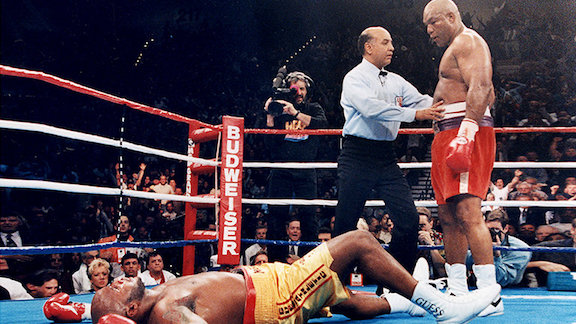
George Foreman's 1994 upset of Michael Moorer

The Three Acts of George Foreman

The Rumble in the Jungle wasn’t just a boxing match—it was the catalyst for one of the greatest transformations in sports history. Instead of breaking George Foreman, the loss ultimately made him a legend in an entirely new way while proving people can actually change. In tribute to the recently departed boxing and pop-culture icon, FreeSportsMagazine.com presents the Three Acts of George Foreman.

Act I: Mean George Foreman

On October 30, 1974, George Foreman entered the ring in Kinshasa, Zaire, as the undefeated heavyweight champion, set to defend his title against Muhammad Ali in what would become one of the most famous boxing matches in history: The Rumble in the Jungle. Foreman, known for his overwhelming power and intimidation, was a heavy favorite. However, by the end of the night, he found himself not only defeated but also on a path that would reshape his life in ways no one could have predicted.

Foreman had dominated his previous opponents, including Joe Frazier and Ken Norton, both of whom he had destroyed in less than two rounds. Many believed Ali wouldn’t last against Foreman’s brutal strength.

However, Ali executed a brilliant strategy—the rope-a-dope—leaning against the ropes, absorbing Foreman’s powerful blows, and letting the younger champion tire himself out. By the eighth round, a drained Foreman left an opening, and Ali capitalized, landing a rapid combination that sent Foreman crashing to the canvas. The world watched in shock as the referee counted Foreman out, giving Ali one of the greatest victories in boxing history.

Losing to Ali was devastating for Foreman. He had built his reputation on invincibility, and this loss shattered his confidence. Foreman later admitted he was deeply depressed following the fight. He struggled to accept the loss, making excuses about unfair conditions, including the heat and a biased referee.

Determined to reclaim his place as champion, Foreman continued fighting. He won several matches but suffered another major defeat to Jimmy Young in 1977. After the Young fight, Foreman claimed he had a near-death experience in the locker room, where he felt as if he was dying and had visions of himself in hell. This moment led him to abandon boxing and dedicate his life to religion.

Act II: Born Again George Foreman

Following his locker-room experience from the Young fight, Foreman retired from boxing at age 28 and became a born-again Christian. He spent the next decade preaching, helping troubled youth, and running a church in Houston, Texas. Many saw this as a shocking transformation for a man once feared as a brutal knockout artist. Even some family members were skeptical.

In need of funds for his youth center, Foreman made an unexpected return to boxing a decade later in 1987. Instead of the scowling destroyer of the ‘70s, he was now “Big George,” a smiling and cheerful fan-favorite known for his humor and humility. He slowly worked his way back into contention and in 1994, at age 45, he completed his redemption arc by knocking out Michael Moorer to regain the heavyweight title, becoming the oldest champion in history. His comeback story was seen as one of the greatest in sports history.

Act III: Spokesman George Foreman

In the midst of this inspiring comeback, Salton, Inc. developed a sloped-surface grill designed to drain fat while cooking. Looking for a marketable celebrity, they approached Foreman, whose friendly, charismatic persona and reputation for power made him the perfect spokesman. Foreman embraced the product, lending his name and image while delivering the famous tagline: “It knocks out the fat!”

The grill became an instant hit, selling millions of units worldwide. At its peak, it was selling 6 million units per year, and in total, over 100 million grills were sold. Foreman’s endorsement deal originally earned him 40% of the profits, but in 1999, he sold his naming rights to Salton for a lump sum of $137.5 million. In total, Foreman made an estimated $200–250 million from the grill—far surpassing his boxing earnings.

Epilogue

George Foreman’s defeat to Ali was the turning point of his life. Though it was painful at the time, it set him on a path to becoming a spiritual leader, comeback hero, and successful businessman. In a heartfelt Instagram post after his passing, Foreman’s family described him as a “devout preacher,” “protector of his legacy,” and a “force for good.”

Travis Kelce Scores Touchdown in Debut as Executive Producer

Travis Kelce has ventured into film production with his role as executive producer for the dark comedy-drama My Dead Friend Zoe, which premiered at the South by Southwest Film Festival on March 9, 2024. The film, directed by Kyle Hausmann-Stokes, explores the story of a U.S. Army veteran dealing with the loss of her best friend and reconciling with her estranged grandfather. The all-star cast includes Morgan Freeman, Ed Harris, Sonequa Martin-Green, and Natalie Morales.

My Dead Friend Zoe is a dark comedy-drama centered on a U.S. Army veteran named Merit, who is grappling with post-military life and the emotional scars of her service. The story explores her complicated relationship with her late best friend, Zoe, whose ghost continues to appear, symbolizing unresolved grief and trauma. As Merit navigates her life, she also faces the challenge of reconnecting with her estranged grandfather, a Vietnam War veteran. Their generational differences and shared experiences with military service create tension, but also opportunities for healing and understanding. 

The film balances humor with heartfelt moments, offering a nuanced look at mental health, military culture, and the complexities of human connection. Perhaps its effectiveness is partly due to the source material for this story being director Hausmann-Stokes’ own experiences. A U.S. Army veteran himself, Hausmann-Stokes served in Iraq and has been an advocate for veteran mental health and storytelling. The film reflects his insights into the emotional and psychological challenges faced by veterans, including themes of grief, survivor’s guilt, and post-traumatic stress. 

Hausmann-Stokes has stated that the story, while fictional, draws heavily from his personal journey and those of fellow veterans, aiming to provide an authentic portrayal of military life and its aftermath. The character of Zoe, who appears as a ghost, symbolizes the lingering presence of fallen comrades, a feeling familiar to many who have served. The film seeks to address these issues with both humor and compassion, offering a fresh perspective on the veteran experience.

Audiences have responded positively to early screenings of the film with Rotten Tomatoes giving it a score of 100% at the time of this writing. Not a bad start for Travis Kelce’s first big project as a producer in Hollywood.

AEW Finds Success in the Land Down Under

AEW Grand Slam: Australia, held on February 15, 2025, at the Brisbane Entertainment Centre, achieved notable success both financially and in terms of viewership. The event generated a gate revenue of $1.3 million, ranking as the third-highest in All Elite Wresting’s history. Attendance figures indicate that approximately 11,000 to 12,000 tickets were distributed, nearing the venue’s capacity of 13,500.

Originally slated for the 52,000-seat Suncorp Stadium, the event was relocated to the Brisbane Entertainment Centre due to reportedly sluggish ticket sales. Despite this change, the event’s financial performance remained strong.

In terms of viewership, the broadcast drew 502,000 viewers, with one million tuning in for the match featuring Kenny Omega and Will Ospreay versus Konosuke Takeshita and Kyle Fletcher. AEW’s leadership expressed satisfaction with these numbers, highlighting the positive momentum leading into the event.

However, some fans expressed dissatisfaction with the event’s promotion and venue change, feeling misled about the scale and nature of the show. Despite these concerns, the event delivered strong financial results and viewership (hitting millions of dollars and at one point millions of viewers), indicating overall success.

AEW Grand Slam: Australia featured several high-profile matches. Below are the results…

AEW Women’s World Championship: “Timeless” Toni Storm defeated Mariah May to capture her record-setting fourth AEW Women’s World Championship.

Tag Team Match: Will Ospreay and Kenny Omega overcame The Don Callis Family’s Konosuke Takeshita and Kyle Fletcher.

TBS Championship: Mercedes Moné successfully defended her title against Harley Cameron.

Brisbane Brawl: Jon Moxley and Claudio Castagnoli defeated Adam Copeland and Jay White in a hard-hitting encounter.

AEW Continental Championship: Kazuchika Okada retained his title against Buddy Matthews.

A Quick History of the First Slam Dunk Contest(s)

Did you know there were two “first-ever” slam dunk contests in the history of professional basketball?

The first first-ever NBA Slam Dunk Contest took place during the 1976 ABA All-Star Game, not in the NBA itself. It was held in Denver, Colorado, as a way to showcase the flashier style of play that the ABA was known for before it merged with the NBA. The NBA then officially introduced their first-ever contest in 1984 during All-Star Weekend, also in the city in Denver. Both contests played a huge role in making dunking an essential part of basketball culture.

Julius “Dr. J” Erving’s free-throw line dunk in the 1976 ABA Slam Dunk Contest is one of the most iconic and influential dunks in basketball history. It was a defining moment that cemented dunking as an art form and set the stage for future high-flyers like Michael Jordan, Vince Carter, and Zach LaVine. For that reason alone, the ABA’s first-ever dunk contest is more significant than the NBA’s first effort (even though a 34-year-old Dr. J performed the same dunk in that one as well). However, it’s unquestionable that once Michael Jordan started participating, the NBA took dunk contests to a whole other level.  

Key Moments of the 1976 ABA Slam Dunk Contest:

  • Julius “Dr. J” Erving won the contest with his iconic free-throw line dunk, which later inspired future dunkers like Michael Jordan.
  • Other participants included David Thompson, Artis Gilmore, George Gervin, and Larry Kenon.
  • The contest was not a head-to-head elimination format, but rather a point-based system where each player attempted five dunks.
  • Dr. J’s free-throw line dunk was the highlight, as it was the first time a player had attempted such a dunk in a major event.

Key Moments of the NBA Slam Dunk Contest (1984)

  • Larry Nance won, defeating Julius Erving in the final round.
  • Nance introduced the two-ball dunk, where he dunked two basketballs in one leap.
  • The contest was structured as a head-to-head elimination tournament.

Now, go forth and conquer (slam dunk videos on YouTube.com we mean).

FREE STICKERS

Super Bowl LIX: That’s a Lot of Wings!

With the Big Game upon us FreeSportsMagazine.com was wondering just how much football food is consumed on super Sunday. The results? We weren’t shocked (though we probably should have been). Check out how much food Americans consume during the Super Bowl and try not to get a stomach ache this year:

For starters, it’s estimated that around 11 million pounds of potato chips are consumed in the U.S. on Super Bowl Sunday.

About 8 million pounds of guacamole are consumed which goes hand-in-hand with all those chips the fans are munching on. Stating the obvious here – Super Bowl weekend is one of the biggest times of the year for avocado sales.

Another staple of the big game, Americans consume an estimated 1.45 billion chicken wings! That’s enough to circle the Earth three times if you lined them up end to end. Wings are definitely a game day MVP alongside chips and guac! Do you like them hot?

To quench their thirst, Americans drink an estimated 325 million gallons of beer while watching the Super Bowl. That’s enough to fill about 500 Olympic-sized swimming pools. Beer is the go-to beverage for many fans, perfectly pairing with all those wings, chips, and guac.

When looking at “main courses”, it’s estimated that around 14 million hamburgers and 10 million hot dogs are consumed in the U.S. during the Super Bowl. While burgers and hot dogs may not be quite as popular as wings and chips, they’re often the only option for hosts firing up the grill! As a side note, t’s estimated that several million pounds of condiments—including ketchup, mustard, and mayonnaise—are used during the big game.

Finally, pizza is often the forgotten food of Super Bowl parties. Americans consume about 12.5 million pizzas during the big game. It’s one of the top game-day foods, with chains like Domino’s and Pizza Hut reporting it as their busiest day of the year.

Murder, Suicide, and the Pro Football Hall of Fame

Jim Tyrer was an American professional football offensive tackle, widely regarded as one of the most dominant players of his era. Born on February 25, 1939, in Newark, Ohio, he attended Newark High School, excelling in track, basketball, and football. He played college football at Ohio State University under head coach Woody Hayes, earning All-America honors.

In 1961, Tyrer signed with the American Football League’s Dallas Texans, who later became the Kansas City Chiefs. Over 13 seasons with the franchise, he played in 180 consecutive games, starting every game of his 11 seasons in Kansas City. Tyrer was a nine-time Pro Bowl selection and a six-time first-team All-Pro. He was instrumental in the Chiefs’ victory in Super Bowl IV, where he and guard Ed Budde opened holes for Chiefs running backs against the Minnesota Vikings’ defensive line.

Following his retirement from football, Tyrer faced financial difficulties. He ran his own company, Pro Forma, representing professional athletes in commercial ventures, which eventually failed. He then worked as a manufacturer’s representative, operated flea market booths, and managed Crown Tire and Alignment, a gas station/tire store, which also failed. In the last months of his life, Tyrer and his wife, Martha, deeply in debt, sold Amway products.

Tragically, in the early morning hours of September 15, 1980, Tyrer shot and killed his wife, Martha, before taking his own life. Three of their four children were in the home at the time. In 2024, research suggested that Tyrer likely suffered from chronic traumatic encephalopathy (CTE) at the time of his death, a condition linked to repeated head injuries.

The revelation of a likely CTE diagnosis led to Tyrer’s consideration as a Seniors finalist for the Pro Football Hall of Fame’s Class of 2025. The nomination alone brings him one step closer to induction, pending approval from at least 80% of the Hall’s Selection Committee during their annual meeting, which will take place in advance of the class unveiling during Super Bowl LIX week in New Orleans.

Advocates for induction, including many former teammates, historians, and fans, argue that Tyrer’s tragic actions at the end of his life were likely influenced by CTE. They contend that understanding CTE provides context for his behavior and should not overshadow his professional accomplishments, which were many. Additionally, many supporters emphasize the importance of recognizing players from the American Football League (AFL) era, during which Tyrer was a main standout.

The skeptics, including some Hall of Fame voters, remain hesitant, citing the lasting impact of his final actions. The circumstances of Tyrer’s death—killing his wife and then himself—make some uncomfortable with honoring him, as it raises questions about the morality of celebrating his legacy. Critics argue that the Hall of Fame should consider a player’s entire legacy, both on and off the field, and that Tyrer’s actions could overshadow his football achievements. Many also worry about setting a precedent for inducting individuals with controversial or criminal histories.

The debate is ongoing, and the decision rests with the Hall of Fame’s Selection Committee next month. The outcome will likely reflect broader discussions about balancing professional achievements with personal conduct in honoring athletes. How would you vote?

The Real-Life Flint Tropics and the Greatest Deal in TV History

The Flint Tropics basketball team from Will Ferrell’s sports comedy classic Semi-Pro is based on an amalgamation of all the teams from the eccentric American Basketball Association (ABA). However, it’s hard to deny that there is one ABA team in particular that seems to make up most of the Tropics’ DNA. While only existing for 2 years, the Spirits of St. Louis made a splash on the sports world during their brief time and somehow ended up with a broadcast television deal that still pays out to this day (more on that later).

Based in St. Louis, Missouri, and playing their home games at the St. Louis Arena, the Spirits existed in the ABA from 1974 to 1976. They were actually one of the last teams to join the ABA. The team’s name was a nod to the Gateway Arch and the city’s aviation history, referencing Charles Lindbergh’s famous plane, the Spirit of St. Louis.

The Spirit team became notable for its colorful players and high-scoring games, consistent with the ABA’s flashy style. The organization’s more entertaining personalities included great player but troubled human, Marvin “Bad News” Barnes and the energetic fledgling (sometimes annoying) announcer Bob Costas. Future hall of famer Moses Malone even logged some minutes with the team.

And if basketball wasn’t your thing, games often featured events for attendees like disco concerts at halftime, Ladies’ Night, or “shooting for cash”. Undoubtedly, a St. Louis version of Dukes from Semi-Pro attempted a half-court shot for cash at some point between 1974 and 1976.

The Tropics’ storyline about struggling to survive the merger with the National Basketball Association (NBA) echoes the real-life challenges faced by ABA teams in 1976. Only four ABA teams were absorbed into the NBA (the Denver Nuggets, Indiana Pacers, New York Nets, and San Antonio Spurs), leaving others to fold or relocate. The Spirits were not among the four teams absorbed. The left-out teams had to either fold or negotiate buyouts.

The owners of the Spirits, Ozzie and Daniel Silna, refused to be bought out and, we’d like to think in the style of Jackie Moon, negotiated a remarkable deal: instead of a lump sum buyout, they retained perpetual rights to a share of future TV revenues from the ABA teams that joined the NBA. The deal entitled the Silnas’ to 1/7th of the TV revenue share received by each of the four former ABA teams that joined the NBA. This worked out to approximately 2% of the NBA’s overall TV revenue.

This seemed like a bold move at the time since TV contracts were very modest and not worth much money. The Silna brothers understood the potential of future television revenue though and resisted that one-time buyout. The ABA agreed to the deal because they thought that 2% would not amount to much cash anyway and they had a merger to complete.

With the arrival of Magic Johnson, Larry Bird, and Michael Jordan, the NBA’s popularity soared and TV contracts exploded in subsequent decades. The Silnas began earning millions annually for a basketball team that no longer even existed.

The NBA naturally had been trying to get out of this deal for a while. In 2014, their wish was granted but at another great cost. A settlement was reached with the Silna brothers to end the perpetual payments. The Silnas reportedly received a lump sum of $500 million while retaining a reduced share of some revenues. It is believed they have earned close to $800 million since the original arrangement was made all those years ago.

The Silna brothers’ deal is a testament to foresight and negotiation skills, as they leveraged a long-term vision over short-term gain. The deal, often called “the greatest deal in sports,” has become a legendary example of how understanding the future potential of a growing industry can result in extraordinary financial returns. The Spirits of St. Louis may have had a short lifespan as a team, but this deal ensured their lasting legacy in sports history.

FSM Scouting Report: The Last Folk Hero

Book/Movie Title: The Last Folk Hero: The Life and Myth of Bo Jackson

Total Pages/Duration: 430 pages (hardcover)

Author/Director: Jeff Pearlman

Pace of Play: This book is certainly not a page-turner and feels more like a low-scoring baseball game that keeps going into another extra inning. That doesn’t mean this book is boring in anyway, just that you will be provided with a lot of different information about many different things related to the Bo Jackson universe. The pace of play here is slow.  

Strengths: The author does not hide the type of person Bo Jackson was as a child. Admittedly, it was hard to root for Jackson after reading the first chapter of The Last Folk Hero. There will be times in that chapter you might ask yourself, “Why am I reading about this sociopath?” Keep reading and you’ll eventually get to a place of acceptance though you’ll probably never feel like rooting for the guy. There are some cool stories throughout subsequent chapters discussing huge acts of kindness that (just barely) balance things out. In addition to Bo Jackson’s suspect personality and charity work, the reader is also treated to multiple “Bo” nickname origin stories and reoccurring tales about bizarre interactions with autograph seekers.  

Weaknesses: Reading, “There is a Bo story you won’t believe” or some variation of that sentence starts feeling a little redundant after the first handful of stories. The premise of this book gets proven over and over and over and over and…well you get the point.  

Unique Attributes: This book is peppered with George Brett anecdotes from Bo Jackson’s time playing in the MLB for the Kansas City Royals.There is also extensive discussion of Jackson’s track and field career in college which is something that is often overlooked.

Scout’s Recommendations: The Last Folk Hero will take some time to read but the journey will be worth it in the end. Even die-hard Bo Jackson fans (if they exist) will learn something new by reading this book. The story of Bo Jackson is more than just someone who played in both the MLB and NFL at  the same time and Jeff Pearlman captures that in his latest work. Based on the information in this FSM scouting report, FreeSportsMagazine.com recommends this book for fans of all sports.

FSM Picks the Greatest Christmas Day NBA Game

Sports on Christmas Day have become a beloved tradition, featuring marquee games across various leagues such as the NFL, NHL, and NBA. Christmas Day games provide a communal and festive experience, often drawing multi-generational viewership. Professional athletes often embrace holiday-themed celebrations during these games, enhancing the festive atmosphere.

The National Basketball Association (NBA) is the most notable sports league with a Christmas Day tradition. The league schedules matchups featuring its biggest stars and teams. These games often draw massive TV audiences as fans gather live and in front of their televisions during the holiday to watch some hoops. Christmas Day matchups highlight iconic rivalries like the Los Angeles Lakers vs. Boston Celtics amongst others.

The best NBA Christmas game is often a matter of personal preference, but FreeSportsMagazine.com considers one in particular the greatest of all time…

Miami Heat vs. Los Angeles Lakers 2004

The key storyline for this game adds to its legendary status. This matchup marked Shaquille O’Neal’s first return to Los Angeles as a member of the Miami Heat after his dramatic split from Kobe Bryant and the Lakers earlier that year. In other words, it was the first time Shaq and Kobe would be opponents.

Star Power abounded in this game with Miami being led by Shaq and a young Dwyane Wade and the Lakers anchored by Kobe Bryant in his prime. A thrilling overtime battle saw the Heat narrowly defeat the Lakers, 104–102. Both Shaq and Kobe had standout performances, highlighting their individual greatness and fueling the narrative of their rivalry.

This game was watched by millions, with intense media coverage leading up to and after the game. It perfectly encapsulates the drama, competitiveness, and star power that make NBA Christmas games special.